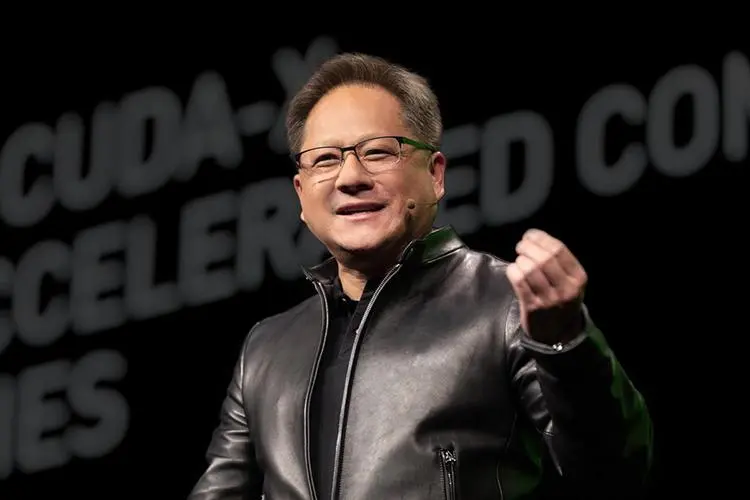
一、NVIDIA公司创始人兼首席执行官黄仁勋
黄仁勋(Jensen Huang),美籍华人,1963年2月17日出生台湾省台南市,美国工程院院士。NVIDIA公司创始人兼首席执行官。
1983年,黄仁勋毕业于俄勒冈州立大学,1990年取得斯坦福大学电子工程硕士学位,先后在AMD、LSI Logic两家公司任职芯片工程师等工作。1993年,黄仁勋创立NVIDIA公司,公司在1999年发明GPU,让实时可编程着色技术成为可能,这一技术也定义了现代计算机图形及后来革命性的并行计算。2006年,推出并行计算平台和编程模型“CUDA”,通过GPU实现多个领域的高效计算,为后来的人工智能发展提供了动力。
2001年,黄仁勋以5.07亿美元的身价名列《财富》杂志评选“40岁以下的40位富翁”版单第12位。此外,他曾获美国半导体行业协会(SIA)最高荣誉罗伯特诺伊斯奖、IEEE 创始人奖章、张忠谋博士模范领袖奖等多个奖项荣誉。2021年11月,入选“福布斯中国·北美华人精英TOP60”。2023年9月8日,被评为全球AI领袖。2024年当选美国工程院院士。
二、NVIDIA公司创始人兼首席执行官黄仁勋个人经历
1. 早年经历
1963年,黄仁勋出生于中国台湾省台南市。父亲为化学工程师,母亲为教师,并有一位哥哥。
1972年,因父亲工作调动需移居泰国,9岁的他与哥哥被送到美国亲戚家。因亲戚家境窘困,他与哥哥前往肯塔基州的一所乡村寄宿学校就读。该学校的不良少年众多,他的室友亦浑身刺青,他和哥哥因处于少年顽皮,也曾和其他孩子爬房顶、偷吃糖果、开始抽烟。与大他7岁、浑身刀疤的室友和睦相处,教他如何读书。为了谋生,他在放学后负责清扫男生宿舍,并且常躲起来独自看书。他在回忆时自述“这两年他上了危险的一课”,但这段经历也让他学会独立、适应与坚强。
1974年,黄仁勋的父母移民定居美国俄勒冈州,黄仁勋开始前往正规学校就读。他开始热衷乒乓球运动并参加各种比赛,在15岁时的美国乒乓球公开赛上获得双打第三名。在接受乒乓球专业训练的同时,黄仁勋仍专注于学业,16岁时考上了俄勒冈州立大学,主修电子工程。
1983年,黄仁勋毕业,次年取得俄勒冈州立大学电气工程学士学位。
2. 就业经历
1983年,大学毕业后的黄仁勋前往硅谷,在AMD公司任职芯片设计工程师,使他更有机会接触芯片业前沿技术。
1984年,认为自己必须深造的黄仁勋,在得知斯坦福大学推出硕士进修合作项目后当即报名。1990年,如愿以偿成为了斯坦福电子工程硕士。 CXO UNION-CXO联盟(cxounion.cn)
1985年,黄仁勋跳槽到偏向于图形处理的芯片商LSI Logi。在经历两年左右的图片处理芯片工程师工作后,掌握前沿技术的他主动申请调至销售部,以出色的业绩晋升业务部主任、“系统集成芯片”总负责人等高级职位。
3. 创业初期
1993年,黄仁勋在丹尼餐厅(Denny’s)与两位好友克里斯·马拉科夫斯基(Chris Malachowsky)和柯蒂斯·普里姆 (Curtis Priem)见面,讨论如何开发一款能在个人电脑上实现逼真3D图形的芯片。1993年2月17日,NVIDIA诞生,黄仁勋担任总裁兼首席执行官,同日也是黄仁勋的30岁生日。
NVIDIA创立初期,由于1993年尚未形成独立的图形芯片市场,风险投资市场仍不看好。黄仁勋费尽周折,在风险投资发达的硅谷仅找到两家有意投资的基金,最终仅一家拿出220万美元。
1995年,NVIDIA推出了第一款图形芯片产品NV1。虽然NV1在图形显示技术上已有重大突破,但由于市场主流变化等缘故,NV1销量惨淡,公司也因风险投资所剩无几而开始被迫裁员。此时,世嘉找到NVIDIA,委托其进行世嘉土星第二代图形芯片的开发,订金700万美元。虽然该开发计划因产品方向等缘故而夭折,但NVIDIA也因此得以继续经营。
4. 变革与上市
1996年,黄仁勋开始改变NVIDIA的技术标准方向,并公开表示将完全支持微软Direct 3D API标准。团队成员开始进行RIVA 128的开发,在1997年4月上市。由于RIVA 128的性能出众、价格实惠,很快受到市场关注。 因市场需求旺盛,黄仁勋回到台湾,与台积电总裁张忠谋会谈并展开合作,快速占据了相当份额的市场。此后推出的Riva TNT、Riva TNT2等图形芯片在性能上的提升,也远超同期的3DFx、ATi和S3等厂商,颠覆了IT界畅销多年的摩尔定律,树立了显示芯片业的标准。
1999年1月,凭借全新的显示芯片理念与技术,NVIDIA在纳斯达克成功上市。同年8月,NVIDIA推出GeForce系列的首个显示芯片产品GeForce 256,迅速将显示芯片业带入了GPU时代。两个月后推出的Quadro系列,既把控了显示芯片业的技术制高点,也是继个人电脑市场之后,成功打开了工作站市场。
2000年12月,黄仁勋以7000万美元的现金和100万股NVIDIA股票,收购了昔日的竞争对手3DFx,确立了NVIDIA在显示芯片业的领导性地位。
5. 全面化布局
在完成了NVIDIA在显示芯片产品线的成功后,在深化丰富原有产品系列的泛用性外,黄仁勋开始基于GPU技术进行加速运算、自动驾驶、机器人技术等方面的布局。 CXO UNION-CXO联盟(cxounion.cn)
2006年,NVIDIA推出并行计算平台和编程模型“CUDA”。通过利用图形处理器的处理能力,可大幅提升计算性能。该举措将图形芯片从电脑游戏的单一领域中分离处理,开始被广泛用于各个领域,其中包括图像与视频处理、计算生物学和化学、流体力学模拟、CT 图像再现、地震分析以及光线追踪等等,并随着人工智能兴起而被广泛运用。
2008年,NVIDIA发布了Tegra系列处理器,并应用于智能手机市场。自2014年后,Tegra系列芯片被重新定位,运用于汽车自动驾驶等领域,与丰田、百度等企业建立运用于自动驾驶汽车的人工智能合作伙伴关系。
除以上举措外,NVIDIA也开始进军机器人技术市场,基于神经网路处理器和运行AI算法的安全架构等技术,开创了价值数十亿美元的产业。而随着数字货币“以太币”的兴起,图形处理单元也被广泛运用于加密货币挖矿。2023年后,NVIDIA发起了工业元宇宙网络联盟计划,旨在为工业带来新的人工智能、模拟和协作能力。
2024年2月,黄仁勋当选美国工程院院士。
三、NVIDIA公司创始人兼首席执行官黄仁勋社会活动
2008年,黄仁勋向斯坦福大学工程学院捐款3000万美元,用于建设黄仁勋工程中心,计划包含全电子图书馆、计算器和图像中心等先进设施。
2008年8月5日,NVIDIA向接受了101名四川地震灾区中小学生的北京海淀外国语实验学校捐赠了一间“爱心电脑教室”。黄仁勋出席“爱心教室”捐赠仪式,向学生赠送万花筒礼物。
2013年5月22日美国的一场慈善晚宴中,黄仁勋获颁来自圣何塞/硅谷城市年(City Year San Jose/Silicon Valley)的年度“公民楷模奖”。黄仁勋与其他的NVIDIA工作伙伴、厂商等在慈善晚宴中宣布共捐出10万美元,以资助当地小学的学生。 CXO UNION-CXO联盟(cxounion.cn)
2022年,黄仁勋夫妇向俄勒冈州立大学捐赠5000万美元,帮助启动俄勒冈州立大学研究中心。

翻译:
Jen-hsun Huang, founder and CEO of NVIDIA
Jen-hsun Huang, founder and CEO of NVIDIA
Jensen Huang, Chinese-American, born on February 17, 1963 in Tainan, Taiwan Province, is a member of the American Academy of Engineering. Founder and CEO of NVIDIA Corporation.
Huang graduated from Oregon State University in 1983 and received a master’s degree in electrical engineering from Stanford University in 1990. He worked as a chip engineer at AMD and LSI Logic. In 1993, Huang founded NVIDIA, which in 1999 invented the GPU, making possible the real-time programmable coloring technology that would define modern computer graphics and later revolutionize parallel computing. In 2006, the parallel computing platform and programming model “CUDA” were launched to achieve efficient computing in multiple fields through Gpus, which provided the impetus for the later development of artificial intelligence.
In 2001, Huang was ranked No. 12 on Fortune magazine’s list of the 40 Richest People under 40 with a net worth of $507 million. In addition, he has received the Robert Noyce Award, the highest honor of the Semiconductor Industry Association (SIA), the IEEE Founder’s Medal, and the Dr. Robert Chang Exemplary Leader Award. In November 2021, he was selected as “Forbes China and North American Chinese Elite TOP60”. On September 8, 2023, he was named a global AI leader. He was elected to the American Academy of Engineering in 2024. CXO UNION-CXO联盟(cxounion.cn)
Personal experience of Jen-Hsun Huang, founder and CEO of NVIDIA
- Early years
Huang was born in Tainan, Taiwan Province, China in 1963. His father is a chemical engineer, his mother is a teacher, and he has one brother.
In 1972, when his father moved to Thailand for work, he and his brother were sent to live with relatives in the United States at the age of 9. Because of his relatives’ poverty, he and his brother went to a rural boarding school in Kentucky. There are many delinquent teenagers in the school, his roommate is also covered in tattoos, and he and his brother have climbed the roof with other children, stole candy, and started smoking because of their naughty youth. Get along with his scarred roommate, seven years his senior, and teach him how to read. In order to make a living, he was responsible for cleaning the boys’ dormitory after school, and often hid to read alone. He recalled that “these two years taught him a dangerous lesson,” but the experience also taught him to be independent, adaptable and strong.
In 1974, Huang’s parents immigrated to Oregon and Huang began attending regular schools. He became keen on table tennis and competed in various competitions, finishing third in doubles at the US Open at the age of 15. While training as a table tennis professional, Huang remained focused on his studies and enrolled at Oregon State University at 16, majoring in electrical engineering.
Huang graduated in 1983 and received a bachelor’s degree in electrical engineering from Oregon State University the following year.
- Employment experience
In 1983, after graduating from college, Huang moved to Silicon Valley to work as a chip design engineer at AMD, which gave him more access to cutting-edge technologies in the chip industry.
In 1984, Huang Renxun, who thought he had to pursue further education, immediately signed up for Stanford University’s cooperative master’s program after learning that it was launched. In 1990, he became a master of Electrical Engineering at Stanford. CXO UNION-CXO联盟(cxounion.cn)
In 1985, Huang moved to LSI Logi, a chipmaker with a bias towards graphics processing. After about two years of work as a picture processing chip engineer, he took the initiative to apply for transfer to the Sales Department and promoted senior positions such as the director of the business department and the general person in charge of “System integrated chip” with excellent performance.
- Early days
In 1993, Huang met with two friends, Chris Malachowsky and Curtis Priem, at Denny’s to discuss developing a chip that would enable realistic 3D graphics on personal computers. NVIDIA was born on February 17, 1993, with Jen-Hsun Huang as president and CEO, the same day as Huang’s 30th birthday.
When NVIDIA was founded, the venture capital market was still not optimistic because there was no independent graphics chip market in 1993. Huang struggled to find only two funds interested in investing in venture capital rich Silicon Valley, and finally only one came up with $2.2 million.
In 1995, NVIDIA introduced its first graphics chip, the NV1. Although NV1 has made a major breakthrough in graphics display technology, due to changes in the mainstream of the market, NV1 sales were dismal, and the company was forced to lay off employees due to the lack of venture capital. At this point, Sega approached NVIDIA and commissioned the development of the second-generation graphics chip for the Sega Saturn for a $7 million deposit. Although the development plan was aborted due to product direction and other reasons, NVIDIA was able to continue operating as a result.
- Change and listing
In 1996, Huang began to change the direction of NVIDIA’s technical standards and publicly stated that it would fully support the Microsoft Direct 3D API standard. The team began work on the RIVA 128, which went on sale in April 1997. Due to its superior performance and affordable price, the RIVA 128 quickly caught the attention of the market. Due to the strong market demand, Huang returned to Taiwan, talked and cooperated with TSMC President Morris Chang, and quickly occupied a considerable share of the market. After the launch of Riva TNT, Riva TNT2 and other graphics chips in the performance improvement, but also far beyond the same period of 3DFx, ATi and S3 manufacturers, subvert the IT industry best-selling Moore’s law for many years, set the display chip industry standard.
In January 1999, with a new display chip concept and technology, NVIDIA successfully listed on the Nasdaq. In August of the same year, NVIDIA launched the GeForce 256, the first display chip product in the GeForce series, quickly bringing the display chip industry into the GPU era. The Quadro series, launched two months later, not only controlled the technical commanding heights of the display chip industry, but also successfully opened the workstation market after the personal computer market.
In December 2000, Huang bought former rival 3DFx for $70 million in cash and 1 million shares of NVIDIA stock, establishing NVIDIA’s leadership in the display chip industry.
- Comprehensive layout
After completing the success of NVIDIA’s display chip product line, in addition to deepening and enriching the universality of the original product series, Huang Renxun began to carry out the layout of accelerated computing, autonomous driving, robotics and other aspects based on GPU technology.
In 2006, NVIDIA introduced a parallel computing platform and programming model called CUDA. By utilizing the processing power of the graphics processor, the computing performance can be greatly improved. This initiative separated the processing of graphics chips from the single domain of computer games and began to be widely used in a variety of fields, including image and video processing, computational biology and chemistry, fluid dynamics simulation, CT image reproduction, seismic analysis, and ray tracing, and was widely used with the rise of artificial intelligence.
In 2008, NVIDIA released its Tegra series of processors for use in the smartphone market. Since 2014, the Tegra series of chips have been repositioned to be used in automotive autonomous driving and other fields, and Toyota, Baidu and other companies have established artificial intelligence partnerships for autonomous vehicles. CXO UNION-CXO联盟(cxounion.cn)
In addition to these initiatives, NVIDIA has also begun to move into the robotics market, creating a multi-billion dollar industry based on technologies such as neural network processors and security architectures that run AI algorithms. With the rise of the digital currency “ether”, graphics processing units are also widely used in cryptocurrency mining. After 2023, NVIDIA launched the Industrial MetaUniverse Network Alliance Program, which aims to bring new AI, simulation and collaboration capabilities to industry.
In February 2024, Huang was elected a member of the American Academy of Engineering.
NVIDIA founder and CEO Jen-Hsun Huang social activities
In 2008, Huang donated $30 million to Stanford University’s School of Engineering for the construction of the Huang Engineering Center, which is planned to include advanced facilities such as a fully electronic library, calculator and image center.
On August 5, 2008, NVIDIA donated a “Love computer classroom” to Beijing Haidian Foreign Language Experimental School, which received 101 primary and secondary school students in the Sichuan earthquake area. Huang Renxun attended the donation ceremony of “Love Classroom” and presented kaleidoscopic gifts to students. CXO UNION-CXO联盟(cxounion.cn)
At a charity dinner in the United States on May 22, 2013, Jen-Hsun Huang received the “Civic Role Model Award” of the Year from City Year San Jose/Silicon Valley. Jen-hsun Huang, along with other NVIDIA partners, manufacturers and others, announced a total donation of $100,000 to support local elementary school students at the charity dinner.
In 2022, the couple donated $50 million to Oregon State University to help launch the Oregon State University Research Center.
由CXO UNION-CXO联盟(cxounion.cn)转载而成,来源于百度百科;编辑/翻译:CXO UNIONCXO联盟小U。
如需加入CXO UNION(CXO联盟)高管社群,请联系社群小伙伴哦~
免责声明: 本网站(http://www.cxounion.cn/)内容主要来自原创、合作媒体供稿和第三方投稿,凡在本网站出现的信息,均仅供参考。本网站将尽力确保所提供信息的准确性及可靠性,但不保证有关资料的准确性及可靠性,读者在使用前请进一步核实,并对任何自主决定的行为负责。本网站对有关资料所引致的错误、不确或遗漏,概不负任何法律责任。
本网站刊载的所有内容(包括但不仅限文字、图片、LOGO、音频、视频、软件、程序等) 版权归原作者所有。任何单位或个人认为本网站中的内容可能涉嫌侵犯其知识产权或存在不实内容时,请及时通知本站,予以删除。
如需加入CXO UNION(CXO联盟)高管社群,请联系社群小伙伴哦~

免责声明: 本网站(http://www.cxounion.cn/)内容主要来自原创、合作媒体供稿和第三方投稿,凡在本网站出现的信息,均仅供参考。本网站将尽力确保所提供信息的准确性及可靠性,但不保证有关资料的准确性及可靠性,读者在使用前请进一步核实,并对任何自主决定的行为负责。本网站对有关资料所引致的错误、不确或遗漏,概不负任何法律责任。
本网站刊载的所有内容(包括但不仅限文字、图片、LOGO、音频、视频、软件、程序等) 版权归原作者所有。任何单位或个人认为本网站中的内容可能涉嫌侵犯其知识产权或存在不实内容时,请及时通知本站,予以删除。
Search
Popular Posts
-

2024数字化灯塔案例评选申报开启!
“2024数字化灯塔案例评选”于3月正式启动,诚挚欢迎业界同仁自荐和推荐,一起推动产业数字化进程,助力赋能企业…
-

2024 X-Award星盘奖申报通道已开启!
X-Award星盘奖是数字化转型服务、IT服务行业重要的商业奖项,旨在表彰行业里提供杰出数字化转型服务与IT服…
-

2024 N-Award星云奖申报通道已开启!
N-Award是数字化转型领域重要的商业奖项,旨在表彰那些以非凡的远见、超群的领导才能和卓越的成就来激励他人的…