
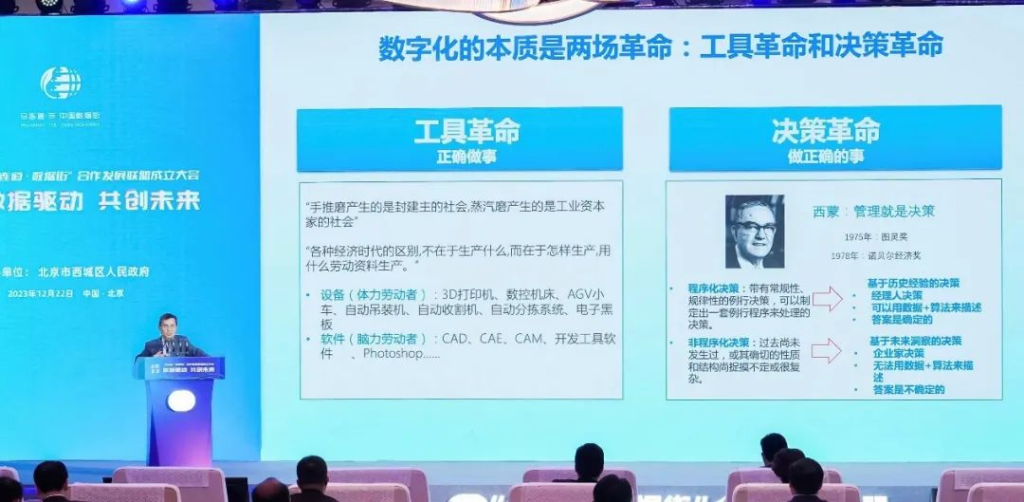
当我们去追问数据到底是怎样创造价值的,或许我们可以先追问数字化的本质到底是什么?在我看来是两场革命:一个是工具革命,一个是决策革命。
本文作者:阿里云智能集团副总裁、中国信息化百人会执委、CCF中国数字经济50人论坛委员安筱鹏博士。

2023年12月22日,在北京市“马连道·数据街”合作发展联盟成立大会上,安筱鹏博士分享了智能时代数据如何创造价值的理解和洞察,以下是发言要点。
一、讨论数据要素的“锚点“是什么?
当下人们围绕“数据要素”有许多讨论的议题,如权属、流通、交易、市场、跨境、隐私、安全、治理等,各界有许多共识、也有些分歧。我们需要探讨的是,人们讨论数据这一议题的“锚点”是什么?“前提”是什么?没有“锚点”和“前提”,就没有对数据议题对错、利弊、好坏、优劣、得失的评价标准。
“如何促进数据要素创造价值”是讨论数据要素议题的“锚点”,而系统科学理解“数据要素如何创造价值”是“前提”。这个“前提”是,人们要清晰地理解,在微观具象世界中数据要素创造价值的技术、原理、路径、模式,在宏观抽象世界的数据要素创造价值的机理、逻辑和意义。事实上关于数据这个议题,我们无论对具象世界的深度观察,还是对抽象世界的规律认知都是不充分的。 CXO UNION-CXO联盟(cxounion.cn)
历史上,人们对生产要素的讨论首先关注的是,它是如何创造价值、促进人类生产力进步。400年前威廉·配第(1623-1687)提出,“土地是财富之母”、“劳动是财富之父”,后来“资本”“技术”先后成为当年新的生产要素的原因,首先是在实践中资本、技术在为人类物质财富创造、生活水平提高及生产力进步做出巨大贡献,这些生产要素成为人类创造价值不可或缺的必要充分条件。
相对于土地、劳动、资本、技术创造价值的机理和逻辑,数据如何创造价值是复杂的。这种复杂性来自于,数据要素既会作用于生产力,也会作用于生产关系;既会作用于看的见的物理世界,也会作用于看不见的赛博空间;既会作用于传统单一要素的价值倍增,也会作用于整个生产要素的资源优化;既会突显单一场景的价值,更会呈现全局系统的意义;既会呈现有形可见的现实价值,也会沉淀无形的潜在优势。
从这个意义上讲,学习《“数据要素×”三年行动计划》征求意见稿,重要的体会是,它重新定义了数据要素议题的“锚点”,夯实了数据要素议题讨论的“前提”,校准了数据要素工作部署的“方向”,将数据要素工作的重心放在“数据如何创造价值”上,回答了数据要素的作用机理、核心瓶颈、优先领域、价值导向、实现路径等重大议题。将数据要素的主流话语体系聚焦在如何加快应用上,锁定在如何服务中国现代化全局上。
二、实践中数据到底是如何创造价值的?
实践是检验真理的唯一标准,应用是检验数据价值的唯一标准(姜奇平),如何理解数据,还是回到技术和商业的一线,回到数据创造价值的现场。我们从快递物流、生产制造、宾馆服务、国防军事等好像没什么关系的几个领域,看看数据是如何创造价值的。
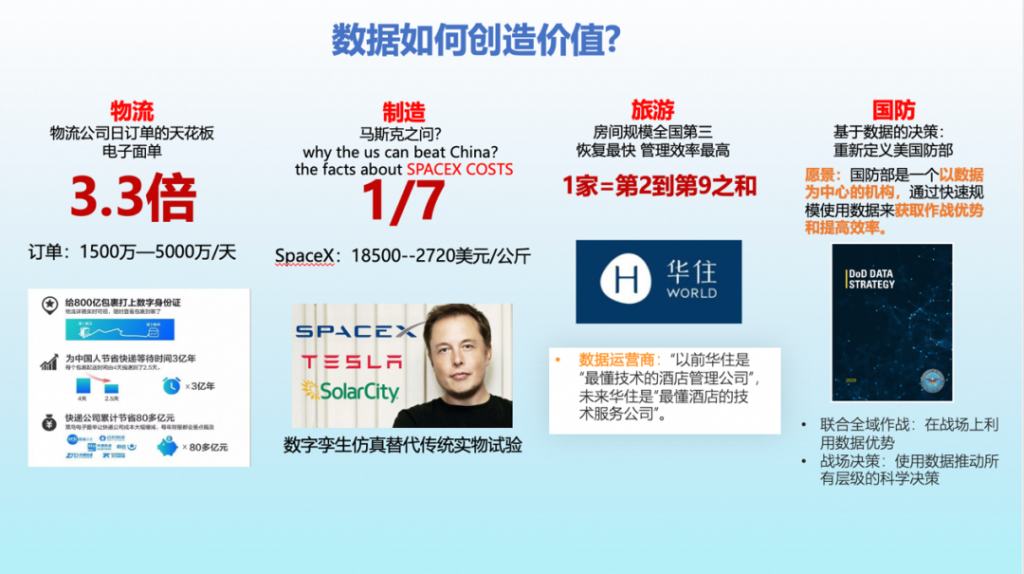
1、快递物流。10多年前,国内一家物流公司每天的快递订单量达到1500万单,之后尽管采取了各种方法,但订单量很难有大的突破。过了几年快递行业出现一项新技术——电子面单,快递公司在车辆、人员、仓库等实物资源没有大的变化背景下,每天订单量达到5000万单、提高了3.3倍。电子面单最大的价值是实现了快递订单端到端的数字化,以数据流优化了物流资源配置效率。 CXO UNION-CXO联盟(cxounion.cn)
2、制造行业。10年前的时候,马斯克在他的网站上发表了一片文章,文章的标题是“why the US can beat China:the facts about SpaceX cost”,在所有人都认为中国是全球成本最低的国家时,马斯克说“我要把美国航空发射器的成本降到中国的1/7”。这个10年前的预言今天实现了。SpaceX每公斤发射成本从18500美元降到2720美元。这背后的一个重要因素在于:SpaceX在产品开发早期阶段,通过数据+算法的模拟择优,替代传统实物试验,大幅降低了研制成本、缩短周期,提高研发效率和产品质量。
3、宾馆服务。旅游宾馆行业是一个非常传统的行业,但国内有一家公司,它拥有的房间数量不是全国第一,但是市值最高的时候是这个行业第2到第9名市值之和。这背后是什么原因呢?背后是数据驱动的决策,重新构建了一套系统性运营体系。它针对客户提供差异化的极致服务,私域拥有会员就数达1.7亿,86%的订单来自于私域流量渠道。就像他们董事长所说的,以前这个宾馆连锁企业是最懂技术的酒店管理公司,未来是最懂酒店的技术服务公司。
4、国防军事。2020年10月,美国国防部发布了首份《数据战略》报告,最重要的一句话是:基于数据决策重新定义美国国防部。美国防部的愿景是“成为一个以数据为中心的机构,通过快速规模使用数据来获得作战优势和提高效率。”在美国国防部看来:数据日益成为国防部各个流程、算法和武器系统的“燃料”;数据的价值在于,在联合全域作战上,在战场上形成数据优势;在高级领导决策支持上,利用数据改进国防部管理工作;在具体业务分析,使用数据推动所有层级的明智决策。说来说去,核心就是用数据推动所有美国国防部各层级的科学决策。
概括起来,无论是制造行业、快递物流、宾馆服务,还是国防军事,数据作为一种要素的底层逻辑是一致的,就是基于数据+算法的科学决策,优化资源配置的效率,提升核心竞争力。
三、数据创造价值的本质是两场革命:工具革命和决策革命
当我们去追问数据到底是怎样创造价值的,或许我们可以先追问数字化的本质到底是什么?在我看来是两场革命:一个是工具革命,一个是决策革命。
什么叫工具革命呢?
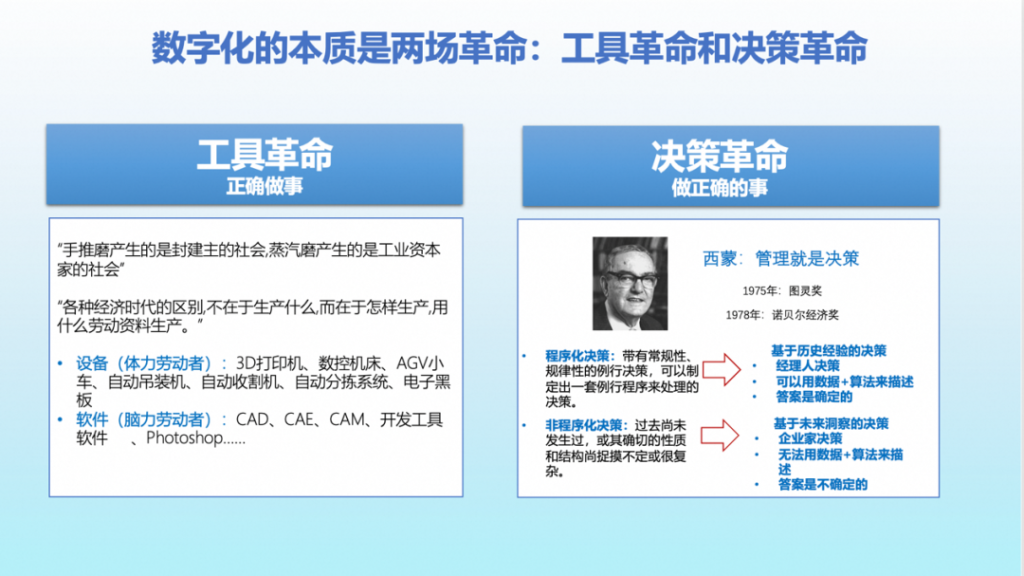
马克思曾说“手推磨产生的是封建主的社会,蒸汽磨产生的是工业资本家的社会”,“各种经济时代的区别,不在于生产什么,而在于怎样生产,用什么劳动资料生产。” CXO UNION-CXO联盟(cxounion.cn)
回到今天的数字时代和智能时代,我们看到:传统的机器人、机床、专业设备等传统工具正升级为3D打印、数控机床、自动吊装设备、自动分检系统等智能工具,传统能量转换工具正在向智能工具演变,大幅提高了体力劳动者效率;同时CAD、CAE、CAM等软件工具提高了脑力劳动者的效率。无论是体力劳动者,还是脑力劳动者,通过新的工具,提高了生产、研发效率。“工具革命”的核心价值在于帮助人们“正确地做事”。
什么叫决策革命呢?
但光“正确地做事”还远远不够,更重要的是“做正确的事”。今天我们讨论数据,数据带来的是一场决策的革命——“决策革命”,帮助人们做正确的事儿。就像图灵奖和诺贝尔经济学奖获得者西蒙所说,管理的核心就是决策。决策可以分成两类:程序化决策和非程序化决策。
程序化决策,是常规的、有规律可循的决策,可以制定出一套规则流程,可以用数据+算法进行描述的决策,是有确定性答案的决策。今天数字化一个重要方向就是在企业研发、设计、生产、运营、管理过程中的每一个决策行为,无论是人的决策还是机器的决策,都在尝试通过数据+算法的方式进行替代。这就是基于历史经验的、有规律可循的程序化决策,这种决策可以称为经理人决策。
非程序化决策,过去尚未发生过,或其确切的性质和结构尚捉摸不定或很复杂。比如企业家的决策,企业家(entrepreneur)是敢于承担一切风险和责任去开创并领导一项事业的人。企业家的决策是基于未来洞察的决策,无法用数据+算法来描述,事前没有标准答案。过去可能没有发生或者它的性质和规律还没有被发现的决策领域,主要靠企业家们去做决策。
所谓的数字化,就是不断地把经理人对管理的、物流的、采购的、研发的规律,不断的模型化、算法化、代码化,用数据驱动构建一套新的决策体系。
基于数据决策的三个核心要素:在线实时+端到端+科学精准
对于这套用数据驱动构建的新的决策体系,我们可以从制造业的场景中感受一下:在一个制造业的物理场景中,无论是生产一辆汽车、一架飞机、一件衣服还是一部手机。当你获得一个个订单后,这个订单信息就会在企业的经营管理、产品设计、工艺设计、生产制造、过程控制、产品测试、产品维护等等各个环节去流动。而流动的背后是决策。什么叫决策?就是你能够把正确的数据、在正确的时间、以正确的方式、传递给正确的人和机器,以这种方式优化资源配置的这样的一个效率。 CXO UNION-CXO联盟(cxounion.cn)
过去我们经常讲什么叫智能制造。智能制造的核心和本质不在于你有更多的机器人、数控机床、AGV小车以及先进的各种设备,而在于数据在企业各个环节的流动过程中,是不是可以越来越少的不需要人去参与,这才是智能制造的最本质的核心。
所以,当我们讲数据驱动决策的时候,面对一个复杂的业务场景,我们要提出三个基本的核心要素。
第一,你的数据是不是实时在线的。
第二,你的数据是不是端到端的。
第三,你的数据是不是科学精准。
基于这三个要素,才能真正地实现数据在正确的时间、以正确的方式、传递给正确的人和机器。
数字化转型的本质:基于数据+算法的决策重构运营机制
今天对于数字化转型来说,数据要素在实体经济中发挥作用的核心在于:基于数据+算法的决策重构企业的运营机制。今天无论是C端还是B端,无论是对消费者的洞察,还是对企业客户的洞察,不仅仅是需要升级你的客户关系管理系统、制造执行系统、PLC等等各类软件系统,更重要的是,数据驱动的核心在于:今天所有的企业决策应当是基于需求的动态决策。
无论是产品研发创新、智能制造、渠道管理、销售和分销、品牌建设、数字化营销还是用户运营,所有的决策都是基于对客户需求的精准决策。不仅可以在前端(C端)实时感知客户的需求,同时可以在B端迭代自己的解决方案,更重要的是它可以基于对客户的感知,满足客户的实时需求。而这个才是数据发挥作用的核心,也是数据要素创造的价值所在。
四、数据要素创造价值的三种模式:价值倍增、投入替代、资源优化
数据要素创造价值不是数据本身,数据只有跟基于商业实践的算法、模型聚合在一起的时候才能创造价值。数据和算法、模型结合起来创造价值,主要有三种模式: CXO UNION-CXO联盟(cxounion.cn)
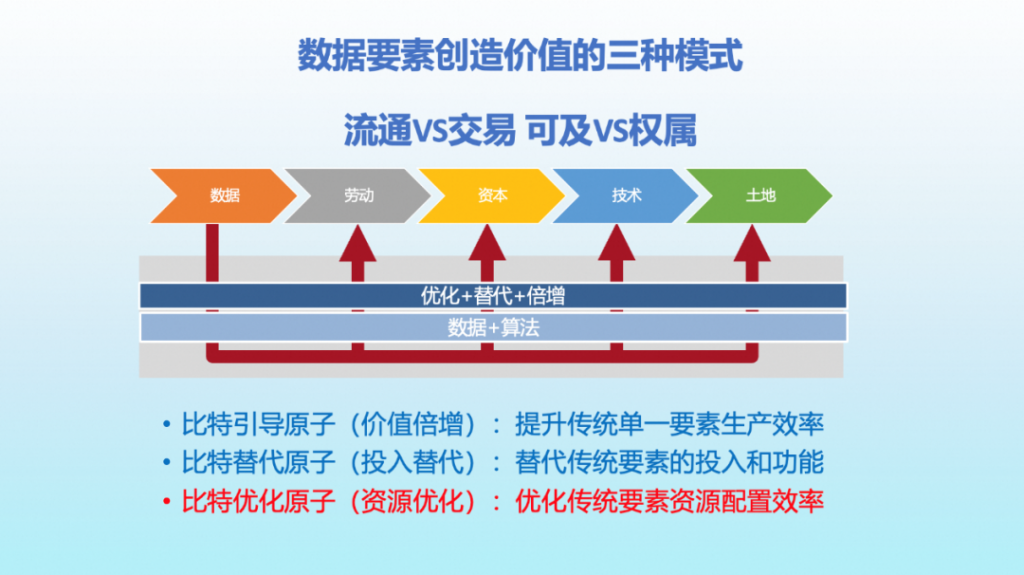
第一种模式:比特引导原子(价值倍增)。数据要素能够提高劳动、资本、技术等单一要素的生产效率,数据要素融入到劳动、资本、技术等每个单一要素,使得单一要素的价值产生倍增效应。
第二种模式:比特替代原子(投入替代)。数据可以激活其他要素,提高产品、商业模式的创新能力,以及个体及组织的创新活力。数据要素可以用更少的物质资源创造更多的物质财富和服务,会对传统的生产要素产生替代效应。移动支付会替代传统ATM机和金融机制的营业场所,波士顿咨询(BCG)估计过去10年由于互联网和移动支付的普及,中国至少减少了1万亿传统线下支付基础设施建设。电子商务减少了传统商业基础设施大规模投入,政务“最多跑一次”减少了人力和资源消耗,数据要素用更少的投入创造了更高的价值。
第三种模式:比特优化原子(资源优化)。数据要素不仅带来了劳动、资本、技术等单一要素的倍增效应,更重要的是提高了劳动、资本、技术、土地这些传统要素之间的资源配置效率。数据生产不了馒头,生产不了汽车,生产不了房子,但是数据可以低成本、高效率、高质量地生产馒头、汽车、房子,高效率地提供公共服务。数据要素推动传统生产要素革命性聚变与裂变,成为驱动经济持续增长的关键因素。这才是数据要素真正的价值所在。
五、AI大模型是数据创造价值的最短路径
数据只有被计算才能产生价值。从数据流动的视角看,数字化解决了“有数据”的问题,网络化解决了“能流动”的问题,智能化解决了“自动流动”的问题。数据流动的自动化,本质是用数据驱动的决策替代经验决策。
基于数据+算力+算法可以对物理世界进行状态描述、原因洞察、结果预测和科学决策。“数据+算法”将正确的数据(所承载知识)、在正确的时间、传递给正确的人和机器,以信息流带动技术流、资金流、人才流、物资流,优化资源的配置效率。
当AI大模型到来的时候,这套逻辑体系发生了什么变化呢?
第一个变化是:AI大模型产生高质量、在线、精准的数据。例如在自动驾驶领域,Corner cases(长尾场景)是指自动驾驶场景中那些不常见或一些极端的场景数据,数据比例可能只有1%,难以获取,影响自动驾驶的有效检测能力,可能引发很多安全问题。而AI大模型可以生成数百万个Corner Cases,助力完成算法训练、测试验证和迭代优化。
第二个变化是:AI大模型自动生成高效率、场景化、高质量算法。2023年11月,特斯拉宣布已开始向员工推出完全自动驾驶(FSD)V12版本,FSD V12的C++代码只有2000行,减少了车机系统对代码的依赖,相比之下,FSD V11有30多万行代码。背后是FSD V12完全采用神经网络进行车辆控制,从机器视觉到驱动决策都将由神经网络进行控制。FSD V12有望打造自动驾驶领域的基础底座,引领视觉算法的GPT时刻。
六、智能时代数据+算法的“两个不等式”
自从2022年11月ChatGPT推出后,经常有人会问“为什么中国没有ChatGPT?”如果你想真正找到答案,正确的提问姿势是“中国为什么没有OpenAI?中国为什么没有Snowflake?中国为什么没有Palantir?”今天,我们把所有的聚光灯都聚焦在ChatGPT上。 CXO UNION-CXO联盟(cxounion.cn)
在我看来,ChatGPT只是美国数字技术创新森林里的一棵树上的两片叶子,今天我们把所有的聚光灯都聚焦在这片叶子上,把这片叶子都快烤黄了。我们需要思考的是:这棵树是什么样子?树根长成了什么样子?它有什么样的土壤?创新的森林生态是什么样子?只有我们把这片森林、这片土壤、这片树的规律都搞清楚了,我们才能找到这一轮数字技术创新的底层逻辑和规律。为什么美国会有这么多数字创新企业?原因有很多,但在我看来,最重要的原因是:“云计算+AI+数据”已成为数字时代创新的基础设施,是孕育孵化新企业、新产品的摇篮。
在这个新的创新基础设施之上,如果我们把时间尺度放到5年、10年或者15年,智能时代数据要素创造价值的方式,将与两个重要的“不等式”密切相关。
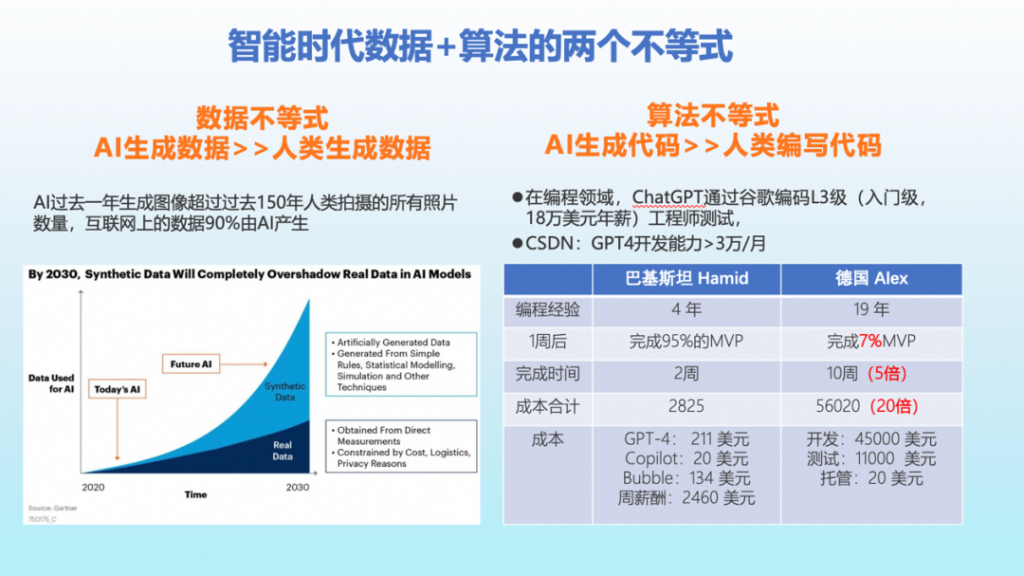
第一个是“数据不等式”:未来AI生成的数据量,将远远大于人类生产的数据量。AI过去一年生成的图像,超过过去150年人类拍摄的所有照片数量。欧盟执法机构“欧洲刑警组织(Europol)”的一份报告预测,到2026年互联网上多达90%的内容是由AI创建或编辑的。
第二是“算法不等式”:AI生成的代码量,将远远大于人类编写的代码量。ChatGPT已经通过了谷歌L3级代码工程师(入门级,18万美元年薪)测试。国内研究机构CSDN测试结果是,GPT-4的软件编程能力相当于中国月薪3万元人民币的程序员水平。GitHub的一项测试表明,完成同样的一个软件最小可行产品(MVP)开发任务,AI工具帮助一位只有4年编程经验的巴基斯坦程序员,只用两周就完成了开发任务。而另一位拥有19年编程经验的资深程序员,因为没有使用AI工具,完成同样任务花费了5倍的时间,20倍的成本。
数据要素的问题要看当前,更要看长远。未来,更多的数据叠加更多的算法,意味着AI将彻底改变数据要素创造价值的方式,并带来指数级的价值增量。
七、美国以公共数据开放强化AI大模型垂直行业应用的领先地位
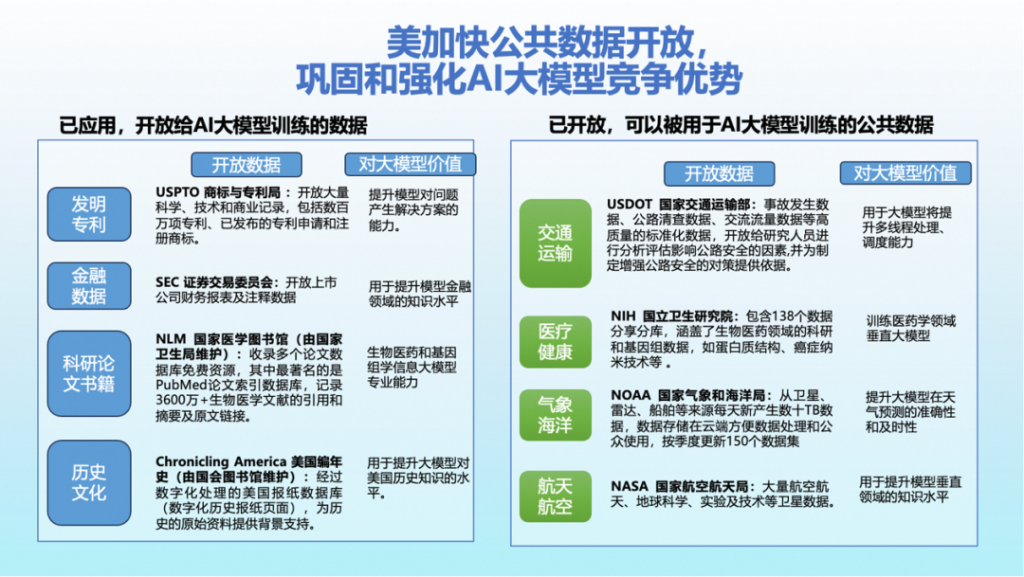
今天的AI竞争不是单一技术的竞争,而是一场体系化竞争。美国不仅有芯片、模型、云计算,我们还观察到,在数据开放领域,美国公共数据的开放力度更大。目前美国已经将发明专利、金融数据、科研论文书籍、历史文化、交通运输、医疗健康、气象海洋、航天航空等高质量数据开放出来。
发明专利:美USPTO商标与专利局开放大量科学、技术和商业记录,包括数百万项专利、已发布的专利申请和注册商标,提升模型对问题产生解决方案的能力。 CXO UNION-CXO联盟(cxounion.cn)
金融数据:美SEC证券交易委员会开放上市公司财务报表及注释数据,用于提升模型金融领域的知识水平。
科研论文书籍:美NLM国家医学图书馆(由国家卫生局维护)开放最著名的是PubMed论文索引数据库,记录3600万+生物医学文献的引用和摘要及原文链接。
交通运输:USDOT国家交通运输部开放事故发生数据、公路清查数据、交流流量数据等高质量的标准化数据,分析评估影响公路安全的因素。
医疗健康:美NIH国立卫生研究院开放包含138个数据库,涵盖了生物医药领域的科研和基因组数据,如蛋白质结构、癌症纳米技术等。
气象海洋数据:美NOAA国家气象和海洋局开放从卫星、雷达、船舶等来源每天新产生数十TB数据,数据存储在云端方便数据处理和公众使用,按季度更新150个数据集
八、范式迁移数据驱动重构人类认识世界的方法论
进入新的智能时代,如何来理解数据驱动?它带来的不仅仅是成本的降低和效率的提升,它还是人们认识和改造世界方法论的一个新的阶段: CXO UNION-CXO联盟(cxounion.cn)
从牛顿、爱因斯坦的“理论推理阶段”,人们通过观察、抽象和数学认识这个世界;到爱迪生在一百多年前发明电灯泡,这是一个“实验验证阶段”,通过假设、实验、归纳总结来认识这个世界;然后再到了80年代进入到“模拟择优阶段”,大飞机的研发,高铁的研发,基于样本数据和机理模型,通过数字仿真的方式去认识和改造这个世界。
到今天,以AI为代表的“大数据分析”形成一种新的范式。如果说模拟择优是基于对机理模型的认知,那么今天对于大数据分析来说,很多的模型,我们其实搞不清楚它为什么会有涌现,为什么会有泛化。虽然我们还不能完全搞清楚,但可以肯定的是,新的认识和改造世界的方法论已经出现,而且必将深度影响人类经济社会的发展。

翻译:
An Xiaopeng, vice president of Ali Cloud Intelligence Group: Three modes of data elements to create value
When we ask how data creates value, perhaps we can first ask what is the nature of digitalization? In my opinion, there are two revolutions: an instrumental revolution and a decision-making revolution.
The author is Dr. An Xiaopeng, Vice President of Alibaba Cloud Intelligence Group, Executive Committee member of China Informatization 100 and member of CCF China Digital Economy 50 Forum.
On December 22, 2023, at the founding conference of the “Maliandao · Data Street” Cooperation and Development Alliance in Beijing, Dr. An Xiaopeng shared his understanding and insight on how data creates value in the intelligent era. The following are the key points of his speech.
1. What are the “anchor points” for discussing data elements?
At present, people around the “data elements” have a lot of discussion topics, such as ownership, circulation, trading, market, cross-border, privacy, security, governance, etc., there are many consensus, but also some differences. What we need to ask is, what are the “anchors” for people to talk about data? What is the “premise”? Without “anchor point” and “premise”, there is no evaluation standard for the right and wrong, pros and cons, good and bad, pros and cons, gains and losses of data issues.
“How to promote data elements to create value” is the “anchor” of the discussion of data elements, and the understanding of “how data elements create value” is the “premise” of system science. This “premise” is that people should clearly understand the technology, principle, path and mode of data elements to create value in the micro concrete world, and the mechanism, logic and significance of data elements to create value in the macro abstract world. In fact, on the subject of data, neither our deep observation of the concrete world nor our knowledge of the rules of the abstract world are sufficient.
Historically, the discussion of factors of production has primarily focused on how they create value and promote the progress of human productivity. 400 years ago, William Pedy (1623-1687) proposed that “land is the mother of wealth” and “labor is the father of wealth”, and later “capital” and “technology” successively became the new factors of production at that time. First of all, in practice, capital and technology have made great contributions to the creation of human material wealth, the improvement of living standards and the progress of productivity. These factors of production become indispensable, necessary and sufficient conditions for human beings to create value.
Compared with the mechanism and logic of land, labor, capital and technology to create value, how data creates value is complicated. This complexity comes from the fact that data elements act on both productivity and production relations; It will act on both the visible physical world and the invisible cyberspace. It not only multiplies the value of the traditional single factor, but also optimizes the resources of the whole factor of production. It will not only highlight the value of a single scene, but also show the significance of the global system; It will not only present tangible and visible realistic value, but also precipitate intangible potential advantages.
In this sense, learning the draft of the Three-year Action Plan of “Data Elements ×”, the important experience is that it redefines the “anchor point” of the data elements issue, consolidates the “premise” of the discussion of data elements issue, calibrates the “direction” of the deployment of data elements work, and puts the focus of data elements work on “how data creates value”. Major issues such as the function mechanism, core bottleneck, priority areas, value orientation and realization path of data elements are answered. The mainstream discourse system of data elements focuses on how to accelerate the application and locks in how to serve the overall situation of China’s modernization.
2. How does data create value in practice?
Practice is the only standard to test truth, application is the only standard to test the value of data (Jiang Qiping), how to understand data, or return to the front line of technology and business, back to the scene of data to create value. We look at how data can create value in seemingly unrelated fields such as express logistics, manufacturing, hotel services, defense and military.
- Express logistics. More than 10 years ago, a domestic logistics company’s daily express order volume reached 15 million orders, and after that, despite various methods, it was difficult to make a big breakthrough in order volume. A few years later, a new technology appeared in the express delivery industry – electronic face order, express companies in the background of vehicles, personnel, warehouses and other physical resources without major changes, the daily order volume reached 50 million, an increase of 3.3 times. The biggest value of e-sheet is to realize the end-to-end digitization of express orders and optimize the efficiency of logistics resource allocation with data flow. CXO UNION-CXO联盟(cxounion.cn)
- Manufacturing industry. Ten years ago, Musk posted an article on his website titled “why the US can beat China:the facts about SpaceX cost,” when everyone thought China was the cheapest country in the world, Musk said, “I’m going to bring the cost of an airborne launcher in the United States down to one-seventh that of China.” This 10-year-old prediction has come true today. SpaceX’s launch cost per kilogram dropped from $18,500 to $2,720. An important factor behind this is that SpaceX in the early stage of product development, through the simulation and optimization of data + algorithms, instead of traditional physical tests, significantly reducing development costs, shortening cycles, and improving R&D efficiency and product quality.
- Hotel service. Tourist hotel industry is a very traditional industry, but there is a company in China, the number of rooms it has is not the first in the country, but the highest market value is the sum of the second to the ninth market value of this industry. What is the reason behind this? Behind it are data-driven decisions that rebuild a systematic operating system. It provides differentiated services for customers, private domain has 170 million members, 86% of orders from private domain traffic channels. Just as their chairman said, this hotel chain was the most knowledgeable hotel management company in the past, and will be the most knowledgeable technical service company in the future.
- National defense and military. In October 2020, the U.S. Department of Defense released its first “Data Strategy” report, and the most important sentence is: Redefine the U.S. Department of Defense based on data decision-making. The Defense Department’s vision is “to be a data-centric agency that uses data at rapid scale to gain operational advantage and improve efficiency.” In the view of the US Department of Defense, data is increasingly becoming the “fuel” of dod processes, algorithms, and weapon systems. The value of data lies in the formation of data advantages on the battlefield in joint global operations; Using data to improve DOD management in senior leadership decision support; In business-specific analytics, use data to drive informed decisions at all levels. After all, the core is the use of data to drive scientific decision-making at all levels of the US Department of Defense.
In summary, whether it is the manufacturing industry, express logistics, hotel services, or national defense and military, the underlying logic of data as a factor is consistent, that is, scientific decision-making based on data + algorithms, optimize the efficiency of resource allocation, and enhance core competitiveness. CXO UNION-CXO联盟(cxounion.cn)
3. The essence of data to create value is two revolutions: the tool revolution and the decision-making revolution
When we ask how data creates value, perhaps we can first ask what is the nature of digitalization? In my opinion, there are two revolutions: an instrumental revolution and a decision-making revolution.
What is the tool revolution?
Marx once said, “The hand mill produces a society of feudalists, the steam mill produces a society of industrial capitalists,” and “the difference between various economic ages lies not in what is produced, but in how it is produced and with what means of labor.”
Back to today’s digital age and intelligent age, we see: traditional robots, machine tools, professional equipment and other traditional tools are being upgraded to 3D printing, CNC machine tools, automatic lifting equipment, automatic sorting system and other intelligent tools, traditional energy conversion tools are evolving to intelligent tools, greatly improving the efficiency of manual workers; At the same time, CAD, CAE, CAM and other software tools improve the efficiency of brain workers. Whether manual or mental workers, through new tools, improve the efficiency of production, research and development. The core value of the “tool revolution” is to help people “do things right.”
What is a decision-making revolution?
But it’s not enough to “do it right,” it’s more important to “do the right thing.” Today we’re talking about data, and data is leading to a revolution in decision making – a “decision revolution” that helps people do the right thing. As Simon, a Turing Prize winner and Nobel laureate in economics, has said, the core of management is decision-making. Decisions can be divided into two categories: procedural decisions and non-procedural decisions.
Procedural decision is a conventional, rule-based decision, can develop a set of rules, can use data + algorithm to describe the decision, is a deterministic answer decision. Today, an important direction of digitalization is that every decision behavior in the process of enterprise research and development, design, production, operation and management, whether it is human decision or machine decision, is trying to replace by data + algorithm. This is the procedural decision based on historical experience, which can be called manager decision.
Unprogrammed decisions that have not occurred in the past, or whose exact nature and structure are uncertain or complex. For example, an entrepreneur is a person who dares to take all risks and responsibilities to create and lead a business. Entrepreneurs’ decisions are decisions based on future insights, which cannot be described by data + algorithms, and there is no standard answer beforehand. Decisions that may not have happened in the past, or whose nature and laws have not yet been discovered, are made primarily by entrepreneurs. CXO UNION-CXO联盟(cxounion.cn)
The so-called digitalization is to constantly model, algorithm and code the rules of managers’ management, logistics, procurement and research and development, and build a new decision-making system driven by data.
The three core elements of data-based decision making: online real-time + end-to-end + scientific accuracy
For this new data-driven decision-making system, we can feel it from the manufacturing scene: in a manufacturing physical scene, whether it is the production of a car, an airplane, a piece of clothing, or a mobile phone. When you get an order, the order information will flow in the operation and management of the enterprise, product design, process design, manufacturing, process control, product testing, product maintenance and so on. And behind the flow are decisions. What is decision making? It’s the efficiency with which you can deliver the right data, at the right time, in the right way, to the right people and machines, optimizing the allocation of resources in this way.
In the past, we often talked about intelligent manufacturing. The core and essence of intelligent manufacturing is not that you have more robots, CNC machine tools, AGV cars and advanced equipment, but that the flow of data in all aspects of the enterprise can be less and less people do not need to participate, which is the most essential core of intelligent manufacturing.
So, when we talk about data-driven decision making, facing a complex business scenario, we need to come up with three basic core elements. CXO UNION-CXO联盟(cxounion.cn)
First, your data is not live online.
Second, your data is not end-to-end.
Third, whether your data is scientifically accurate.
Based on these three elements, data can really be delivered to the right people and machines at the right time, in the right way.
The essence of digital transformation: decision reconfiguration operation mechanism based on data + algorithm
Today, for digital transformation, the core of the role of data elements in the real economy is: based on data + algorithm decision-making to restructure the operating mechanism of the enterprise. Today, whether it is the C-end or the B-end, whether it is the insight of the consumer, or the insight of the enterprise customer, it is not only the need to upgrade your customer relationship management system, manufacturing execution system, PLC and other kinds of software systems, but more importantly, the core of the data driven is that all the enterprise decisions today should be based on the dynamic decision.
Whether it is product development and innovation, intelligent manufacturing, channel management, sales and distribution, brand building, digital marketing or user operations, all decisions are based on precise decisions about customer needs. It can not only perceive the needs of customers in real time at the front end (C end), but also iterate its own solution at the B end. More importantly, it can meet the real-time needs of customers based on the perception of customers. This is the core of the role of data and the value created by data elements.
4. Three modes of value creation by data elements: value multiplication, input substitution and resource optimization
Data elements create value, not data itself; data can only create value when aggregated with algorithms and models based on business practices. Data, algorithms, and models combine to create value in three main modes:
The first mode: bits guide atoms (value multiplication). Data factors can improve the production efficiency of labor, capital, technology and other single factors, and data factors are integrated into each single factor of labor, capital, technology and other single factors, so that the value of a single factor has a multiplier effect. CXO UNION-CXO联盟(cxounion.cn)
The second mode: bits replace atoms (input substitution). Data can activate other factors, increasing the ability to innovate products, business models, and individuals and organizations. Data elements can create more material wealth and services with less material resources, which will have a substitution effect on traditional production factors. Mobile payments will replace traditional ATMs and financial mechanisms for business premises, Boston Consulting Group (BCG) estimates that over the past 10 years due to the popularity of Internet and mobile payments, China has reduced the construction of traditional offline payment infrastructure by at least 1 trillion yuan. E-commerce reduces large-scale investment in traditional business infrastructure, government affairs “run once at most” reduces manpower and resource consumption, and data elements create higher value with less investment.
Third mode: Bit optimization atom (resource optimization). Data factors not only bring the multiplier effect of single factors such as labor, capital and technology, but more importantly, improve the efficiency of resource allocation among traditional factors such as labor, capital, technology and land. Data can’t produce steamed buns, cars, or houses, but data can produce steamed buns, cars, and houses at low cost, high efficiency, and high quality, and provide public services efficiently. Data factors promote revolutionary fusion and fission of traditional production factors, and become a key factor driving sustained economic growth. This is where the real value of the data element lies.
5. AI large model is the shortest path for data to create value
Data can produce value only if it is calculated. From the perspective of data flow, digitalization solves the problem of “having data”, networking solves the problem of “being able to flow”, and intelligence solves the problem of “automatic flow”. The automation of data flow essentially replaces empirical decision making with data-driven decision making.
Based on data + computing power + algorithm, state description, cause insight, result prediction and scientific decision can be made on the physical world. “Data + algorithm” will be the right data (carrying knowledge), at the right time, to the right people and machines, with information flow to drive technology flow, capital flow, talent flow, material flow, optimize the allocation efficiency of resources.
When the AI grand model arrived, what happened to this logic system?
The first change is that large AI models produce high-quality, online, accurate data. For example, in the field of automatic driving, Corner cases(long tail scenarios) refer to the data of uncommon or extreme scenarios in automatic driving scenarios. The proportion of data may only be 1%, which is difficult to obtain, affecting the effective detection ability of automatic driving and may cause many safety problems. The large AI model can generate millions of Corner Cases to help complete algorithm training, test verification and iterative optimization.
The second change is that AI large models automatically generate efficient, scenario-based and high-quality algorithms. In November 2023, Tesla announced that it had begun rolling out the fully Autonomous Driving (FSD) V12 version to employees, with only 2,000 lines of C++ code in the FSD V12, reducing the reliance of the vehicle system on code, compared to more than 300,000 lines of code in the FSD V11. The FSD V12 is fully powered by neural networks for vehicle control, from machine vision to drive decisions. The FSD V12 is expected to create a foundation in the field of autonomous driving, leading the GPT moment of vision algorithms. CXO UNION-CXO联盟(cxounion.cn)
6. The “two inequalities” of data + algorithm in the era of intelligence
Since the launch of ChatGPT in November 2022, people have often asked “Why is there no ChatGPT in China?” If you want to really find out, the right way to ask is “Why is there no OpenAI in China?” Why is there no Snowflake in China? Why is there no Palantir in China?” Today, we put all the spotlight on ChatGPT.
The way I see it, ChatGPT is just two leaves on a tree in the forest of American digital technology innovation, and today we are baking the leaf with all the spotlight on it. What we need to think about is: What does this tree look like? What did the roots grow into? What kind of soil does it have? What does an innovative forest ecology look like? Only when we make clear the laws of this forest, this soil, and this tree can we find the underlying logic and laws of this round of digital technology innovation. Why are there so many digital innovators in the US? There are many reasons, but in my opinion, the most important reason is that “cloud computing +AI+ data” has become the infrastructure of innovation in the digital age, and is the cradle of incubating new enterprises and new products.
On top of this new innovation infrastructure, if we take the time scale to 5, 10, or 15 years, the way data elements create value in the age of intelligence will be closely related to two important “inequalities.”
The first is the “data inequality” : the amount of data generated by AI in the future will be far greater than the amount of data produced by humans. AI has produced more images in the past year than all the photographs taken by humans in the past 150 years. A report by Europol, the European Union’s law enforcement agency, predicts that as much as 90 percent of the content on the Internet will be created or edited by AI by 2026. CXO UNION-CXO联盟(cxounion.cn)
The second is the “algorithmic inequality” : the amount of code generated by AI will be far greater than the amount of code written by humans. ChatGPT has passed the Google L3 Level Code Engineer (entry-level, $180,000 annual salary) test. According to CSDN, a Chinese research institute, GPT-4’s software programming ability is equivalent to that of a Chinese programmer with a monthly salary of Rmb30,000. A GitHub test showed that the AI tool helped a Pakistani programmer with only four years of programming experience complete the same software minimum viable product (MVP) development task in just two weeks. Another senior programmer with 19 years of programming experience, because he did not use AI tools, spent 5 times the time and 20 times the cost to complete the same task.
The problem of data elements should look at the current, but also look at the long-term. In the future, more data stacked with more algorithms means that AI will revolutionize the way data elements create value and bring exponential value increments.
7. The United States strengthens its leading position in the vertical industry application of AI large models with the opening of public data
Today’s AI competition is not a single technology competition, but a systematic competition. The United States not only has chips, models, cloud computing, but we also observe that in the field of data openness, the United States has a greater degree of openness in public data. At present, the United States has opened up high-quality data such as invention patents, financial data, scientific research papers and books, history and culture, transportation, medical and health care, weather and ocean, and aerospace. CXO UNION-CXO联盟(cxounion.cn)
Invention patents: The USPTO Trademark and Patent Office provides access to a vast array of scientific, technical and business records, including millions of patents, issued patent applications and registered trademarks, enhancing the ability of models to generate solutions to problems.
Financial data: The US SEC Securities and Exchange Commission opens the financial statements and annotated data of listed companies to improve the level of knowledge in the field of model finance.
Research Papers Books: The NLM National Library of Medicine (maintained by the National Health Service) is best known for its PubMed Papers Index database, which records 36 million + citations and abstracts and links to original articles in the biomedical literature.
Transportation: The USDOT National Department of Transportation has access to high-quality standardized data such as accident occurrence data, highway inventory data, and exchange traffic data to analyze and evaluate factors affecting highway safety.
Health care: The National Institutes of Health in the United States opens 138 databases, covering scientific research and genomic data in the field of biomedicine, such as protein structure and cancer nanotechnology. CXO UNION-CXO联盟(cxounion.cn)
Weather and ocean data: NOAA’s National Weather and Ocean Service opens up tens of terabytes of new data from satellites, radars, ships and other sources every day, and the data is stored in the cloud to facilitate data processing and public use, and 150 data sets are updated quarterly
8. Paradigm transfer Data-driven reconstruction of human understanding of the world methodology
Entering the new era of intelligence, how to understand data-driven? It brings not only cost reduction and efficiency improvement, but also a new stage for people to understand and transform the world methodology:
From the “theoretical reasoning stage” of Newton and Einstein, people understand the world through observation, abstraction and mathematics; Until Edison invented the light bulb more than 100 years ago, this was a “experimental verification stage”, through hypothesis, experiment, summary to understand the world; Then in the 1980s, it entered the “simulation optimization stage”, the research and development of large aircraft and high-speed rail, based on sample data and mechanism models, through digital simulation to understand and transform the world. CXO UNION-CXO联盟(cxounion.cn)
Today, “big data analysis” represented by AI has formed a new paradigm. If simulation optimization is based on the cognition of the mechanism model, then today for big data analysis, many models, we actually do not know why it will emerge, why there will be generalization. Although we can not fully understand, but it is certain that a new understanding and transformation of the world methodology has emerged, and will profoundly affect the development of human economy and society.
由CXO UNION-CXO联盟(cxounion.cn)转载而成,来源于数字化企业;编辑/翻译:CXO UNIONCXO联盟小U。
如需加入CXO UNION(CXO联盟)高管社群,请联系社群小伙伴哦~
免责声明: 本网站(http://www.cxounion.cn/)内容主要来自原创、合作媒体供稿和第三方投稿,凡在本网站出现的信息,均仅供参考。本网站将尽力确保所提供信息的准确性及可靠性,但不保证有关资料的准确性及可靠性,读者在使用前请进一步核实,并对任何自主决定的行为负责。本网站对有关资料所引致的错误、不确或遗漏,概不负任何法律责任。
本网站刊载的所有内容(包括但不仅限文字、图片、LOGO、音频、视频、软件、程序等) 版权归原作者所有。任何单位或个人认为本网站中的内容可能涉嫌侵犯其知识产权或存在不实内容时,请及时通知本站,予以删除。
如需加入CXO UNION(CXO联盟)高管社群,请联系社群小伙伴哦~

免责声明: 本网站(http://www.cxounion.cn/)内容主要来自原创、合作媒体供稿和第三方投稿,凡在本网站出现的信息,均仅供参考。本网站将尽力确保所提供信息的准确性及可靠性,但不保证有关资料的准确性及可靠性,读者在使用前请进一步核实,并对任何自主决定的行为负责。本网站对有关资料所引致的错误、不确或遗漏,概不负任何法律责任。
本网站刊载的所有内容(包括但不仅限文字、图片、LOGO、音频、视频、软件、程序等) 版权归原作者所有。任何单位或个人认为本网站中的内容可能涉嫌侵犯其知识产权或存在不实内容时,请及时通知本站,予以删除。
Search
Popular Posts
-

2024数字化灯塔案例评选申报开启!
“2024数字化灯塔案例评选”于3月正式启动,诚挚欢迎业界同仁自荐和推荐,一起推动产业数字化进程,助力赋能企业…
-

2024 X-Award星盘奖申报通道已开启!
X-Award星盘奖是数字化转型服务、IT服务行业重要的商业奖项,旨在表彰行业里提供杰出数字化转型服务与IT服…
-

2024 N-Award星云奖申报通道已开启!
N-Award是数字化转型领域重要的商业奖项,旨在表彰那些以非凡的远见、超群的领导才能和卓越的成就来激励他人的…
