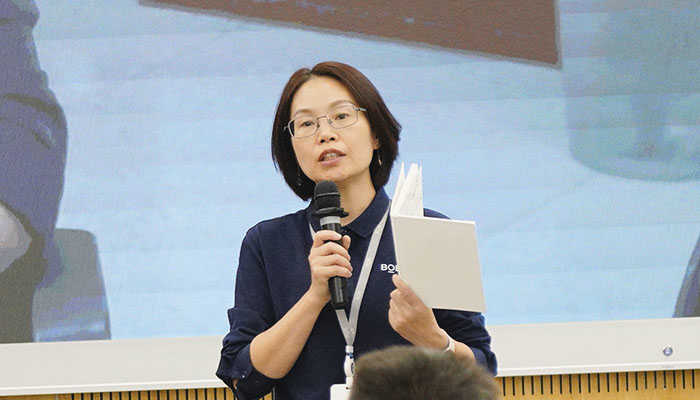
本访谈收录于《灯塔企业高层访谈实录》第二期:对话京东方科技集团。
由世界经济论坛牵头并联合麦肯锡开展的全球灯塔网络倡议,代表了当今全球制造业智能制造和数字化的最高水平。入选的“灯塔工厂”也是具有榜样意义的“数字化制造”和“工业化4.0”示范者。2021年3月,京东方福州8.5代半导体显示生产线入选中国大陆首家也是唯一一家显示类“灯塔工厂”。
挑战方显勇毅,磨砺始得玉成。今天,全球每4个智能显示终端,就有一块显示屏来自京东方。从中国首条依靠自主技术建设的显示生产线,到产能与出货量双双位居行业前列,京东方从0到1,成为终结“缺屏时代”的国之重器。即将步入而立之年的京东方,选择主动打破天花板,更上一层楼,开启了以“屏质取胜”的创新之路。
近日,麦肯锡全球董事合伙人侯文皓对京东方科技集团副总裁、首席变革官和IT管理官付华女士进行了访谈。付华女士长期致力于推进数字化技术和业务的深度融合,以技术赋能业务,帮助业务提质增效。我们希望,领先者的成功经验可成为制造业同行的指路明灯,照亮智能制造的未来之路。
侯文皓:很高兴今天付华女士同我们做这一期访谈 。很多企业开展数字化转型是被“逼”的,为了解决痛点和难题不得己而为之。京东方数字化转型的初心是什么?
付华:京东方的基因就是积极迎接挑战和主动自我革命,它是我们成长近30年的内在动力。早在信息化时代,我们就意识到,信息技术和制造技术的应用会给企业带来极大的竞争优势。的确在京东方的发展过程中,竞争优势得到了体现。
在智能制造和数字化的时代浪潮下,我们董事长陈炎顺提出了数字化不是值不值得做的事,而是必须做,正当其时去做。未来企业的核心竞争力很大程度体现在数字化运营和管理能力上。这是从高层发出的呼声,传递的意识。事实上,在京东方成为行业龙头时,数字化已经形成一定规模了。
京东方的愿景是成为地球上最受人尊敬的伟大企业。基于这一宏大远景,探索、规划未来发展方向的时候,我们就在想,如何利用自身特点和优势,通过数字化技术和智能制造技术的充分融合,来赋能制造,提升竞争力,树立行业标杆,同时把优秀成果和心得体会加以推广。
京东方在全国各地有十几条产线,因此标杆的树立是非常重要的。那么问题来了,怎么做呢?用什么标准来指导、规划和检验智能制造的发展水平?这时我们想到了“灯塔工厂”,其主旨就是甄选工业4.0先进技术应用的示范者和领先者,给面临数字化变革困局的其它产线一些引领和启发。
基于这个考虑,我们决定通过打造“灯塔工厂”来规划、实施和检验智能制造的能力和水平。
侯文皓: 数字化转型是非常困难的,我们跟前几期嘉宾交流下来,有人才的困难,有技术的困难,也有业务落地的困难。您作为京东方数字化转型的推动者,当初遇到过哪些艰辛?又是怎么克服,往前推进的?
付华: 我认为关键是信念。尤其在前期规划的时候,数字化变革、智能制造需要长期的大量的资源投入,而相关的数字化技术,比如说排产的算法,图像识别,还有智能预测等等,在行业里没有成功先例,这就导致第一,我们没有可以借鉴和参考的方案;第二,我们的技术人才显得不够全面。这些不确定因素让我们很难衡量投入会带来的回报,所以当时大家脑子里有个很大的问号,数字化转型能做成什么样子?能不能实现我们想要的那些结果和目标?
这个时候,包括董事长在内的集团高层决心非常坚定,给我们传递了信心,数字化和智能制造的未来肯定是光明的,京东方一定要做这件事,并且对全员进行宣贯和鼓励。在无人区树立“灯塔”,作出引领和表率的责任感和兴奋感,驱动着我们扛下沉甸甸的压力。
集团层面也是做了大量的研讨工作,才决定以此为契机,拉开京东方数字化变革的帷幕。集团层面成立了CTIO,即首席变革与IT管理官,绘制数字化转型蓝图,指明了方向。
同时,福州工厂成立了数字化转型办公室和数字化平台,结合实际的业务场景,将变革蓝图转化为行动方案,将行动方案落实为一个个成果。比较好的是,这些细分项目逐步取得了一些成果。这样,不管是中高层的管理人员,还是底层的工程师基层人员,都尝到了转型所带来的“甜头”,也积累了经验。正是这些“甜头”和经验,让我们坚定了数字化转型必将取得成功的信心。有了信心,后面就都好做了。
侯文皓:首先是一把手推进,坚持要做。其次是形成了比较好的路径和方案。最后,一旦产生了好的成果,大家因为看见,所以相信,搬动了大石头,形成了良形循环。您能跟大家分享一个特别值得骄傲的案例吗?
付华:这几年的数字化变革,还有智能制造的应用,京东方有很多收获。在分享案例之前,我想讲一讲收获。首先一个收获,是打造了一支坚定相信数字化转型会取得成功、能够自发地持续地把数字化理念结合实际应用场景去创新应用、并且发扬光大的团队。(转型)团队成员数量还是很多的,每个工厂都有,如果把全部成员加起来,人数就很可观了。
第二个收获,是总结出培养体系,锻炼了一批有着数字化业务规划、实施能力,还有落地实战经验并形成了自造血功能的业务骨干。同时也积累了一批涵盖生产计划、运营管理、过程品质、节能减碳等多个维度,经过提炼总结,可在全公司和行业推广的成功经验。
说到成功案例,福州工厂我们还是挺骄傲的,毕竟它入选了“灯塔工厂”。这个项目我们感到比较骄傲的是智能化设备综合效率(OEE)平台。它的特点是可以把OEE的数据全面、及时、准确地线上化分析呈现,实现了多瓶颈生产线的自动识别。做到这一点难度很大,如果是单一瓶颈倒比较好识别,如果瓶颈总在漂移,靠人工去追踪去发现的话,肯定会有延迟,产能就会损失。
通过现代化的机器识别和算法分析,我们就可以基于专家经验的知识图谱分析,当设备出现异常时主动提出建议方案。得益于这个平台,这几年福州产线的生产制造在极限的基础上,(通过)一轮轮的优化和改善,产能有了很大提升,也给工厂带来非常可观的收益。现在福州工厂的整个稼动率是京东方现有工厂中最好的产线之一,智能化OEE平台功不可没。
侯文皓:这个案例特别好。我们在福州工厂看到了通过数字化、智能化视觉的方式,自动捕捉产线当中的动态瓶颈,再据此做设备效率改善的工作。这样可以不需要做太多投入,就可以大幅提升产能。我理解京东方所在的行业,产能利用率和规模化对成本的影响是非常显著的,其他行业的企业也有在做类似案例。
另一个,京东方去年获得了我国质量领域最高荣誉的中国质量奖,凭借“屏质取胜”的质量管理模式,从近700家受理单位中脱颖而出,取得第一名的骄人成绩。 “屏”的数字化和智能化为京东方带来哪些改变?
付华:京东方建立了一个全面质量管理系统,这是我们质量建设的最大亮点。它的出发点是将质量管理尽可能往前追溯,及时追溯,而不是停留在事后管理。
我们将产线上的各种生产数据、设备数据、产品数据和材料数据整合到一个平台,同时将售后端数据也整合到一个平台上。如果出现异常,就能够第一时间在产线上发现。当市场端有问题时,我们能第一时间反馈到产线,并且可以更快定位到产线上具体问题产生的环节。
同时,京东方的全面质量管理系统整合了工艺系统,我们在对工艺做一些改善时,可以结合之前的经验快速定位。我们可以发现有些改善的效果是有限的,可能还会带来别的问题,应该怎么去平衡等等。所以在做品质、质量改善时,需要一些标靶性的方案,改善才会比较快。
侯文皓:所以不能只是事后质量管理,更重要的是发现和预防质量问题,数字化起到了功不可没的作用。您前面提到人才培养和造血机制,可以更具体一点吗?大规模培养人才有哪些好的做法?
付华:数字化转型刚开始时大家有个误区,觉得这是技术和IT的事情。另一个不太明确的是,到底是出现问题后去解决,还是站在一个更宏观的层面,分解到下面去做。
反映在建设数字化人才体系时,我们有两个做法。第一个是找对标公司,看看数字化人才应该怎样推进建设。后来发现,如果只是顶层参与,向下推广就会出现问题,所以规划数字化蓝图是全方位参与。
京东方的人才培养,既有从外面学到的人才梯队建设和体系建设的具体方法,同时我们又将这个体系分解到公司不同的层级,高层要怎么培养,中层要怎么培养,基层人员怎么培养,然后把不同人员、不同角色的培养体系,与项目对接。通过项目的建设,以战代练,让人员逐步培养和具备数字化能力和技能。
再由这些人才去推广和宣传,包括给其他组织的人员提供培训。同时一些相关的工具,比如报表展示的工具,数据拉通的工具,我们也会提供技术培训。另外,每年京东方都会盘点数字化人才,通过盘点发现差距,然后补齐短板。
侯文皓:工作做得非常细致,有培训,有“做中学”,也有盘点和持续改进,人才培训非常体系化。福州工厂部署了大量的突破性技术,再往前走,您看好哪些技术未来可能需要深度挖掘?除了制造领域,也包括供应链、研发应用领域。
付华:我们感到欠缺的是算法。目前海量的数据是躺着的,没有发挥效能,这些数据怎么用起来?如果从技术层面看,说明我们的大数据分析能力需进一步得到提升,这是今后的发力方向。
第二个是仿真。我们的投入成本极大,如果投一条OLED产线,或是Micro LED产线,基本得要上百个亿,还要做产能的试跑,在量产之前还需大量投入,这样才能保证一条产线跑一个产品比较顺。
为了节省成本,我们希望做产线仿真。但由于工艺比较复杂,精细程度也比较高,对仿真的要求和数据的积累是很严苛的。这也是我们今后研究和突破的方向之一。
侯文皓:数字孪生对于投资大的企业特别有意义,从工厂新建到爬坡阶段,虚拟仿真可以大量减少真实世界里面的工作。的确,大量的数据还没有被很好地利用,您觉得怎样让真正有用的数据,甚至微数据产生比较好的业务效果,这既是难点,也是必须要做的事。
付华:我的体会是,对数据最了解的人是那些应用数据的人。因此,如果想挖掘数据的价值,我们应该让他们发挥主观能动性。通过一些小的案例,或者培养和鼓励使用数据的分析人员,来发掘他们的价值。当然还有很重要的一点,数据模型和分析策略需要在这个过程中逐步学习和掌握。
目前京东方在做的是,培养基层的数据分析人员,推动数据的使用。由于这部分人员的数据能力相对较弱,所以我们组织了一些课程,对他们进行培训,希望以此来促进员工更好地使用数据和分析数据。
侯文皓:非常精彩的分享。传统做法是通过转译,运营技术的人(OT)加上建模和数据分析的人(IT),把数字化转型落地。另外,我们看到福州“灯塔工厂”还有一个思路,一些工程师很懂数字,很懂分析,也会建模,我们称之为数字化工作的民主化,就是工程师和一线人员都能用好数字化工具。这对推进数字化的真正落地非常直接,效果特别好。
最后一个问题我也想请教您,展望未来两三年,集团层面的数字化转型,您认为应聚焦哪几件事?
付华:从大的层面来看,我认为有三点比较重要。第一个是基础数据。很多公司的数据质量不是很好,原因是之前的建设导致了数据的信息孤岛,数据多元化的一些管理,以及数据的标准不统一产生的问题。
在数字化推进过程中,数据是最有价值的财富,数据的标准化和流动化是一切数字化行动的基础,是重中之重。所以必须要完善这个基础,才能够重塑流程,构建系统。有了一个比较好的数据基础,才能够用技术手段发掘价值,引导业务发展的方向和改善的方向。
第二个是全面建设数字化的人才体系。现在所有数字化活动的最终核心载体是人,人员的能力是非常重要的。我们将借助企业数字化转型和“灯塔工厂”的经验,构建系统化的数字化人才培养体系。这是一个长期的投入过程,一定要打造自己的人才培养体系。京东方目前已完成初步建立,正逐步加以完善。
第三个是文化。要在企业内部营造数字化变革的文化。开头我提到了,京东方数字化转型董事长和高层很重视,这坚定了我们的信念。在数字化转型中,最难解决的是思想问题,而决定企业数字化转型成功与否的关键,是各层级的人员能不能接受数字化转型。它不是一个纯技术问题,而是企业的文化变革。
如果忽视了数字化文化的建设,可能组织内会比较顽固保守,员工不愿意进行重大变革,新的工作方式、工作流程会很难被采用。数字化变革将遇到一些阻碍,最后可能就面临转型的失败。
所以要通过数字化文化的培育,加强员工对数字化的理解,引导员工转变传统思维,他们在这个过程中还能尝到一些“甜头”,这样使数字化转型深入人心,从而推动变革的顺利实施。
侯文皓:关于文化和理念的做法非常值得借鉴。首先是一把手的决心传递下去了。第二是实际落地的效果以及建立的信心有了。第三个是通过文化培育和成效的取得,让数字化转型深入人心。最后我有个不情之情,您可否给正在数字化转型道路上探索的企业负责人一些建议?
付华:大家可能看过《刷新》这本书,它提到了同理心,也提到了开放和共享,所以我给数字化转型负责人的建议是,不要害怕,去做,去改变,放开心胸,跟大家去分享和沟通,站在对方的立场去考虑他会害怕什么,然后帮助他解决他所害怕的问题,那么数字化变革一定会取得成功的。
侯文皓:非常感谢付华女士的分享,相信对于许多同为制造行业的企业来说具有很大的借鉴价值。我们也希望京东方在奔向愿景的征途中,既能实现自我成长,也能为中国智能制造提供更多的成功经验,照亮前方更远的路。今天的访谈到此结束,谢谢。
翻译:
This interview is included in the “Lighthouse Enterprise senior executives Interview Record” second: Dialogue with BOE Technology Group.
The Global Lighthouse Network Initiative, led by the World Economic Forum and conducted in conjunction with Mackenzie, represents the highest level of smart manufacturing and digitalization in the global manufacturing industry today. The selected “Lighthouse Factory” is also a model of “digital manufacturing” and “Industrialization 4.0” demonstration. In March 2021, BOE Fuzhou 8.5-generation semiconductor display production line was selected as the first and only display “lighthouse factory” in mainland China.
The challenge shows courage and perseverance, honing the beginning to succeed. Today, every four intelligent display terminals in the world, there is a display from BOE. From China’s first display production line that relies on independent technology to rank in the forefront of the industry in terms of production capacity and shipments, BOE has become a national key to ending the “lack of screen era” from 0 to 1. Boe, which is about to enter its thirtieth year, chose to take the initiative to break the ceiling, go to a higher level, and open the road of innovation with “screen quality win”.
Recently, McKinsey Global Managing Partner Hou Wenhao interviewed Ms. Fu Hua, Vice president, Chief Change Officer and IT Management Officer of boe Technology Group. Ms. Fu Hua has long been committed to promoting the deep integration of digital technology and business, empowering business with technology and helping business improve quality and efficiency. We hope that the successful experience of the leaders can serve as a beacon for their manufacturing peers and illuminate the future of intelligent manufacturing.
Hou Wenhao: It’s a pleasure to have Ms. Fu Hua with us today for this interview. Many enterprises to carry out digital transformation is “forced”, in order to solve the pain points and problems have to do it. What is BOE’s initial intention of digital transformation?
Fu Hua: BOE’s gene is to actively meet challenges and take the initiative to self-revolution, which is the internal driving force for our growth in the past 30 years. As early as in the information age, we have realized that the application of information technology and manufacturing technology will bring great competitive advantages to enterprises. Indeed, in the development process of BOE, competitive advantages have been reflected.
In the era of intelligent manufacturing and digitalization, our chairman Chen Yanshun put forward that digitalization is not something worth doing, but must be done, and it is the right time to do it. The core competitiveness of future enterprises is largely reflected in the digital operation and management capabilities. It’s a voice from the top, a message of awareness. In fact, when BOE became the industry leader, digitalization had already formed a certain scale.
Boe’s vision is to be the most respected and great company on the planet.
Based on this grand vision, when exploring and planning the future development direction, we are thinking about how to use our own characteristics and advantages, through the full integration of digital technology and intelligent manufacturing technology, to empower manufacturing, enhance competitiveness, establish industry benchmarks, and promote excellent results and experiences.
Boe has more than a dozen production lines across the country, so the establishment of benchmarks is very important. So the question is, how do you do it? What standards are used to guide, plan and test the development level of intelligent manufacturing? At this time, we thought of the “Lighthouse factory”, whose main purpose is to select the demonstrator and leader of the application of advanced technology of Industry 4.0, and give some guidance and inspiration to other production lines facing the dilemma of digital change.
With this in mind, we decided to plan, implement and test the capabilities and levels of smart manufacturing by creating a “lighthouse factory”.
Hou Wenhao: Digital transformation is very difficult, we have communicated with the previous guests, there are talent difficulties, technical difficulties, but also the difficulty of business landing. As a driver of BOE’s digital transformation, what difficulties did you encounter in the beginning? How did you get over it? How did you move forward?
Fu Hua: I think the key is faith. Especially in the pre-planning, digital transformation, intelligent manufacturing require long-term large amount of resource investment, and related digital technologies, such as production scheduling algorithms, image recognition, and intelligent forecasting, etc., have no successful precedents in the industry, which leads to the first, we have no reference and reference programs; Second, our technical talent is not comprehensive enough. These uncertainties made it difficult to measure the return on investment, so there was a big question in everyone’s mind: What could digital transformation look like? Can we achieve the results and goals we want?
At this time, the determination of the senior management of the group, including the chairman, is very firm, and gives us confidence that the future of digital and intelligent manufacturing is definitely bright, BOE must do this thing, and promote and encourage all staff. To set up a “lighthouse” in a no-man’s land, to lead and set an example of the sense of responsibility and excitement, driving us to carry the heavy pressure.
The group level has also done a lot of research work before deciding to take this opportunity to open the curtain of BOE’s digital transformation.
At the group level, CTIO, the Chief Change and IT Management Officer, has been established to map out the digital transformation and set the direction.
At the same time, Fuzhou factory set up a digital transformation office and digital platform, combined with the actual business scenarios, the blueprint for change into action plans, the action plan into a result. The good news is that these sub-projects have gradually achieved some results. In this way, whether it is the middle and senior management personnel, or the grass-roots engineers at the bottom, they have tasted the “sweetness” brought by the transformation and accumulated experience. It is these “sweeteners” and experiences that make us firmly confident that digital transformation will succeed. With confidence, everything will be easy to do.
Hou Wenhao: First of all, the leader of the push, insist on doing. The second is to form a better path and plan. Finally, once a good result is produced, everyone believes that because they see it, they move the big stone and form a good shape cycle. Can you share a case you’re particularly proud of?
Fu Hua: BOE has gained a lot from the digital transformation in recent years, as well as the application of intelligent manufacturing. Before I share the case, I want to talk about the gains.
The first achievement is to build a team that firmly believes in the success of digital transformation, and can spontaneously and continuously apply digital concepts in practical application scenarios to innovate and carry forward. (Transformation) the number of team members is still very large, each factory has, if you add up all the members, the number is very considerable.
The second harvest is to sum up the training system, exercise a group of digital business planning, implementation capabilities, as well as practical experience and form a self-hematopoietic function of the business backbone. At the same time, it has also accumulated a number of successful experiences covering production planning, operation management, process quality, energy saving and carbon reduction, etc., which can be promoted in the whole company and the industry after refining and summarizing.
Speaking of success stories, we are still very proud of Fuzhou factory, after all, it was selected as the “lighthouse factory”. One of the projects we’re more proud of is the Intelligent Equipment Overall Efficiency (OEE) platform. It is characterized by comprehensive, timely and accurate geodesic analysis of OEE data and automatic identification of multi-bottleneck production lines. It is very difficult to do this, if it is a single bottleneck is better to identify. If the bottleneck is always drifting, by manual tracking to find it. There will certainly be delays, production capacity will be lost.
Through modern machine recognition and algorithm analysis, we can proactively propose solutions when equipment is abnormal based on the knowledge graph analysis of expert experience.
Thanks to this platform, in recent years, the production and manufacturing of Fuzhou production line on the basis of the limit, (through) rounds of optimization and improvement, the production capacity has been greatly improved, and it has also brought very considerable benefits to the factory. At present, the overall operation rate of Fuzhou plant is one of the best production lines in BOE’s existing plants, and the intelligent OEE platform has contributed greatly.
Hou Wenhao: This case is particularly good.
We have seen in Fuzhou factory that through digital and intelligent vision, dynamic bottlenecks in the production line can be automatically captured. And then equipment efficiency can be improved accordingly. In this way, we can greatly increase production capacity without making too much investment. I understand that BOE is in an industry where capacity utilization and scale have a significant impact on costs. And companies in other industries are also doing similar cases.
On the other hand, BOE won the China Quality Award last year. The highest honor in the field of quality in China. With the quality management model of “screen quality wins”, BOE stood out from nearly 700 acceptance units and achieved the first place. What changes have the digitalization and intelligence of the “screen” brought to BOE?
Fu Hua: BOE has established a total quality management system, which is the biggest highlight of our quality construction. Its starting point is the quality management as far back as possible, timely traceability, rather than staying in the post-management.
We integrate all kinds of production data, equipment data, product data and material data from the production line into one platform
We integrate all kinds of production data, equipment data, product data and material data from the production line into one platform, and also integrate after-sales data into one platform. If an anomaly occurs, it can be detected on the production line as soon as possible. When there is a problem at the market end, we can feedback to the production line at the first time. And can locate the specific problems in the production line more quickly.
At the same time, BOE’s total quality management system integrates the process system. And when we make some improvements to the process, we can combine the previous experience to quickly locate. We can find that the effect of some improvements is limited, may also bring other problems, how to balance and so on. Therefore, when doing quality and quality improvement, some target-oriented programs are needed, and the improvement will be faster.
Hou Wenhao: Therefore, it is not only quality management after the fact. But more important to find and prevent quality problems, and digitalization has played an indispensable role. You mentioned personnel training and hematopoietic mechanism, can you be more specific? What are some good practices for developing talent on a large scale?
Fu Hua: At the beginning of digital transformation, there was a misconception that IT was a matter of technology and IT.
What is less clear is whether to solve problems after they occur, or to stand on a more macro level and break down to do it below.
Reflected in the construction of digital talent system, we have two approaches. The first is to find the right company to see how digital talent should advance the construction. Later, it was found that if only the top-level participation, there would be problems in the downward promotion, so the planning of the digital blueprint is to participate in all aspects.
Boe’s talent training, both from the outside to learn the specific methods of talent echelon construction and system construction. At the same time, we also break down the system to different levels of the company. How to train the senior level, how to train the middle level, how to train the grass-roots staff, and then different personnel, different roles of the training system, docking with the project. Through the construction of the project, the personnel are gradually cultivated and equipped with digital capabilities and skills.
These talents are then used to promote and publicize, including providing training to personnel of other organizations.
At the same time, we will also provide technical training for some related tools. Such as report presentation tools and data pulling tools. In addition, BOE will take stock of digital talents every year, find the gap through inventory, and then make up for the shortcomings.
Hou Wenhao: The work is very detailed, there is training, there is “learning by doing”. There is also inventory and continuous improvement, talent training is very systematic. Fuzhou plant has deployed a large number of breakthrough technologies, going forward. Which technologies do you think may need to be further explored in the future? In addition to manufacturing, it also includes supply chain, research and development applications.
Fu Hua: What we feel is missing is the algorithm.
At present, the huge amount of data is lying, not playing efficiency, how to use these data? If from the technical level, it means that our big data analysis ability needs to be further improved, which is the future direction of force.
The second is simulation. Our input cost is very large, if the investment of an OLED production line, or Micro LED production line, basically hundreds of billions. But also to do a trial run of production capacity, before mass production also need a lot of investment. So as to ensure that a production line runs a product more smoothly.
In order to save costs, we want to do production line simulation. However, due to the complexity of the process and the high degree of precision. The requirements for simulation and the accumulation of data are very strict. This is also one of the directions of our future research and breakthrough.
Hou Wenhao: Digital twins are especially meaningful for enterprises with large investments, from the new factory to the climbing stage, virtual simulation can greatly reduce the work in the real world. Indeed, a lot of data has not been well used, you think how to make really useful data, even micro-data to produce better business results, this is difficult, but also must do.
Fu Hua: My experience is that the people who know the data best are the ones who apply it.
Therefore, if we want to tap the value of data, we should let them exercise subjective initiative. Discover the value of data through small cases, or by training and encouraging analysts to use it. Of course, it is also important to note that data models and analysis strategies need to be learned and mastered in this process.
At present, BOE is doing is to train grassroots data analysts and promote the use of data. Since this group of people is relatively weak in data skills, we have organized some courses to train them, hoping to promote employees to better use and analyze data.
Hou Wenhao: Very wonderful sharing. The traditional approach is to land digital transformation through translation, operational technology people (OT) plus modeling and data analysis people (IT). In addition, we see that Fuzhou “lighthouse factory” has another idea. Some engineers know digital, understand analysis, can also model, we call it the democratization of digital work. That is, engineers and front-line personnel can use digital tools. This is very direct to promote the real landing of digitalization, and the effect is particularly good.
The last question I would like to ask you is, looking ahead to the next two or three years. The digital transformation at the group level, what do you think the focus should be on?
Fu Hua: From a broad perspective, I think there are three important points.
The first is the underlying data. The data quality of many companies is not very good, the reason is that the previous construction led to the data information island. Some management of data diversification, and the data standards are not unified.
In the process of digital promotion, data is the most valuable wealth. And the standardization and mobility of data is the basis of all digital actions and is the top priority. So you have to improve this foundation to be able to reinvent the process and build the system. With a better data base, we can use technical means to explore value and guide the direction of business development and improvement.
The second is to comprehensively build a digital talent system. Now the ultimate core carrier of all digital activities is people, and the capabilities of people are very important. We will use the experience of enterprise digital transformation and “lighthouse factory” to build a systematic digital talent training system. This is a long-term investment process, we must build our own talent training system. Boe has completed its initial establishment and is gradually improving it.
The third is culture. Create a culture of digital change within your organization. As I mentioned at the beginning, BOE Digital Transformation chairman and senior management attach great importance to it, which strengthens our belief. In the digital transformation, the most difficult problem to solve is the ideological problem. And the key to determining the success of the digital transformation of the enterprise is whether the personnel at all levels can accept the digital transformation. It is not a purely technical problem, but a cultural change in the company.
If the construction of digital culture is ignored
If the construction of digital culture is ignored. The organization may be more stubborn and conservative, employees are not willing to make major changes. And new working methods and work processes will be difficult to adopt. Digital transformation will encounter some obstacles, and may eventually face the failure of transformation.
Therefore, it is necessary to strengthen employees’ understanding of digitalization through the cultivation of digital culture, guide employees to change traditional thinking, and they can taste some “sweetness” in the process. So that digital transformation is deeply rooted in people’s hearts, and thus promote the smooth implementation of change.
Hou Wenhao: The approach to culture and philosophy is worth learning from.
The first is that the determination of the leader is passed on. The second is the effect of the actual landing and the confidence built. The third is to make digital transformation deeply ingrained through cultural cultivation and achievement. Last but not least, could you give some advice to business leaders who are exploring the path of digital transformation?
Fu Hua: You may have read the book “Refresh”, which mentions empathy. But also mentions openness and sharing, so my advice to the person in charge of digital transformation is: don’t be afraid, do it, change it, open your mind, share and communicate with you, stand in the other person’s position to consider what he will be afraid of. And then help him solve the problem he is afraid of. Then the digital revolution will succeed.
Hou Wenhao: Thank you very much for Ms. Fu Hua’s sharing. I believe that it has great reference value for many enterprises in the manufacturing industry. We also hope that BOE, in its journey towards the vision, can not only achieve self-growth. But also provide more successful experience for China’s intelligent manufacturing and illuminate the further road ahead. That’s all for today’s interview. Thank you.
如需加入CXO UNION(CXO联盟)高管社群,请联系社群小伙伴哦~
本文由CXO UNION-CXO联盟(cxounion.cn)转载而成,来源于McKinsey&Company;编辑/翻译:CXO UNIONCXO联盟小宁檬。
免责声明: 本网站(http://www.cxounion.cn/)内容主要来自原创、合作媒体供稿和第三方投稿,凡在本网站出现的信息,均仅供参考。本网站将尽力确保所提供信息的准确性及可靠性,但不保证有关资料的准确性及可靠性,读者在使用前请进一步核实,并对任何自主决定的行为负责。本网站对有关资料所引致的错误、不确或遗漏,概不负任何法律责任。
本网站刊载的所有内容(包括但不仅限文字、图片、LOGO、音频、视频、软件、程序等) 版权归原作者所有。任何单位或个人认为本网站中的内容可能涉嫌侵犯其知识产权或存在不实内容时,请及时通知本站,予以删除。
如需加入CXO UNION(CXO联盟)高管社群,请联系社群小伙伴哦~

免责声明: 本网站(http://www.cxounion.cn/)内容主要来自原创、合作媒体供稿和第三方投稿,凡在本网站出现的信息,均仅供参考。本网站将尽力确保所提供信息的准确性及可靠性,但不保证有关资料的准确性及可靠性,读者在使用前请进一步核实,并对任何自主决定的行为负责。本网站对有关资料所引致的错误、不确或遗漏,概不负任何法律责任。
本网站刊载的所有内容(包括但不仅限文字、图片、LOGO、音频、视频、软件、程序等) 版权归原作者所有。任何单位或个人认为本网站中的内容可能涉嫌侵犯其知识产权或存在不实内容时,请及时通知本站,予以删除。
Search
Popular Posts
-

2024数字化灯塔案例评选申报开启!
“2024数字化灯塔案例评选”于3月正式启动,诚挚欢迎业界同仁自荐和推荐,一起推动产业数字化进程,助力赋能企业…
-

2024 X-Award星盘奖申报通道已开启!
X-Award星盘奖是数字化转型服务、IT服务行业重要的商业奖项,旨在表彰行业里提供杰出数字化转型服务与IT服…
-

2024 N-Award星云奖申报通道已开启!
N-Award是数字化转型领域重要的商业奖项,旨在表彰那些以非凡的远见、超群的领导才能和卓越的成就来激励他人的…