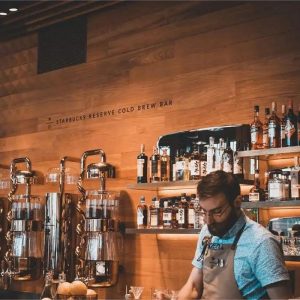
1982年9月7日,霍华德·舒尔茨(Howard Schultz,星巴克创始人、董事会主席)在第一家星巴克店”派克市场店”开始工作。
1987年,他自创的公司“天天”(I1 Giornale)咖啡馆与星巴克合并成“星巴克咖啡公司”,星巴克咖啡帝国悄然而生。
走过10年荣光,星巴克的经营在2007年开始走下坡路,当时世界正产生巨大变动,无论是全球经济、消费行为,还是数字革命迎来的传播方式,都在在考验它的危机应变能力。
2008年,霍华德·舒尔茨再度回任首席执行官,两年后的9月,星巴克再度创造历史上盈利最高的财务季度。
在霍华德·舒尔茨的领导下,星巴克重新拥有了其企业文化所倡导的创造力和规范、创业精神和精确流程、纪律以及创新之间的平衡。
这再次证明,企业家在危机时刻做的领导企业变革,不外乎从企业内部文化变革,同时也提供多数想变革,走更长远路的企业新思维──企业、员工以及顾客相互系上情感带,互利共生。
“对我而言这是个特殊的日子,”在一家小小的餐馆里,我面向在座的咖啡师以及门店经理如是说,“确切地讲,28年前的今天,也就是1982年9月7日,我开始在第一家星巴克店工作,也就是你们这家,就在这里——派克市场店”。
说着,我将手伸进口袋,掏出一把钥匙,“我一直留着前门的钥匙。”
谁能想到星巴克的首席执行官会随身携带一把门店钥匙,但是我把它当做钥匙链,每次一看到它,我都会想起我所肩负的责任——将公司的传统发扬光大,并以此来向我的前辈们致敬。
自1971年星巴克诞生以来,派克市场店的店面就一直保持这个样子,从未改变,当然,还包括它最初的标识。
就在几周前,这家门店的经理查德·穆尔(Chad Moore)给我写了一封邮件,他希望我能来激励他的团队突破连续8周的销售纪录。
我备受感动,邀请整个团队共进晚餐。吃饭时,其他几个分店的咖啡师和地区经理们都要求调到派克市场店来工作。
在这个温暖的西雅图夜晚,在这间专属于我们的餐厅,有27个伙伴正在把酒言欢。
席间,我逐一到每张桌子旁问候所有的伙伴。他们的年龄从28岁到40岁不等,大家都聊得十分开心。忽然,不知从哪儿冒出来一个声音,要我透露一点儿自己的故事。回想过去,我的脸上露出了笑容。
一、一切从遇见以及想分享美好开始
霍华德·舒尔茨在纽约市布鲁克林区的公租房长大,半工半读上完大学,最后才和妻子雪莉搬到了华盛顿的西雅图。
当时霍华德·舒尔茨负责西雅图一家名为星巴克的小型咖啡公司的销售业务,一次去意大利的出差唤起他真正的激情。
他徜徉在米兰和维罗纳星罗棋布的小型意式浓缩咖啡吧之间,更惊叹咖啡竟串起人与人的交流,他当下下定决心,要将世界级的咖啡以及意式浓缩咖啡吧的浪漫播撒在美国这片热土上。
因为他坚信这可以丰富人们的生活,但因许多人不相信他的眼光,他选择离开星巴克,并自开一家“天天”(I1 Giornale)咖啡馆。
1987年,在几个投资者的支持下,霍华德·舒尔茨将天天(I1 Giornale)咖啡馆以及星巴克两家公司合并且仍冠之以“星巴克咖啡公司”。
“同年年末,我们拥有了11家门店、100名伙伴以及一个创造全国性品牌的梦想。”
2010年秋,星巴克的财务表现正处于它近40年来的巅峰,“尽管有评论家曾预言星巴克的好日子不会长久。”
然而,星巴克的生意却从未如此蓬勃地发展,利润也在持续增长,这不只是依靠在全球范围内不断建立的创新而取得的,更是凭借星巴克与消费者建立的深厚感情,不断推陈出新和大范围推广星巴克系列产品而取得的。
作为一名商业领袖,霍华德·舒尔茨的目标从来不局限在获胜或者盈利上,他更渴望打造出伟大而永恒的企业帝国,这就意味着要在盈利与社会良知之间找到平衡。
“没有哪家企业可以在惠及它的业务链各个环节相关人员之前,先满足股东的需求,”霍华德·舒尔茨说,这就意味着要尽自已最大努力尊重每个人,无论是咖啡农还是咖啡师,顾客还是同行。
“我明白要追逐利润又不愿违背人类道德听起来有点狂妄,但我始终不愿放弃。即使星巴克和我一同处于迷茫的时候,我也不愿放弃这一原则。”
星巴克是美国第一家为临时工提供全面医疗保险的企业,也是第一家给临时工股票期权的企业,因此一向被认为是最棒的就业单位。
二、化解危机
2000年,霍华德·舒尔茨从首席执行官的位置上退了下来,担任公司主席,此后不再涉足公司的日常运营,转而关注其全球性战略扩张策略。
但由于过分追求增长,星巴克核心高管忽略公司运营,对公司的核心价值也不再那么重视了。直到2007年,星巴克开始走下坡路。
一项又一项的决议,一家又一家的门店,一批又一批的顾客,星巴克一直赖以生存的基础正在不断瓦解。更槽的是,随着世界经历着前所未有的变化,星巴克内部问题越来越受外部环境影响。
最明显的是,经济正飞速陷入巨大的金融危机之中,这造成上万亿美元的个人财富损失,进一步加剧信用恐慌,刺激房地产泡沫破裂,导致失业率居高不下,并最终使世界跌入全球性经济衰退的深渊。
与此同时,消费者的行为也发生着巨变,他们关心的不再是商品的价格,转而开始更注重环境与健康,更在意生产者的伦理道德。消费者正迫使那些同他们有生意往来的公司提高自身标准,这其中就包括星巴克。
此外,还有数字革命,它彻底颠覆了以往信息传递的方式。网络传媒与社交网络蓬勃发展,其中包括博客的兴起。多数情况下,星巴克的每个举动似乎都在全世界的注视之下。
最后,是来自同行业竞争者的猛烈攻击,从跨国公司到个体咖啡店,竞争者们无一不迅速地抢占市场,也无一不将矛头直指星巴克,他们对我们横加指责,而且毫无歉意。
这一切的一切无非是痛击视星巴克为生命、是身体一部份的霍华德·舒尔茨,他为了抢救公司,2008年1月,再次回任首席执行官之职。
三、新的成长蓝图
2010年9月,星巴克创造了历史上盈利最高的财务季度。
霍华德·舒尔茨为公司伙伴自豪,但他却从来没有尽情享受过庆祝活动,反倒是停下脚步,放下日常业务,反思经验教训以及对未来的意义。
他明白到,增长并不是一个战略,而是一种战术。过去的战路是不顾一切地追求增长,因而迷失方向,“我们不会再采用过去的策略发展公司。”
总之,今天星巴克的目标是成为一个与众不同的公司。
20多年来,霍华德·舒尔茨一直认为,每个公司都必须推动自我更新和改造,不断挑战现状。对星巴克而言,这样做意味着要想得更长远,尝试以前从未走过的路。
要如何将星巴克的消费品业务和零售门店、强大的顾客交流工具和资源结合起来。需要考虑:全球零售网络、商店销售产品及与客户建立情感纽带。
星巴克完全做到了这三点,甚至还有两大优势可以在门店以及其他分销渠道,比如杂货店,为顾客提供新的消费品和消费方式。这两大优势是:
其一,我们数以千计的门店伙伴所营造的良好顾客关系和情感纽带;
其二,通过数字平台和忠诚计划加深与顾客间的联系。
就是这一战略构想引领并开启了星巴克的下一个新篇章。如果首先没有成功地进行变革,稳固美国市场的门店业务和品牌,星巴克就无法翻开新的篇章,这是永葆生机、不断成长的基础。
四、实现变革
正如没有任何一个单独的产品、个人或者单一创新能够决定星巴克的未来一样,也没有一件事能够改变公司,使之实现前所未有的增长。
自从霍华德·舒尔茨再次担任首席执行官以来,许多持久的创新开始扎根、开花、每一个都帮助星巴克实现2008年初确定的变革议程目标。
霍华德·舒尔茨重温并回顾一路以来,星巴克在新计划举措上取得的进展。他相信,只有这样做,才能全面看待公司运营,证明所制订、执行的计划不仅实现了公司变革,同时帮助星巴克增强了实力,去追求所构想的可持续的获利性增长。
重温这些创新,同時也是赞扬星巴克伙伴辛勤工作和多种才能的一种很好方式。没有他们,星巴克就不会有今天。
五、人永远是最重要的资产,也是竞争优势
是的,在当今不断变化的复杂的世界,我们很有可能经历成功、失败、再次成功,找回失去的梦想,成就更大的梦想,并取得成功。
在星巴克,最重要的是我们的指导原则,以及支撑它的企业文化。
星巴克重新拥有了其企业文化所倡导的创造力和规范、创业精神和精确流程、纪律以及创新之间的平衡。
但先前经验也明白提醒,也许最重要的是我们重获的信心,我们相信,面临困难,我们依然能够坚持我们的价值观。
在动荡的旅程中,只有坚守这些价值观念,我们才能够稳步前进。在公司成长的过程中,我们经营业务的方式,也让我们的伙伴为之自豪,也点燃了他们积极参与的激情。
务必谨记:人永远是我们最重要的资产,也是星巴克的竞争优势。
如需加入CXO UNION(CXO联盟)高管社群,请联系社群小伙伴哦~
翻译:
On September 7, 1982, Howard Schultz (founder and chairman of the Board of Starbucks) started work at the first Starbucks store, Pike Place Market.
In 1987, his company I1 Giornale Cafe merged with Starbucks to form Starbucks Coffee Company, and the Starbucks coffee empire was quietly born.
After a decade of glory, Starbucks’ fortunes began to decline in 2007, just as the global economy, consumer behavior and communications ushered in by the digital revolution were testing its resilience.
Howard Schultz returned as CEO in 2008, and two years later in September, Starbucks had the most profitable quarter in its history.
Under Howard Schultz, Starbucks has regained the balance between creativity and discipline, entrepreneurship and precise processes, discipline and innovation that its corporate culture espoused.
This proves once again that what entrepreneurs do in times of crisis is not only to change the internal culture of the enterprise, but also to provide the new thinking of the enterprise that wants to change and go for a longer distance — the enterprise, the employees and the customers connect with each other’s emotional belt for mutual benefit and symbiosis.
“This is a special day for me,” I said to an audience of baristas and store managers in a small restaurant. “To be exact, 28 years ago today, September 7, 1982, I started working at the first Starbucks, yours, right here at Pike Place Market.”
I reached into my pocket and pulled out a key. “I’ve been keeping the key to the front door.”
Who would have thought the CEO of Starbucks would carry around a key to the store, but I think of it as a keychain, and every time I look at it, I’m reminded of my responsibility to honor those who came before me by advancing the company’s heritage.
The Pike Place Market location has remained exactly the same since the inception of Starbucks in 1971, including, of course, its original logo.
Just a few weeks ago, the store’s manager, Chad Moore, sent me an email asking me to help motivate his team to break their eight-week sales streak.
I was so moved that I invited the whole team to dinner. Over dinner, baristas and regional managers at several other locations asked to be transferred to Pike Place Market.
It’s a warm Seattle night, and in our exclusive restaurant, 27 people are having a drink.
During the dinner, I went to each table to greet all my companions. They ranged in age from 28 to 40, and they all had a great time chatting. Suddenly, out of nowhere, a voice asked me to tell a little bit of my story. Looking back, my face lit up with a smile.
Everything starts with meeting and wanting to share
Howard Schultz grew up in public housing in Brooklyn, New York, and worked his way through college before moving to Seattle, Washington, with his wife, Sherry.
Howard Schultz was in charge of sales for a small coffee company called Starbucks in Seattle when a business trip to Italy sparked his true passion.
He wandered among the small espresso bars dotted in Milan and Verona, marveling at the connection that coffee can make to people, and he was now determined to bring world-class coffee and espresso bar romance to America.
Because he believed it could enrich people’s lives, but because many people didn’t believe his vision, he left Starbucks and opened his own cafe, I1 Giornale.
In 1987, with the backing of several investors, Howard Schultz merged the I1 Giornale Cafe and Starbucks, still known as the Starbucks Coffee Company.
“By the end of the same year, we had 11 stores, 100 partners and a dream to create a national brand.”
In the fall of 2010, Starbucks’ financial performance was at its highest level in nearly 40 years, “despite predictions from critics that the good times would not last.”
But Starbucks’ business has never been stronger, and its profits have continued to grow, not only because of the innovation it continues to build around the world, but also because of the deep relationship it has built with its customers, by constantly introducing new products and expanding the range of Starbucks products.
As a business leader, Howard Schultz’s goals were never limited to winning or making money
As a business leader, Howard Schultz’s goals were never limited to winning or making money. He was more interested in building great and lasting empires, which meant balancing profits with a social conscience.
“No business can satisfy the needs of its shareholders before it benefits the people involved in all parts of its business chain,” says Howard Schultz, which means doing your best to respect everyone, from farmers to baristas, customers to peers.
“I know it sounds presumptuous to chase profit without violating human morality, but I’m still reluctant to give up. Even when Starbucks was confused with me, I didn’t want to give up on that principle.”
Starbucks was the first company in the United States to offer full health insurance and stock options to temporary workers, so it has long been considered one of the best places to work.
Defuse the crisis
Howard Schultz stepped down as CEO in 2000 to become chairman and stepped back from day-to-day operations to focus on its global strategic expansion strategy.
But in the pursuit of growth, Starbucks’ core executives neglected to run the company and paid less attention to its core values. By 2007, Starbucks was in decline.
Resolution by resolution
Resolution by resolution, store by store, customer by customer, the foundation on which Starbucks had always been built was crumbling. What’s more, as the world goes through unprecedented changes, Starbucks’ internal problems are increasingly influenced by external circumstances.
Most obviously, the economy is hurtling toward a massive financial crisis that is destroying trillions of dollars in personal wealth, further fueling credit fears, fueling a housing bust, causing high unemployment, and ultimately plunging the world into a global recession.
At the same time, the behavior of consumers has changed dramatically. Instead of caring about the price of goods, consumers have become more concerned about the environment and health, and about the ethics of producers. Consumers are forcing companies that do business with them to raise their standards, including Starbucks.
Then there is the digital revolution, which has upended the way information is delivered. Online media and social networking have flourished, including the rise of blogs. For the most part, the world seems to be watching Starbucks’ every move.
there was the onslaught of competitors from the same industry
Finally, there was the onslaught of competitors from the same industry, from multinationals to individual coffee shops, who were quick to grab the market. Who were relentless in their criticism of Starbucks, and who were unapologetic.
All of this was to beat Howard Schultz. Who saw Starbucks as part of his life and returned as chief executive in January 2008 to save the company.
New blueprint for growth
In September 2010, Starbucks had its most profitable financial quarter in history.
Howard Schultz is proud of his company partners, but he never enjoys the festivities. Instead, he pauses to step back from his daily business and reflect on the lessons learned and what they mean for the future.
He learned that growth is not a strategy, but a tactic. The path of the past was a desperate pursuit of growth that lost its way. “We’re not going to grow the company the way we did.”
In short, Starbucks today aims to be a different kind of company.
For more than 20 years, Howard Schultz has believed that every company must push to renew and reinvent itself, constantly challenging the status quo. For Starbucks, doing so means thinking bigger and going where it has never gone before.
How to combine Starbucks’ consumer products business with its retail stores, powerful customer communication tools and resources. Need to consider: global retail network, stores selling products and building emotional bonds with customers.
Starbucks does all three. And it even has two big advantages to offer customers new consumer goods and ways to consume them in stores and other distribution channels, such as grocery stores.
These two advantages are:
First, the customer relationships and emotional bonds created by our thousands of store partners;
Second, through digital platforms and loyalty programs to deepen the relationship with customers.
It was this strategic vision that led and opened the next chapter for Starbucks. Starbucks won’t be able to move on without first successfully making changes that solidified its store business and brand in the U.S., which is the foundation for continued survival and growth.
Bring about change
Just as no single product, person, or innovation is going to determine the future of Starbucks, no single thing is going to change the company and make it grow like never before.
Since Howard Schultz returned as CEO. Many lasting innovations have taken root, blossomed, and each has helped Starbucks achieve the goals of the change agenda it set out to achieve in early 2008.
Howard Schultz revisits the progress Starbucks has made along the way with its new initiatives. Only by doing so, he believed, would he be able to take a holistic view of the company’s operations and demonstrate that the plans he had developed and executed were not only transforming the company, but also strengthening Starbucks to pursue the sustainable, profitable growth it envisioned.
Reliving these innovations is also a great way to praise the hard work and diverse talents of our Starbucks partners. Without them, Starbucks wouldn’t be where it is today.
People are always the most important asset and competitive advantage
Yes, in today’s ever-changing and complex world, it is possible to succeed, fail, succeed again, recover lost dreams, dream bigger, and succeed.
At Starbucks, the most important thing is our guiding principles and the culture that underpins them.
Starbucks has regained the balance between creativity and discipline, entrepreneurship and precise processes, discipline and innovation that its corporate culture advocates.
But perhaps most important of all is our renewed confidence that we can hold true to our values in the face of hardship.
Only by holding fast to these values can we make steady progress through the turbulent journey. As the company grew, we conducted our business in a way that made our partners proud and motivated them to get involved.
Remember: People are always our most important asset and a competitive advantage for Starbucks.
本文由CXO UNION-CXO联盟(cxounion.cn)转载而成,来源于领教工坊;编辑/翻译:CXO UNIONCXO联盟小C。
免责声明: 本网站(http://www.cxounion.cn/)内容主要来自原创、合作媒体供稿和第三方投稿,凡在本网站出现的信息,均仅供参考。本网站将尽力确保所提供信息的准确性及可靠性,但不保证有关资料的准确性及可靠性,读者在使用前请进一步核实,并对任何自主决定的行为负责。本网站对有关资料所引致的错误、不确或遗漏,概不负任何法律责任。
本网站刊载的所有内容(包括但不仅限文字、图片、LOGO、音频、视频、软件、程序等) 版权归原作者所有。任何单位或个人认为本网站中的内容可能涉嫌侵犯其知识产权或存在不实内容时,请及时通知本站,予以删除。
如需加入CXO UNION(CXO联盟)高管社群,请联系社群小伙伴哦~

免责声明: 本网站(http://www.cxounion.cn/)内容主要来自原创、合作媒体供稿和第三方投稿,凡在本网站出现的信息,均仅供参考。本网站将尽力确保所提供信息的准确性及可靠性,但不保证有关资料的准确性及可靠性,读者在使用前请进一步核实,并对任何自主决定的行为负责。本网站对有关资料所引致的错误、不确或遗漏,概不负任何法律责任。
本网站刊载的所有内容(包括但不仅限文字、图片、LOGO、音频、视频、软件、程序等) 版权归原作者所有。任何单位或个人认为本网站中的内容可能涉嫌侵犯其知识产权或存在不实内容时,请及时通知本站,予以删除。
Search
Popular Posts
-

2024数字化灯塔案例评选申报开启!
“2024数字化灯塔案例评选”于3月正式启动,诚挚欢迎业界同仁自荐和推荐,一起推动产业数字化进程,助力赋能企业…
-

2024 X-Award星盘奖申报通道已开启!
X-Award星盘奖是数字化转型服务、IT服务行业重要的商业奖项,旨在表彰行业里提供杰出数字化转型服务与IT服…
-

2024 N-Award星云奖申报通道已开启!
N-Award是数字化转型领域重要的商业奖项,旨在表彰那些以非凡的远见、超群的领导才能和卓越的成就来激励他人的…