五步组合论、战略十步法等管理方法不是写出来的,而是在实践中做出来的。
企业管理虽然没有统一不变的全能方法,但有一定的规律,规律就是我们在试验过多种方法后梳理出来要遵循的原则。相对于其他学科,企业管理成为专门学科较晚,而且在不同的社会文化和经济环境下,企业管理原则有不同的变化。
我曾任职多家企业,通过在实践中不断探索规律和方法、形成共识来指导企业的发展,由此才有了五步组合论、6S 管理、战略十步法、价值管理四要素、经理人标准等工作方法。
这些理念方法都被广泛使用过,并且在实践过程中不断修正完善,经历了市场和时间的检验,是相对成功的,这是其珍贵之处。CXO UNION-CXO联盟cxounion.cn
一、五步组合论
企业是有机的生命体,它的每一个局部功能之间都存在密切的联系,但我们容易把它们看成是孤立的、分割的。
一些人读过MBA,MBA一般有一二十门科目,看起来挺丰富,但是这些科目之间实际上很少建立联系。MBA的课程没有讲企业在实践中到底如何做,没有讲财务和人是什么关系,人力资源和战略是什么关系,战略和评价是什么关系,选择经理人和战略有什么联系等。
五步组合论就是内部管理各个环节、各个元素间的逻辑关系,不仅把企业管理的每个环节和要素都说清楚,而且可以把它们互相之间的逻辑关系说清楚,如图1所示。
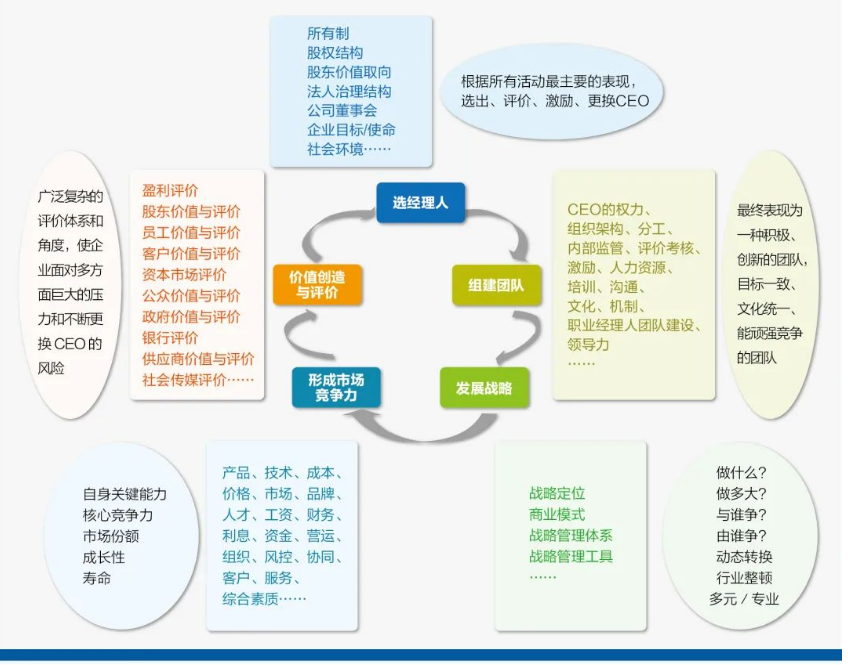
大部分企业出现问题后,在解决问题过程中又会产生很多新的矛盾,我们往往用另一个妥协来解决前面的矛盾。比如和别人合资解决技术问题,却发现因为引进技术而牺牲了管理权和对企业的掌控权。所以不能只局部地看问题,必须把问题排列好,系统地加以解决,要用五步组合论把内在的逻辑关系连接起来。CXO UNION-CXO联盟cxounion.cn
第一步,选经理人
一个崭新的股权和管理权分离的企业,第一步应该是选经理人,用科学的方法选经理人最重要。要有公开与可行的标准,所选的经理人一定是能够带领公司进步的人。管理者必须清楚地表明提拔此人的理由,对员工要有清晰的导向性,而不是仅仅下达一个任命文件。
五步组合论对国有企业、家族企业更适用,因为所有制形式决定了选谁当CEO,同时也关联着治理结构(如董事会、监事会等)。无论是公有制还是私有制的治理结构,最终落到实处的都是选个适合的CEO。如果CEO选错了,其他一切做法都没用;如果CEO选对了,大部分问题会迎刃而解。
在选CEO的过程中,股东的导向性容易出问题,如公正性、价值取向有误等。股东可能想选个能力平平但对股东好的,业绩其次。可是CEO实在很重要,未来公司的决策都与CEO息息相关。
选CEO是第一步,任何业务的开始,无论大小,先要确定负责人是谁,负责人的潜力标准是什么。如果公司业绩表现不好,开个小会重新选CEO,可能只需要三分钟,但是对公司未来的发展而言,风险是很大的。CXO UNION-CXO联盟cxounion.cn
第二步,组建团队
经理人上任后,面临的任务就是组建团队,这是很严峻的考验。大企业的CEO都有足够的权力,通过个人意志把企业凝聚起来。管理者能不能在不断监督、不断纠正的过程中,给经理人足够的用人、组建团队、带领队伍的权力?
组建队伍很考验经理人的能力。比如是民主还是集权?组织架构如何设置?怎么对员工进行评价和激励?内部监管怎么进行?其中包括了文化机制,职业生涯的设计、培训、沟通。完成所有这些工作,目的是建立一个积极、创新的团队,经理人再按每个人的特点把他们放在合适的位置上,这样团队才可以成长。
作为经理人,领导力非常重要。领导力能不能训练出来?人作为个体是很难转变的,但作为组织的一分子就很容易转变,因为人是环境动物,适应环境的能力很强,所以领导力是可以训练与培养的。但是要做优秀的经理人,最大的难度是“均好”,要平衡,要有全面的综合素质。
经理人要抓重点、抓大事,有带动公司转型的全局观。每年做好最重要的十件事,做好能影响组织架构、影响团队、影响财务报表、影响战略方向的事情,要发挥团队的作用。经理人要敢于为团队成员承担责任,这样团队才能不断地向前冲锋。CXO UNION-CXO联盟cxounion.cn
团队有韧性也是非常关键的。不是任何时候、任何事情对团队都公平,所以有韧性、有毅力、能经受挫折,对经理人也是基本要求。
优秀的经理人是资源的组织者,能目标明确地把集团内外部所有资源组织起来。把每个员工都调动起来,让他们在最好的环境中工作,是经理人需要具备的基本素质。
优秀的经理人要提升对自己、对团队的标准,不断自我反省、自我批评和总结经验。做人要坦诚,要直接,要有心灵的契约,这样员工对经理人才有期望值。CXO UNION-CXO联盟cxounion.cn
评价经理人有很多的标准,但优秀经理人最核心的、必须具备的就是:责任感、使命感、激情、学习力、团队精神、诚信。经理人必须从能力到心态,以高标准塑造自己,否则就不会进步。
第三步,发展战略
战略以团队为基础,应该在团队的默契和统一目标之下讨论。使命、目标一致才能讨论战略如何执行。很多公司请咨询机构提供有关行业选择、竞争方式选择的战略咨询,中粮集团也曾经请麦肯锡做过战略咨询。
麦肯锡的咨询报告有厚厚的五大本,但麦肯锡不负责后续的监督执行和方案落实,中粮集团也没按照咨询报告系统地去落实,只做了部分容易落实的事情,这样是不行的。战略不能破碎地做,要整体地、系统地推进。CXO UNION-CXO联盟cxounion.cn
第四步,形成市场竞争力
战略做完以后,就是执行力和管理的问题,包括产品技术、成本、价格、市场、品牌、人才、财务、资金等。如果前几步因素不具备,后面根本不成立。在清晰的战略基础上,每个经营层面必须形成真正的竞争力。MBA课程大部分集中在如何提升经营能力上。做企业,要看准趋势,订好战略,利用好先发优势,可能一下子就能做起来了,但对后入者来说就比较难了。
第五步,价值创造与评价
选经理人,组建团队,发展战略,形成市场竞争力,以上四步最终做得好不好,要有一个评价。评价的过程就是价值创造。比如对盈利、股东价值、员工价值、客户、公众、政府、银行、客户供应商、传媒的评价等,广泛的评价体系和不同的评价角度使企业面对巨大的、多方面的压力,面临不断更换经理人的风险。
“价值创造”的概念是从英文翻译来的,是投行常用的概念。投行做任何决策和建议前都先问,这是不是价值创造。比如一家企业新并购一家啤酒厂,企业想要盈利第一, 某些费用能省就省。
投行不建议这样,这样做会降低企业价值。价值有不同的层面,最低层面是盈利,上面还有无形价值,如文化价值、品牌价值、资本市场价值。CXO UNION-CXO联盟cxounion.cn
例如,中粮地产的商业物业是新业务,就是价值创造,其商业模式伴随着市场发展将有很高的成长预期,即使它的价值没有立即体现在数字上,但已经超出了简单的当期盈利。所以,成长预期也可以是价值评价的一个维度。
股东的投资取向是重要维度之一。如果股东的投资取向是希望短期内盈利,忽视长期价值,可能会把系统管理的过程扰乱。关注价值创造,会帮助我们用长远眼光看待和评价业务。
品牌价值也是价值评价的重要维度。华润的蒸馏水业务“怡宝”以前没上市时,资本市场都不看好。但华润饮料业务跟麒麟全面整合后,蒸馏水业务作价超过60亿元,市场彻底承认了“怡宝”的品牌价值,“怡宝”管理团队的价值也得到了实现。CXO UNION-CXO联盟cxounion.cn
在五步组合论的循环过程中,每项因素都需要经理人逐一处理。由此可见,管理者面临的是一个很复杂的矩阵,同时也担负着重要的责任。希望整个战略制定以后,团队的能力能够一起提高。
二、6S管理体系
华润、中粮、中化等企业,都在推广分解6S 管理体系。在企业运行过程中如何管理企业,从中可以看到人和事情的关系。
第一,战略单元管理体系(BU、事业部)。一方面战略单元本身有行业的战略性;另一方面战略单元管理体系有对战略的理解和驱动性。CXO UNION-CXO联盟cxounion.cn
第二,全面预算体系(业务、市场)。过去编预算是财务部的事,现在不是,有些企业甚至只做工作计划而不做预算,明年做什么、卖什么产品、占多少市场,不再把数算出来,因为这个数算出来也基本上没有意义。全面预算系统是真正把业务搞清楚。
第三,管理报告体系(当期、主业、真实)。过去都有财务报表,但是拿财务报表来管理不行,因为财务报表把历史上非现金性的、会计处理的东西都做到一起,很难评价。而管理报告系统剔除历史、会计原则等,专门对主业的当期竞争性做出评价。这样团队的责任很清晰,而且很容易评价。
第四,审计体系(内部运营合规建设)。审计体系是内部审计,主要以合规性审计为主。比如给别人放账、贷款,把货卖了钱没有收回来,这些会计是审不出来的,但从企业来讲,需要考虑这个业务应该如何放款,如何确定最高的负债比例。CXO UNION-CXO联盟cxounion.cn
第五,业务评价体系(标杆、市场、历史)。对业务的评价过去靠预算,比如某年要赚1亿元,年底赚了1.2亿元就需要表扬,如果只赚8000万元就需要批评,这样预算就变成了讨价还价的系统。而所谓以标杆、竞争对手、市场、历史来评价,预算评价只占10% 〜 15%,如果达到预算,最多只能得15 分,还有85分怎么办?一定是依据标杆、市场、历史进行评价。
第六,管理团队及经理人评价体系(团队、创新、潜力)。企业最难的事情,就是战略性的投资要经过一个长时期,可能需要三五年甚至更长时间的培育。度过困难阶段,这是最重要的事情,也是最难的事情,更是最没人想干的事情,但是应该让最好的管理者去做。
否则企业某一年盈利了,但经理人离职了,相关业务也随之减少了;换了领导班子,企业就不行了;企业做了几个交易型的生意挣了钱,但并没有战略性基础,无法被拉到增长轨道上来。
所以如何评价团队经理是一个难点,能赚钱的不一定是好经理,不赚钱的也不一定是坏经理。这里涉及对企业发展阶段、创新性、潜力的评价。CXO UNION-CXO联盟cxounion.cn
把这六点连在一起,运营就开始了,每年都会分解成投资、业务运行过程等进行评价。如中化集团的体系正在变成一个自动周转运作,每年自我完善、自我更新、自我提升的体系。
三、战略十步法和价值管理四要素
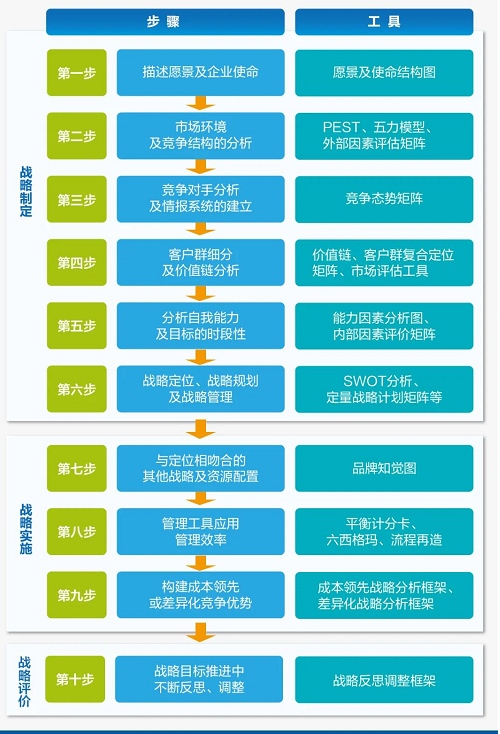
战略十步法讲的是如何制定战略,如图2所示。理解它并从逻辑上弄通,就能逐步形成公司的战略定位。CXO UNION-CXO联盟cxounion.cn
中国中化在战略十步法的基础上经过战略研讨,提出包含企业公民、客户导向、股东取向、员工发展在内的价值管理四要素理论,如图3所示。这是中国中化企业价值创造的坐标体系,也是对标管理坐标体系四要素。
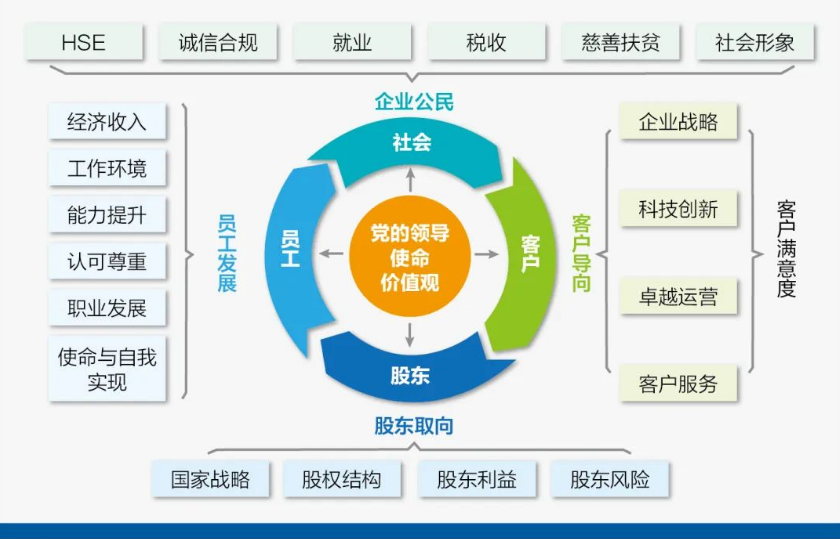
这个坐标体系的中心是出发点,包括党的领导、使命和价值观。
第一个要素是企业公民,包含HSE(职业健康、安全和环境),还有诚信合规、就业、税收、慈善扶贫、社会形象(即社会责任)。
第二个要素是客户导向,包括企业战略、科技创新、卓越运营、客户服务,最终达到的目标是客户群体满意,即客户满意度。
第三个要素是股东取向,包括国家战略、股权结构、股东利益、股东风险。对于国有企业,股东好也就是国家好。
第四个要素是员工发展,包括经济收入、工作环境、能力提升、认可尊重、职业发展、使命与自我实现。员工完全将企业利益和自身利益联系在一起,就达到了企业与员工关系的最高境界。
四、经理人标准及素质要求
企业还有个难题,就是什么样的人是优秀的经理人,这是全世界范围内的难题。很多人去通用电气学习,我去学习的时候还是韦尔奇时代,韦尔奇讲4E,Energy(活力)、Energize(激励)、Edge(胆识和决断)、Execute(执行力),这4E是通用电气对经理人的评价。
后来换了伊梅尔特,伊梅尔特把4E换成了专业、学习、创新和尊重人,重新解释了对经理人评价的要求和理解。当然他把通用电气的战略也转变了,把过去并购甚至金融为主的业务,转变成了需要更多的工程师,不需要更多的会计师。CXO UNION-CXO联盟cxounion.cn
伊梅尔特做了16年就被换掉了,外界认为伊梅尔特没有跟上数字化、互联网经济时代,虽然他一直非常努力。
对企业内部来说,评价一个经理人的标准很多,包括学习、激情、团队、创新、敬业、廉洁,每个人都会说出不同的内容。CXO UNION-CXO联盟cxounion.cn
我认为标准有两个作用:
第一,选人时有一定依据。每个标准都可以打分,比如是否诚信、是否有担当,从1分到10分,如果大家都有这个看法,就有一定的准确性。
第二,如果不断推动这些标准,让大家觉得这个标准是企业追求的、是企业推崇的,那么大部分人就会去效仿、学习,标准慢慢就会起到作用。
我认为经理人70%是天生的,30%是培养出来的。只有经理人的性格特点里有这些特质,才能被培养出来。所以,当所有理念性、政策性、宏观性的东西都具备了以后,对经理人的判断就变成了最难、风险最大、收益也最大的事情。CXO UNION-CXO联盟cxounion.cn
标准可以分为思想素质标准和工作能力标准,这方面的内容可以罗列得非常多,企业要有意识地不断修正、完善、使用、推动标准,这和执行战略密切相关。

翻译:
Management methods such as five-step combination theory and strategic ten-step method are not written out, but made in practice.
Although there is no universal and uniform method for enterprise management, there are certain rules, and the rules are the principles to be followed after we have sorted out a variety of methods. Compared with other disciplines, business management became a specialized discipline late, and in different social culture and economic environment, business management principles have different changes.
I have worked for many enterprises, through the practice of constantly exploring laws and methods, to form a consensus to guide the development of enterprises, thus have the five-step combination theory, 6S management, strategic ten-step method, four elements of value management, manager standards and other working methods.
These concepts and methods have been widely used, and in the process of practice constantly revised and improved, experienced the test of the market and time, is relatively successful, which is its precious place.CXO UNION-CXO联盟cxounion.cn
One, five steps combined theory
The enterprise is an organic organism, and there are close links between each of its local functions, but we tend to regard them as isolated and divided.
Some of you have done an MBA, which usually has ten or twenty subjects that seem rich, but there is very little connection between these subjects. The MBA curriculum does not explain how enterprises do in practice, what is the relationship between finance and people, what is the relationship between human resources and strategy, what is the relationship between strategy and evaluation, and what is the connection between the selection of managers and strategy.
The five-step combination theory is the logical relationship between the various links and elements of internal management, which not only makes each link and element of enterprise management clear, but also makes the logical relationship between them clear, as shown in Figure 1.CXO UNION-CXO联盟cxounion.cn
Most enterprises have problems, in the process of solving the problem will produce a lot of new contradictions, we often use another compromise to solve the previous contradictions. For example, to solve technical problems in a joint venture with others, only to find that management and control of the company were sacrificed because of the introduction of technology. Therefore, we can not only look at the problem locally, we must arrange the problem and solve it systematically, and use the five-step combination theory to connect the internal logical relations.
Step one: Choose a manager
The first step in a new enterprise that separates ownership and management should be to select managers, and the most important thing is to select managers in a scientific way. For there to be open and workable criteria, the managers chosen must be those who can lead the company to progress. The manager must clearly state the reasons for the promotion and provide clear guidance to the employee, rather than just issuing an appointment paper.CXO UNION-CXO联盟cxounion.cn
The five-step combination theory is more applicable to state-owned enterprises and family enterprises, because the ownership form determines who will be the CEO, and it also relates to the governance structure (such as the board of directors, the board of supervisors, etc.). Whether the governance structure of public or private ownership, the ultimate implementation is to choose a suitable CEO. If the CEO gets it wrong, nothing else works; If the CEO picks the right one, most of the problems will be solved.
In the process of selecting a CEO, the orientation of shareholders is prone to problems, such as impartiality and wrong value orientation. Shareholders may want to choose someone who is mediocre but good for shareholders, and performance is secondary. But the CEO is really important, and the decisions of the company in the future are closely related to the CEO.CXO UNION-CXO联盟cxounion.cn
Choosing a CEO is the first step, and the beginning of any business, no matter how big or small, must first determine who is in charge and what the potential criteria for that person are. If the company is not performing well, a meeting to re-elect the CEO may only take three minutes, but the risk to the future development of the company is great.
Step two: Build a team
When managers take office, they face the task of building a team, which is a serious test. The CEO of a large company has enough power to hold the company together through personal will. In the process of constant supervision and continuous correction, can the manager give the manager enough power to employ, build a team and lead the team?CXO UNION-CXO联盟cxounion.cn
Building a team tests a manager’s ability. Like democracy or centralization? How is the organizational structure set up? How to evaluate and motivate employees? How is the internal control carried out? These include cultural mechanisms, career design, training, and communication. All of this is done with the goal of building a positive, innovative team, and the manager putting each person in the right place for their characteristics so that the team can grow.
As a manager, leadership is very important. Can leadership be trained? As an individual, it is difficult for people to change, but as a member of an organization, it is easy to change, because people are environmental animals and have a strong ability to adapt to the environment, so leadership can be trained and cultivated. But to be an excellent manager, the biggest difficulty is “all good”, to balance, to have a comprehensive comprehensive quality.
Managers should focus on key points, grasp major events, and have an overall view of driving the transformation of the company.
Do the ten most important things every year, do things that can affect the organizational structure, affect the team, affect the financial statements, affect the strategic direction, and play the role of the team. Managers should dare to take responsibility for their team members, so that the team can constantly move forward.
It is also critical that the team is resilient. Not everything is fair to the team at all times, so resilience, perseverance, and the ability to withstand setbacks are also basic requirements for managers.CXO UNION-CXO联盟cxounion.cn
A good manager is a resource organizer who can organize all resources inside and outside the group with a clear goal. Mobilizing every employee so that they can work in the best possible environment is a basic quality that managers need to possess.
A good manager should raise the standards for himself and his team, constantly reflect on himself, criticize himself and sum up experience. To be honest, to be direct, to have a spiritual contract, so that employees have expectations of managers.
There are many criteria to evaluate managers, but the core of a good manager must have is: responsibility, sense of mission, passion, learning ability, team spirit, integrity. Managers must shape themselves to a high standard, from ability to mentality, or they will not progress.CXO UNION-CXO联盟cxounion.cn
The third step is development strategy
Strategy is team-based and should be discussed under the tacit understanding and unity of purpose of the team. Only when the mission and goals are aligned can we discuss how to implement the strategy. Many companies ask consulting agencies to provide strategic consulting on industry selection and competition mode selection, and CoFCO has also asked McKinsey to do strategic consulting.
McKinsey’s consulting report has five thick copies, but McKinsey is not responsible for the follow-up supervision and implementation of the plan, and CoFCO has not systematically implemented according to the consulting report, only doing some things that can be easily implemented. The strategy should not be done in pieces, but should be promoted in a holistic and systematic way.
The fourth step is to form market competitiveness
After the strategy is completed, it is a matter of execution and management, including product technology, cost, price, market, brand, talent, finance, capital and so on. If the first few factors are not present, the latter is simply not true. On the basis of a clear strategy, every level of operations must be truly competitive. Much of the MBA program focuses on how to improve business skills. To do business, we must look at the trend, set a strategy, and make good use of the first-mover advantage, which may be able to do it all at once, but it is more difficult for the latecomers.CXO UNION-CXO联盟cxounion.cn
The fifth step is value creation and evaluation
The selection of managers, the formation of teams, the development of strategies, the formation of market competitiveness, the above four steps ultimately do not do well, there must be an evaluation. The process of evaluation is value creation. For example, the evaluation of profits, shareholder value, employee value, customers, the public, the government, banks, customers and suppliers, media, etc., a wide range of evaluation systems and different evaluation angles make enterprises face enormous pressure from various aspects and face the risk of constantly changing managers.CXO UNION-CXO联盟cxounion.cn
The concept of “value creation”, translated from English, is a commonly used concept in investment banking. Investment banks always ask whether this is value creation before making any decisions and recommendations. For example, when a company newly acquires a brewery, the company wants to make profits first, and some costs can be saved.
Investment banks do not recommend this, which will reduce the value of the enterprise. There are different levels of value, the lowest level is profit, and above that there are intangible values, such as cultural value, brand value, and capital market value.
For example
the commercial property of CoFCO Real Estate is a new business, that is, value creation, and its business model will have high growth expectations along with market development, even if its value is not immediately reflected in the numbers, but it has exceeded the simple current profit. Therefore, growth expectation can also be a dimension of value evaluation.CXO UNION-CXO联盟cxounion.cn
The investment orientation of shareholders is one of the important dimensions. If the investment orientation of shareholders is to hope for short-term profits, ignoring long-term value, it may disrupt the process of system management. Focusing on value creation helps us view and evaluate our business in the long term.
Brand value is also an important dimension of value evaluation. When China Resources’ distilled water business, “Ebon”, was not listed before, the capital markets were not optimistic. However, after the full integration of China Resources beverage business and Kirin, the distilled water business was valued at more than 6 billion yuan, and the market thoroughly recognized the brand value of “Ebon” and the value of the “Ebon” management team was also realized.CXO UNION-CXO联盟cxounion.cn
In the five-step combinatorial cycle, each factor needs to be addressed by the manager. It can be seen that the manager is faced with a very complex matrix, but also shoulder important responsibilities. I hope that after the whole strategy is formulated, the ability of the team can be improved together.
Second, 6S management system
China Resources, CoFCO, Sinochem and other enterprises are promoting the decomposition of 6S management system. How to manage the enterprise in the process of enterprise operation, you can see the relationship between people and things.
First, strategic unit management system (BU, business division). On the one hand, the strategic unit itself has the industry strategy; On the other hand, the strategic unit management system has the understanding and drive of strategy.
Second, a comprehensive budget system (operational, market). In the past, budgeting was a matter for the finance department, but now it is not, and some enterprises even only do work plans without budgeting, and no longer work out the number of what to do next year, what products to sell, and how much market they occupy, because this number is basically meaningless. The comprehensive budget system is really getting the business straight.CXO UNION-CXO联盟cxounion.cn
6S management system
Third, management reporting system (current period, main business, real). In the past, there were financial statements, but financial statements could not be managed, because financial statements combined historical non-cash and accounting processing things, which was difficult to evaluate. The management reporting system, excluding history and accounting principles, evaluates the current competitiveness of the main business. This way the team’s responsibilities are clear and easy to evaluate.CXO UNION-CXO联盟cxounion.cn
Fourth, audit system (internal operation compliance construction). The audit system is internal audit, mainly based on compliance audit. For example, to lend money to others, loans, the sale of goods did not recover the money, these accountants are not audited, but from the perspective of enterprises, need to consider how this business should be lent, how to determine the highest debt ratio.
Fifth, business evaluation system (benchmarking, market, history). The evaluation of the business used to rely on the budget, for example, to earn 100 million yuan in a year, to earn 120 million yuan at the end of the year, you need to praise, if you only earn 80 million yuan, you need to criticize, so the budget has become a bargaining system. The so-called benchmark, competitors, market, history evaluation, budget evaluation accounts for only 10% to 15%, if the budget is reached, can only get 15 points, there are 85 points? It must be evaluated according to benchmarks, markets, and history.CXO UNION-CXO联盟cxounion.cn
6S management system
Sixth, management team and manager evaluation system (team, innovation, potential). The most difficult thing for enterprises is that strategic investments go through a long period of time, which may take three or five years or even longer to cultivate. It’s the most important thing, it’s the hardest thing, it’s the thing that nobody wants to do, but it should be done by the best managers.
Otherwise, the company made a profit in one year. But the manager left, and the related business also decreased; Change the leadership, the enterprise can not survive; The company made money from a few transactional deals, but did not have the strategic basis to be pulled onto a growth trajectory.CXO UNION-CXO联盟cxounion.cn
So how to evaluate the team manager is a difficult point, can make money is not necessarily a good manager, do not make money is not necessarily a bad manager. This involves the evaluation of the development stage, innovation and potential of the enterprise.CXO UNION-CXO联盟cxounion.cn
When these six points are connected together, the operation begins. And it is evaluated every year by breaking down the investment and business operation process. For example, the system of Sinochem Group is becoming an automatic turnover operation, self-improvement, self-renewal and self-promotion system every year.
Three, ten steps of strategy and four elements of value management
The strategy ten-step method is how to develop strategy, as shown in Figure 2. Understand it and logically understand it, you can gradually form the strategic positioning of the company.
Based on the strategic ten-step approach, Sinochem proposed a four-element theory of value management. Including corporate citizenship, customer orientation, shareholder orientation and employee development, as shown in Figure 3. This is the coordinate system of value creation of China’s Sinochem enterprises. And also the four elements of the coordinate system of benchmarking management.CXO UNION-CXO联盟cxounion.cn
At the center of this coordinate system is the starting point, including the party’s leadership, mission, and values.
The first element is corporate citizenship, which includes HSE (Occupational health, safety and environment), integrity and compliance, employment, taxation, charity and poverty alleviation. And social image (i.e., social responsibility).
The second element is customer orientation. Including enterprise strategy, scientific and technological innovation, operational excellence, customer service. And the ultimate goal is customer satisfaction, that is, customer satisfaction.
The third element is shareholder orientation, including national strategy, ownership structure, shareholder interest and shareholder risk. For state-owned enterprises, good for shareholders means good for the country.CXO UNION-CXO联盟cxounion.cn
The fourth element is employee development, including financial income, working environment, competence enhancement, recognition and respect, career development, mission and self-actualization. Employees completely connect the interests of the enterprise with their own interests. Which reaches the highest state of the relationship between enterprises and employees.
Manager standards and quality requirements
There is also the problem of what makes a good manager, which is a problem all over the world. A lot of people went to GE to study, I went to study in the Welch era, Welch talked about the four E’s, Energy, Energize, Edge, Execute, the four E’s are GE’s evaluation of managers.CXO UNION-CXO联盟cxounion.cn
Then came Immelt, who replaced the four Es with professionalism, learning, innovation and respect. And reinterpreted the requirements and understanding of manager evaluation. He certainly changed GE’s strategy from a business that used to be dominated by mergers and acquisitions. And even finance, to one that needed more engineers, not more accountants.
Immelt, who was replaced after 16 years, was seen as having failed to keep up with the digital, Internet economy, despite his efforts.CXO UNION-CXO联盟cxounion.cn
Internally, there are many criteria to evaluate a manager. Including learning, passion, team, innovation, dedication, integrity. And everyone will say different things.CXO UNION-CXO联盟cxounion.cn
I think standards do two things:
First, there is a basis for selecting candidates. Each criterion can be scored, such as whether it is honest, whether it is responsible. From 1 to 10 points, if everyone has this opinion, there is a certain accuracy.CXO UNION-CXO联盟cxounion.cn
Second, if you continue to promote these standards. Let everyone feel that this standard is the pursuit of the enterprise, is the enterprise respected. Then most people will follow, learn, the standard will slowly play a role.
I think managers are 70% born and 30% made. These qualities can only be cultivated if they are in the character of the manager. Therefore, when all the conceptual, policy, macro things are in place. The judgment of managers becomes the most difficult, the most risky, and the most profitable thing.
Standards can be divided into ideological quality standards and work ability standards. The content of this can be listed very much, enterprises must consciously and constantly revise, improve, use, promote standards. Which is closely related to the implementation of strategy.CXO UNION-CXO联盟cxounion.cn
本文由CXO UNION-CXO联盟(cxounion.cn)转载而成,来源于企业管理杂志,作者:宁高宁;编辑/翻译:CXO UNIONCXO联盟小宁檬。
如需加入CXO UNION(CXO联盟)高管社群,请联系社群小伙伴哦~
免责声明: 本网站(http://www.cxounion.cn/)内容主要来自原创、合作媒体供稿和第三方投稿,凡在本网站出现的信息,均仅供参考。本网站将尽力确保所提供信息的准确性及可靠性,但不保证有关资料的准确性及可靠性,读者在使用前请进一步核实,并对任何自主决定的行为负责。本网站对有关资料所引致的错误、不确或遗漏,概不负任何法律责任。
本网站刊载的所有内容(包括但不仅限文字、图片、LOGO、音频、视频、软件、程序等) 版权归原作者所有。任何单位或个人认为本网站中的内容可能涉嫌侵犯其知识产权或存在不实内容时,请及时通知本站,予以删除。
如需加入CXO UNION(CXO联盟)高管社群,请联系社群小伙伴哦~

免责声明: 本网站(http://www.cxounion.cn/)内容主要来自原创、合作媒体供稿和第三方投稿,凡在本网站出现的信息,均仅供参考。本网站将尽力确保所提供信息的准确性及可靠性,但不保证有关资料的准确性及可靠性,读者在使用前请进一步核实,并对任何自主决定的行为负责。本网站对有关资料所引致的错误、不确或遗漏,概不负任何法律责任。
本网站刊载的所有内容(包括但不仅限文字、图片、LOGO、音频、视频、软件、程序等) 版权归原作者所有。任何单位或个人认为本网站中的内容可能涉嫌侵犯其知识产权或存在不实内容时,请及时通知本站,予以删除。
Search
Popular Posts
-

2024数字化灯塔案例评选申报开启!
“2024数字化灯塔案例评选”于3月正式启动,诚挚欢迎业界同仁自荐和推荐,一起推动产业数字化进程,助力赋能企业…
-

2024 X-Award星盘奖申报通道已开启!
X-Award星盘奖是数字化转型服务、IT服务行业重要的商业奖项,旨在表彰行业里提供杰出数字化转型服务与IT服…
-

2024 N-Award星云奖申报通道已开启!
N-Award是数字化转型领域重要的商业奖项,旨在表彰那些以非凡的远见、超群的领导才能和卓越的成就来激励他人的…