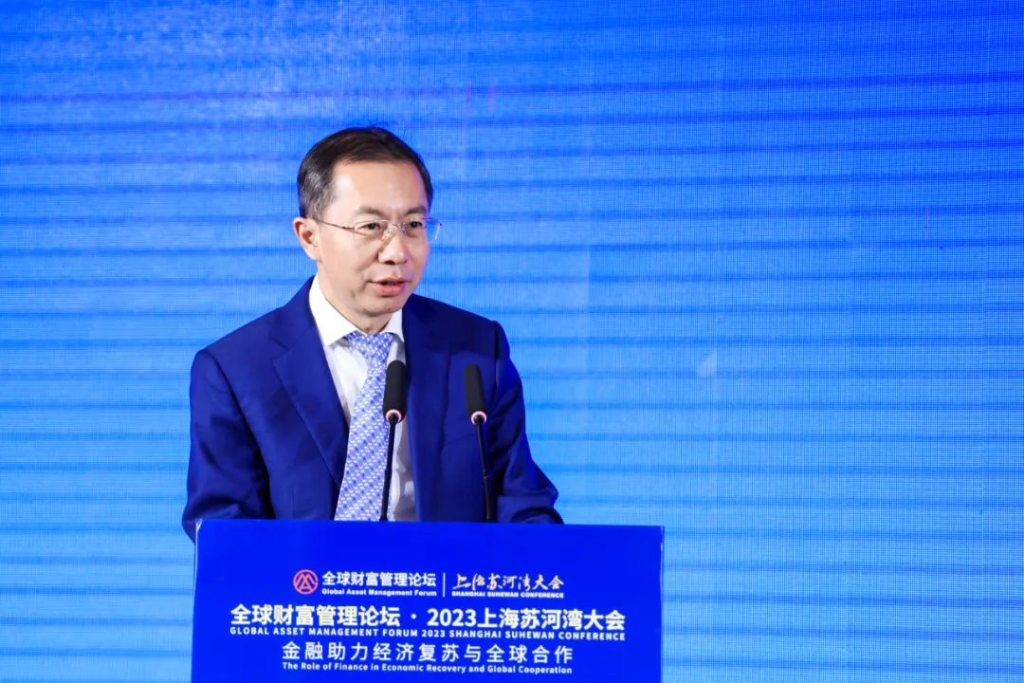
华泰保险集团首席投资官、华泰资产总经理杨平在全球财富管理论坛•2023的主题论坛“全球经济形势展望与投资未来”上发表主题演讲。
杨平表示,当前全球经济增长仍然缓慢且不平衡,美国经济维持温和增长,巴以冲突增加了未来大宗商品和金融市场的不确定性,全球金融市场风险加剧。他指出,全球资管行业面临新的发展趋势,国内养老金市场仍有较大发展空间,ESG仍是长期增长点,房地产收缩周期中另类资产投资往往借势发展壮大,全球资管行业α与β分化格局仍在深化,指数基金继续崛起,主动基金表现不佳。他认为,中国经济已初步企稳反弹,中国金融市场仍具有较大投资机会,未来的发展主要侧重于人工智能、“新三样”、大消费、新能源等热点问题,把握人才红利以及城投债化债机遇。
我本次发言的主题是“步履蹒跚的全球经济以及中国的投资前景”。今天我报告的内容分为四个部分,我将侧重分享前瞻性的内容。
第一部分,全球经济倾向性。
前面讨论中,嘉宾们已经详细阐述了全球经济的情况,结论是全球经济的增长仍然缓慢而且不平衡,预计未来几年将是一个长期的修复过程。国际货币基金组织(IMF)和其它机构的预测表明全球经济增速放缓。此外,全球贸易的增长也在放缓,其特征在于具有广泛基础,涉及多个国家和多种商品,而通胀和商品价格波动也会对区域贸易量发展产生重大影响。
关于美国经济,普遍认为在前三季度高通胀和货币紧缩的背景下,经济仍维持温和增长。然而,四季度美国经济向好迹象与风险因素交织,美联储大概率将结束本轮紧缩周期。与此同时,通胀仍存韧性成为一个共识。
近期,巴以冲突增加了未来大宗商品和金融市场的不确定性。当前油价的反应相对温和,涨幅未超过双位数,与以前的巴以冲突或两个教派冲突的情况有所不同。此次影响相对有限,风暴扩散的概率不高。然而,当前全球金融市场具有不确定性,此次冲突叠加新冠疫情的尾声以及俄乌战争等因素,将对相关的金融市场产生一定的外溢和冲击。
全球金融市场风险加剧。股票市场方面,受到高利率和美国债务上限的影响,全球股市受到不同程度的冲击,不同国家和地区的表现各有差异。美债作为全球安全资产,利率维持高位,或对全球金融资产产生风险外溢和冲击。
第二部分,全球资管行业面临一些新的发展趋势。
第一,老龄化问题普遍存在,发达经济体已构建较为成熟的养老金三支柱体系,国内养老金市场仍有较大发展空间。中国近年来明显进入老龄化的阶段,现在包括日本在内等诸多发达国家先后进入老龄化社会。在此背景下,全球范围内的养老金三支柱体系变得越来越重要。尽管在五年或十年前,西方国家对此更为重视,但现在中国也在逐步加强对养老金体系的重视。根据前年年末数据,美国、欧洲和日本的资管规模中约有50%来自养老金。预计未来5-10年,中国将面临8~10万亿养老金的缺口,这是资本市场长期资金流入情况下的预计规模。
第二,ESG依然是长期的增长点。
第三,房地产收缩周期中,另类资产投资往往借势发展壮大。
第四,全球资管行业 α 与 β 分化格局仍在深化,指数基金继续崛起,主动基金表现不佳。被动型基金除了费率低外,还有一个明显的特点,即底层资产非常透明,不会因为更换基金经理和风格而产生变动。被动指数型基金的性价比越来越高,这种投资的方式也驶入发展的快车道,体现为从宽基指数逐渐细分到行业和主题策略指数等。
第三部分,中国经济已初步企稳反弹。
最新公布的经济数据显示,中国生产端和需求端均出现明显的边际改善,经济恢复的信号不断增多。例如,生产端方面,9月工业增加值在增长;需求端方面,前九个月的固定资产投资也在增长。三季度数据中的最大亮点是消费,社会消费品零售总额增长5.5%,远超市场预期和七八月的表现,连续三个月出口出现明显改善。物价方面,今年对通缩的担忧或会稍有缓解。城镇调查失业率开始止跌,工业利润增长和PMI等一系列的数据已经表现出中国经济企稳。
第四部分,中国金融市场仍具有较大投资机会。
第一,前三季度中国金融市场一波三折。今年中国三大资产市场的表现均不够理想,股市完全无视基本面的改善和政策面的支持,主要的指数不断走低,凸显了中国经济面临的复杂情形和诸多困难挑战。汇市今年以来持续走软,人民币相对于美元呈现弱势,跌破了7.3,体现境内外投资者对人民币资产的信心较以往不足。房地产问题也比较严重,虽然9月房地产销售较8月的低迷有了明显的改善,但是仍然不能表明房地产已经走出了困境,目前房地产还处于增长期。
第二,未来宏观经济政策仍有较大扩张空间。中国各个重要指标都体现出中国经济三季度出现了明显的回暖,这与7月底中央政治局会议调整的相关政策有密切关联,已经出台的扩张性经济政策提供了巨大的政策支撑作用。同时,目前中国的通胀处于历史的低位,中央政府的杠杆率明显低于国际的水平,目前政府在加杠杆方面还较为审慎,这为政策应对超预期挑战和变化留有较为充足的空间。
第三,未来中国金融市场仍具有较大投资机会。本世纪初加入WTO之后,中国享受了多年的全球化红利,一是外需带动中国经济明显增长,二是房地产驱动中国经济在20年内高速增长。中国经济正进入到一个全新的发展阶段,高质量发展已经成为全社会和全市场的基本共识。中国金融市场正逐步从传统的“房地产驱动”和“外需驱动”,日益向“科技创新驱动”和“消费升级驱动”转变,这也为资管行业提供了较大的投资机会。2023年9月,习近平总书记在黑龙江考察调研期间,提到一个非常重要的新词汇——“新质生产力”。“新质生产力”的最新提法及其相应的投资机会值得市场密切关注。未来中国产业发展的重点和机遇都非常明确,即战略性新兴产业和未来产业。
关于未来的发展,主要侧重以下六个方面:
一是数智时代的科技创新和产业升级发展的空间辽阔,人工智能、数字经济、半导体等板块今年表现比较突出。
二是“新三样”(电动载人汽车、锂电池、太阳能电池)逐渐取代以前的“老三样”(服装、家具、家电)在外贸中的地位,“新三样”出口持续增长,成为推动我国外贸提质升级的新动能。
三是大消费成为双循环的重要支撑,消费群体方面与以往区别较大,未来消费最突出的亮点是三大人群:“Z世代”(出生在1995年之后的年轻人)、“新中产”和“银发族”。
四是碳达标和碳中和领域有巨大的投资机遇,市场已经关注了很长时间。
五是从人口红利到人才红利的人口转型是由量到质的飞跃。虽然我国人口的增速在放缓,老年化进度在加快,但是人均的消费能力不一定会下降,这些变化及市场特点都为中国的资产管理行业带来较多的想象空间和投资机遇。
六是把握化债方案落地带来的城投债机遇。

翻译:
Yang Ping, Chief investment officer of Huatai Insurance Group: Where are the investment prospects in China?
Yang Ping, Chief Investment Officer of Huatai Insurance Group and General Manager of Huatai Assets, delivered a keynote speech at the theme forum “Global Economic Outlook and Investment Future” of the Global Wealth Management Forum 2023.
Yang Ping said that the current global economic growth is still slow and unbalanced, the US economy maintains moderate growth, the Palestinian-Israeli conflict has increased the uncertainty of the future commodity and financial markets, and the risk of the global financial market has intensified. He pointed out that the global asset management industry is facing new development trends, the domestic pension market still has a large space for development, ESG is still a long-term growth point, alternative asset investment often takes advantage of the real estate contraction cycle to develop and grow, the global asset management industry α and β differentiation pattern is still deepening, index funds continue to rise, active funds poor performance.
He believes that China’s economy has initially stabilized and rebounded, China’s financial market still has a large investment opportunity, the future development mainly focuses on artificial intelligence, “new three things”, large consumption, new energy and other hot issues, to grasp the talent dividend and urban investment debt opportunities.
The topic of my speech is “The faltering Global Economy and China’s investment Prospects.” My report today is divided into four parts, and I will focus on sharing forward-looking content.
The first part, global economic tendency.
In the previous discussion, panelists have elaborated on the state of the global economy, concluding that global growth remains slow and uneven, and the next few years are expected to be a long repair process. Forecasts from the International Monetary Fund and others point to a slowdown in global growth. In addition, the growth of global trade is also slowing, which is characterized by its broad-based nature, involving multiple countries and commodities, while inflation and commodity price fluctuations can also have a significant impact on regional trade volume developments.
Regarding the US economy, it is generally believed that the economy maintained moderate growth in the context of high inflation and monetary tightening in the first three quarters. However, the fourth quarter of the United States economic signs and risk factors interwoven, the Federal Reserve is likely to end the current tightening cycle. At the same time, there is a consensus that inflation remains resilient.
In the near term, the Israeli-Palestinian conflict has increased uncertainty about the future of commodity and financial markets.
The current oil price reaction has been relatively modest, with no double-digit increase, unlike previous episodes of Israeli-Palestinian or sectarian conflict. The impact is relatively limited, and the probability of the storm spreading is not high. However, the current global financial market is uncertain, and the conflict combined with the end of the novel coronavirus epidemic and the Russia-Ukraine war and other factors will have a certain spillover and impact on the relevant financial markets.
Risks in global financial markets have intensified. In the stock market, affected by high interest rates and the US debt ceiling. The global stock market has been affected by different degrees, and the performance of different countries and regions has been different. As a safe asset in the world, the interest rate of US Treasuries remains high, or risk spillover and impact on global financial assets.
In the second part, the global asset management industry is facing some new development trends.
First, the problem of aging is widespread, developed economies have established a relatively mature three-pillar pension system. And the domestic pension market still has a large room for development. In recent years, China has obviously entered the stage of aging. And now many developed countries including Japan have entered the aging society. In this context, the three-pillar pension system is becoming increasingly important worldwide. Although five or ten years ago, Western countries took this more seriously. China is now gradually increasing its attention to the pension system. According to data at the end of last year, about 50% of assets under management in the United States, Europe and Japan came from pensions. It is estimated that in the next 5-10 years, China will face a pension gap of 8 to 10 trillion yuan, which is the expected scale in the case of long-term capital inflows from the capital market.
Second, ESG remains a long-term growth area.
Third, in the real estate contraction cycle, alternative asset investment often takes advantage of the momentum to grow.
Fourth, the global asset management industry α and β differentiation pattern is still deepening, index funds continue to rise, active funds poor performance. In addition to low fees, passive funds also have an obvious feature, that is. The underlying assets are very transparent, and will not change because of the change of fund managers and styles. The cost performance of passive index funds is getting higher and higher. And this investment method has also entered the fast lane of development, which is reflected in the gradual subdivision from the broad base index to the industry and theme strategy index.
The third part is that China’s economy has initially stabilized and rebounded.
The latest economic data show that China’s production side and demand side have shown obvious marginal improvement. And the signal of economic recovery is increasing. For example, on the production side, industrial production increased in September. On the demand side, fixed-asset investment also rose in the first nine months. The biggest bright spot in the third quarter data is consumption, with retail sales of consumer goods up 5.5%, far exceeding market expectations and the performance of July and August, and exports have improved significantly for three consecutive months. On the price front, fears of deflation may ease a bit this year. The surveyed urban unemployment rate has started to stop falling, and a series of data such as industrial profit growth and PMI have indicated that China’s economy is stabilizing.
The fourth part, China’s financial market still has great investment opportunities.
First, the first three quarters of China’s financial market twists and turns.
、The performance of China’s three major asset markets this year is not ideal. The stock market has completely ignored the improvement of fundamentals and policy support. And the main index has been falling, highlighting the complex situation and many difficult challenges facing the Chinese economy. Since the beginning of this year, the foreign exchange market has continued to weaken. And the renminbi has weakened against the US dollar, falling below 7.3, reflecting that domestic and foreign investors have less confidence in renminbi assets than before. The real estate problem is also relatively serious. Although the real estate sales in September have improved significantly compared with the downturn in August. It still does not show that the real estate has gone out of the dilemma. And the real estate is still in the growth period.
Second, there is still considerable room for expansion of macroeconomic policies in the future.
All important indicators in China show that the Chinese economy has picked up significantly in the third quarter. Which is closely related to the relevant policies adjusted by the Political Bureau meeting of the Central Committee at the end of July. And the expansionary economic policies that have been introduced have provided huge policy support. At the same time, China’s inflation is at a historically low level. The central government’s leverage ratio is significantly lower than the international level. And the government is still relatively prudent in increasing leverage, which leaves ample room for policies to respond to challenges and changes that exceed expectations.
Third, China’s financial market still has large investment opportunities in the future.
After China joined the WTO at the beginning of this century, China has enjoyed many years of globalization dividends. First, external demand has driven China’s economic growth, and second, real estate has driven China’s economic growth in 20 years. China’s economy is entering a new stage of development, and high-quality development has become the basic consensus of the whole society and the whole market. China’s financial market is gradually shifting from the traditional “real estate driven” and “external demand-driven” to “scientific and technological innovation driven” and “consumption upgrading driven”, which also provides greater investment opportunities for the asset management industry. The latest formulation of “new quality productivity” and its corresponding investment opportunities deserve close attention from the market. The focus and opportunities of China’s industrial development in the future are very clear, that is, strategic emerging industries and future industries.
As for the future development, we mainly focus on the following six aspects:
First, the space for scientific and technological innovation and industrial upgrading and development in the era of digital intelligence is vast. And the performance of artificial intelligence, digital economy, semiconductor and other sectors is more prominent this year.
Second, the “new three” (electric manned vehicles, lithium batteries, solar cells) gradually replaced the previous “old three” (clothing, furniture, home appliances) in foreign trade status, the “new three” exports continued to grow, becoming a new momentum to promote the quality of China’s foreign trade upgrading.
Third, large consumption has become an important support for the double cycle. Consumer groups are quite different from the past, and the most prominent highlight of future consumption is the three major groups: “Generation Z” (born after 1995 young people), “new middle class” and “silver”.
Fourth, there are huge investment opportunities in the area of carbon compliance and carbon neutrality, which the market has been paying attention to for a long time.
Fifth, the demographic transition from demographic dividend to talent dividend is a leap from quantity to quality. Although the growth rate of China’s population is slowing down and the progress of aging is accelerating. The per capita consumption power will not necessarily decline. These changes and market characteristics have brought more imagination space and investment opportunities for China’s asset management industry.
The sixth is to grasp the opportunity of urban investment bonds brought by the landing of the debt program.
本文由CXO UNION-CXO联盟(cxounion.cn)转载而成,来源于中国财富管理50人论坛;编辑/翻译:CXO UNIONCXO联盟小U。
如需加入CXO UNION(CXO联盟)高管社群,请联系社群小伙伴哦~
免责声明: 本网站(http://www.cxounion.cn/)内容主要来自原创、合作媒体供稿和第三方投稿,凡在本网站出现的信息,均仅供参考。本网站将尽力确保所提供信息的准确性及可靠性,但不保证有关资料的准确性及可靠性,读者在使用前请进一步核实,并对任何自主决定的行为负责。本网站对有关资料所引致的错误、不确或遗漏,概不负任何法律责任。
本网站刊载的所有内容(包括但不仅限文字、图片、LOGO、音频、视频、软件、程序等) 版权归原作者所有。任何单位或个人认为本网站中的内容可能涉嫌侵犯其知识产权或存在不实内容时,请及时通知本站,予以删除。
如需加入CXO UNION(CXO联盟)高管社群,请联系社群小伙伴哦~

免责声明: 本网站(http://www.cxounion.cn/)内容主要来自原创、合作媒体供稿和第三方投稿,凡在本网站出现的信息,均仅供参考。本网站将尽力确保所提供信息的准确性及可靠性,但不保证有关资料的准确性及可靠性,读者在使用前请进一步核实,并对任何自主决定的行为负责。本网站对有关资料所引致的错误、不确或遗漏,概不负任何法律责任。
本网站刊载的所有内容(包括但不仅限文字、图片、LOGO、音频、视频、软件、程序等) 版权归原作者所有。任何单位或个人认为本网站中的内容可能涉嫌侵犯其知识产权或存在不实内容时,请及时通知本站,予以删除。
Search
Popular Posts
-

2024数字化灯塔案例评选申报开启!
“2024数字化灯塔案例评选”于3月正式启动,诚挚欢迎业界同仁自荐和推荐,一起推动产业数字化进程,助力赋能企业…
-

2024 X-Award星盘奖申报通道已开启!
X-Award星盘奖是数字化转型服务、IT服务行业重要的商业奖项,旨在表彰行业里提供杰出数字化转型服务与IT服…
-

2024 N-Award星云奖申报通道已开启!
N-Award是数字化转型领域重要的商业奖项,旨在表彰那些以非凡的远见、超群的领导才能和卓越的成就来激励他人的…