管理体系是在解决自己实际的管理问题过程中逐渐建立起来的,而不应是一个完美体系的嫁接,一下子披在企业的身上,然后企业就先进了。
在一个过分强调管理、强调制度、强调流程的企业,我们往往会发现大伙儿整天忙碌着填表,开会,检查,开罚单,却很少有人关心经营面临什么问题,这时企业的员工是一群听话、压抑、谨小慎微的小绵羊,很难找到几只激发大家的能动性,团结起来去争夺市场的狼。
问题的产生,往往是在最上层的理念。在我的咨询实践中,我经常碰到一些成长中的中小企业提出需求——我需要一套先进的管理理念和管理体系,然后我的企业就在高起点,高水平了。
其实,管理体系是在解决自己实际的管理问题过程中逐渐建立起来的,而不应是一个完美体系的嫁接,一下子披在企业的身上,然后企业就先进了。 CXO UNION-CXO联盟(cxounion.cn)
外部管理咨询机构有价值,最重要的是要激发自己的管理团队不断自己解决问题,然后在解决问题的前进中,形成了自己的管理体系,这样不会产生排异现象,同时保证企业真正的成长。
为什么很多企业没有认识到,还经常发生 ” 管理过度 ” 的情况呢?
一个重要原因是我们的管理太发达,太多企业领导人听到企业发展靠管理,百年企业靠制度等管理概念和模型,舍本求末,以为有了这些制度,企业自然就会更好,却忘记创业初期的常识性真理——企业要赚钱,要激发员工去赚钱,要能长久的激发员工去赚钱。本文是夏惊鸣老师管理体系的三个方法,分享如下:
一、管理体系在推动经营的过程中逐步建设起来
企业很小的时候,根本不需要什么管理。 CXO UNION-CXO联盟(cxounion.cn)
企业大一点,部门多了,人也复杂了,共同争夺市场的场面逐渐衰退,各部门不知不觉地成了一个一个的孤岛,都认为自己的工作重要,都认为协同出现了问题是别的部门不配合。但市场不管是谁的问题,这个时候需要基于当时的问题,基于争夺市场,对职责、流程不断的优化。
企业再大一点,企业招聘的人越来越多,但内部慢慢出现了很多人在抱怨,都自认为自己被不公平对待,并诉说做多做少一样,能力好能力差一个样,但企业又没有依据判断,谁贡献的大,谁贡献的少。
这个时候企业要建立起 ” 格子 ” 和 ” 标准 “,即建立企业的 ” 价值秩序 ” ——组织、薪酬、评价体系。不同的层级,不同的岗位、不同的任职能力处在不同的格子上。然后通过评价体系,让大家可以在这个格子上上下移动,实现动态调整,形成竞争机制。
企业再发展会面临许多发展机会,发展很快,同时需要大量不同产业、不同专业、不同层次的人员,人员的涌进,进一步冲击原有脆弱的管理体系,内部出现了混乱,然后企业加强管理,制定制度,但更加混乱,内部思想林立,认为这样做是错,那样做是对,不同的人有不同的看法,甚至高层也有不同的看法,表面上团结无比,但是背后各有各的说词,各行其是。
这个时候需要重构价值秩序——组织、薪酬、评价;需要进行文化建设,形成共同纲领,让企业的管理团队在企业发展、组织建设、价值创造与价值分配、管理者责任与行为等方面的原则达成共识,为今后的管理再建设减少障碍;需要集中进行人才计划和梯队培育计划。
二、相关链接:等级—评价—竞争(分配)
1. 等级
等级是价值分配机制的价值区分。它包括职位等级、薪酬等级、人才梯队。为什么要有等级体系呢?因为我们首先需要有一个区分不同价值高度的 ” 梯子 “,不然,我们就不能区分不同的价值,就无法激发动力。
因此,等级体系是价值分配的基础。其中,梯队尤其重要,我曾总结,没有梯队,企业的管理机制就会失灵。因为如果没有梯队,假如你觉得一个人不行,很可能你也没有办法去处理,因为可能没有人能够做得比他更好,企业首先要活下去,首先要做业务,所以只有妥协,一方面心怀不满,另一方面,又可能无奈纵容,久而久之,组织还会形成博弈的氛围。这就是讲,没有梯队,你的考核机制、用人机制就会失灵了。
当然,我们培育梯队,不是为了换人,而是为了组织可以持续奋斗。对于梯队建设,很多企业存在不少误区。比如认为多设置一些副职或者助理岗位,就形成了人才梯队,就有了后备力量;在比如设置很多级别,认为这样就形成了职业通道。其实,梯队建设的关键不在于此,而是另外两个要素: CXO UNION-CXO联盟(cxounion.cn)
(1)增长。梯队是在增长的过程中形成的,增长带动梯队培养;
(2)评价。梯队的关键在于评价,而不在于有多少等级。绩效优秀的及时承认,及时激励,优先给予机会,绩效差劲的,及时处理,这自然就是梯队了。极端地说,一个企业哪怕只有两个等级,也可以形成上升通道,只要是 ” 能者上、庸者下 “,并不绝对需要有很多的级别来体现差别。
很多企业的员工没有激情,感觉没有前途,我们通常认为是因为缺乏职业发展通路,但更多的一个是企业的增长问题,员工看不清企业的前途;另一个也不是企业没有上升的等级通道,而是没有形成明确的优者上,庸者下的机制,让员工感觉,即使做得好,也可能没有前途,有通道但不通,评价、区分了,就形成了梯队!
2. 评价
有了不同价值等级的梯子和人才,如何区分呢?靠评价。但评价是个世界级的难题,我们在做评价的时候,经常会遇到两个现象: CXO UNION-CXO联盟(cxounion.cn)
(1)员工评价结果很卓越,都是 90 多分,但是企业业绩没怎么进步,或者讲很多问题都没有得到解决。
这个问题的关键在于——企业评价的不是企业所需要的。要做到评价的想要的,核心是要做目标管理,企业的经理人从上至下,要进行目标分解。企业要什么,要成功的话,有哪些关键领域,这些关键的领域现实存在什么问题,那么应该做什么,要做到什么程度,那么,考核什么,标准是什么。
评价不是坐在办公室里设计指标,关键是经理人员们好好讨论企业目标实现的路径是什么?这些路径中,现实是什么?存在哪些问题和差距,应该做什么。因此,我们经常看到我们做的很专业,看起来似乎都是正确的,但是,就是没有实现公司目标和解决问题,就在于,我们的管理做的很 ” 专业 “,制度、流程、表格都没有问题,但是表格的内容却是不需要的,就比如我们管理制度、流程专业的像高速公路,但我们上面跑的是马拉车。
评价之所以是一个世界级的难题,我认为真正的原因是需要所有的直线经理去做目标管理,要切切实实地去做目标管理,这才是评价的难点所在。这一点没有做好,必然出现考核的不是所需要的。
大家想想,做目标管理不是在讨论公司目标实现的路径和方法吗?做目标管理不是在进行在责任、任务的分配吗?做目标管理不是在沟通、协调吗?做目标管理不是在督导、指导和培养人吗?做目标管理不是在激发士气吗?
(2)如何衡量贡献
我们经常听到有的企业员工抱怨 ” 做多错多 “,有的人抱怨,评价不公平。那么,绩效评价如何衡量贡献呢?
首先要确立一个观念,我们不要追求评价的数量精确,而要追求评价的导向明确。
其次,衡量贡献的关键在于 ” 改进 “,只有改进才是真正的贡献,只有衡量改进,我们才能知道,评价分数高,是在推动进步!
最后,改进的关键在于 ” 对标 “。比如,你比过去进步,你比竞争对手的进步。假设,我们的企业要做成行业内的中国第一,那么就要对标行业里的中国第一,那么,我们的考核目标怎么定?那一定是要超越对表竞争对手,考核目标实现了,就是天下第一了,所以,天下第一,从这个角度讲,也是考核出来的。
3. 竞争
竞争通俗地说,就是优者上,庸者下。很多企业往往害怕冲突,执行不坚决,或流于形式,这个环节不执行,等级、评价都变成假的了,所以,一定要敢于落实 ” 优者上,庸者下 ” 的策略。
对于这个环节,很多企业害怕冲突,期望一个管理技术或管理系统来解决,这个不可能,必须要有魄力来执行,只有靠人 ” 认真 “、” 坚持 ” 才能解决这个问题,而不是所谓的管理技术。企业真正的核心能力是什么?就是 ” 认真、坚持、必达目标 “。为什么说这三个词是核心能力,是因为绝大多数企业都做不到。想想当年华为有什么?要技术没技术,要资本没资本,就靠这三个词。 CXO UNION-CXO联盟(cxounion.cn)
三、管理建设依附于管理体系
企业的管理建设,实质是要建管理体系建设出来,制度自然就依附在管理体系上。因为只有建立在以实现战略为目标的管理体系,我们设计的制度才有方向,不然有可能变成为了制度而制度,制度很美,但是经营的活力和员工的活力低迷,一个压抑经营者和员工活力和创造力的组织,是很难培养出卓越的领军人物的。
管理体系是什么呢?首先企业的战略是对整个组织所有经营管理活动的牵引:企业要做到什么程度,企业的业务定位、企业如何达成战略目标的路径、企业应该构建壁垒的关键领域和任务,企业要形成什么样的能力。这决定我们每各业务单元和部门的工作目标、重点和任务,从而具体化为各单元、各部门的目标、计划和预算,这是规划和计划层面。规划和计划确定之后,关键在于需要人去行动,这就是干部员工梯队。
如何管理行动?行动的效果又如何?这就要业绩管理体系。
如何保证有足够的人力资源、各部门员工各司其职又整体协同,各级员工有足够的动力去实践战略呢?这就是组织与人力机制。 CXO UNION-CXO联盟(cxounion.cn)
在实践公司战略的过程中,如何保证各级员工行进在公司期望的轨道上呢?这就是管控机制。
如何保障各级员工统一于争夺市场,高效、有序的运转呢?这就是运营体系。
在实践战略的过程中,我们期望员工坚持什么样的信念、立场和原则呢?这就是公司的文化纲领。
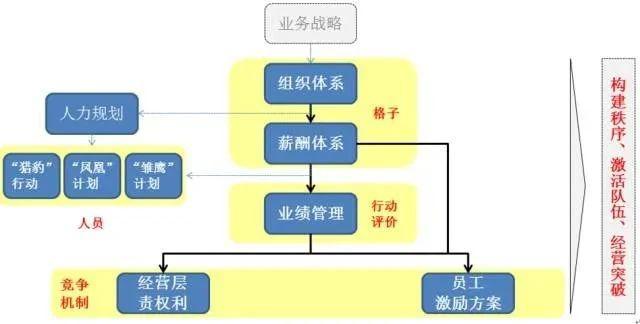
只有以实践战略为目的,构建管理体系,才知道我们这些管理方案的目的。在此基础上形成相关的制度,才不至于我们的制度是一些完美的布片叠着另一条完美的布片,但就像补丁打补丁一样,至于能否激发大家去创造价值,实现战略就不得而知。
按此思路,在一个跳跃式发展的企业如果现在需要进行管理建设,应该怎么做呢?基于解决企业的现实问题,即基于企业的战略落地,如果易制度代替管理,问题无法解决,而且企业会陷入活力的困境,就会变成领军人物的盐碱地,不仅仅是培育不出来的问题,而且招募进来后,也很难存活。
四、管理建设表率胜过一切
管理不仅仅是流程、制度、机制等,更重要的是管理者的领导。企业小的时候,有什么制度、流程和机制么?都是企业家的领导——要达到什么目标,如何达到,如何分配任务,这个过程有什么问题,与大家一起讨论如何解决,最后做得怎么样,如何分配等等。 CXO UNION-CXO联盟(cxounion.cn)
管理建设能够做的好,大家愿意充满激情地去干,是因为企业家的表率作用:他自己充满激情,把企业当着自己的命,没日没夜;他自己非常务实,就在一线,身先士卒;他自己就是精益求精。不断创新改进;他自己就是追求成功,不达目标誓不罢休;他能够公正的判断谁创造了价值,应该如何分配价值……
这说明一个道理——管理建设中的一个重要中的重要因素是领导,而领导重要中的重要就是表率。用一句话,表率胜过一切管理!其实有了这一点,很多问题就迎刃而解,文化建设、干部管理等等,一个核心目的就是希望我们的管理者按照期望的去表率行动,那么,自然就带动了整个组织。

翻译:
Xia Zhenming: Crack the three methods of over-management
The management system is gradually established in the process of solving their own actual management problems, and should not be the grafting of a perfect system, all at once draped in the body of the enterprise, and then the enterprise is advanced. CXO UNION-CXO联盟(cxounion.cn)
In an enterprise that overemphasizes management, emphasizes systems, and emphasizes processes, we often find that people are busy filling out forms all day, holding meetings, inspecting, and issuing tickets, but few people care about what problems the business is facing. At this time, the employees of the enterprise are a group of obedient, repressed, and cautious sheep, and it is difficult to find a few wolves that stimulate everyone’s initiative and unite to compete for the market.
Problems often arise at the very top of the idea. In my consulting practice, I often meet the needs of some growing small and medium-sized enterprises – I need a set of advanced management concepts and management systems, and then my enterprise will be at a high starting point and a high level.
In fact, the management system is gradually established in the process of solving their own actual management problems, rather than a perfect system of grafting, all at once draped in the body of the enterprise, and then the enterprise is advanced.
External management consulting institutions are valuable, and the most important thing is to stimulate their own management team to constantly solve the problem by themselves, and then in the process of solving the problem, the formation of their own management system, so that there will be no rejection phenomenon, while ensuring the real growth of the enterprise.
Why do many companies fail to recognize that “over-management” often occurs?
One important reason is that our management is too developed, too many business leaders hear that the development of enterprises depends on management, hundred years of enterprises rely on systems and other management concepts and models, sacrifice the basics, thinking that with these systems, enterprises will naturally be better, but forget the common sense truth in the early stage of entrepreneurship – enterprises to make money, to stimulate employees to make money, to be able to stimulate employees to make money for a long time. This article is the three methods of teacher Xia Jingming’s management system, which are shared as follows: CXO UNION-CXO联盟(cxounion.cn)
First, the management system is gradually built up in the process of promoting business
When businesses are small, they don’t need management at all.
The enterprise is a little bigger, the department is more, the people are complicated, and the scene of the common competition for the market is gradually declining, and the departments have become an island unconsciously, all think that their work is important, and all think that the problem of coordination is that other departments do not cooperate. But no matter who the market is, this time needs to be based on the problems at that time, based on the competition for the market, the responsibility, the process is constantly optimized.
The enterprise is a little bigger, the enterprise recruitment more and more people, but the internal slowly appeared a lot of people complain, they think they are unfair treatment, and tell the same to do more to do less, the ability is good and the ability is poor, but the enterprise has no basis to judge, who contributes more, who contributes less.
At this time, enterprises should establish “grid” and “standard”, that is, establish the enterprise “value order” – organization, compensation, evaluation system. Different levels, different positions, and different working abilities are on different grids. Then, through the evaluation system, we can move up and down on this grid to achieve dynamic adjustment and form a competitive mechanism.
Enterprises will be faced with many development opportunities and develop rapidly, while requiring a large number of personnel from different industries, different professions and different levels. The influx of personnel will further impact the original fragile management system, resulting in internal chaos. Then enterprises will strengthen management and formulate systems, but the internal thoughts will become more chaotic, believing that doing this is wrong and doing that is right. Different people have different views, even the top also have different views, on the surface of unity, but behind each have their own words, each act. CXO UNION-CXO联盟(cxounion.cn)
At this time, we need to reconstruct the value order — organization, compensation, evaluation; It is necessary to carry out cultural construction, form a common program, so that the management team of the enterprise can reach a consensus on the principles of enterprise development, organization construction, value creation and value distribution, management responsibility and behavior, and reduce obstacles for the future management reconstruction; Talent planning and echelon development programs need to be focused.
Second, related links: Grade – evaluation – competition (distribution)
Step 1: Level
Rank is the value division of the value distribution mechanism. It includes job grade, salary grade, talent echelon. Why is there a hierarchy? Because we first need to have a “ladder” to distinguish between different values, otherwise, we can not distinguish between different values, and we can not stimulate motivation. CXO UNION-CXO联盟(cxounion.cn)
Therefore, the hierarchy is the basis of the distribution of value. Among them, echelon is particularly important, I have concluded that without echelon, the management mechanism of the enterprise will fail. Because if there is no echelon, if you feel that a person is not good, it is likely that you have no way to deal with it, because no one may be able to do better than him, the enterprise must first live, first do business, so only compromise, on the one hand, disgruntled, on the other hand, and may be helpless to indulge, over time, the organization will form a game atmosphere. This is to say that without echelons, your assessment mechanism and employment mechanism will fail.
Of course, we cultivate echelons, not to replace people, but so that the organization can continue to struggle. For echelon construction, many enterprises have many misunderstandings. For example, it is believed that setting up more deputy or assistant posts will form a talent echelon and have a reserve force; For example, there are many levels, thinking that this creates a career path. In fact, the key to echelon construction is not this, but the other two elements:
(1) Growth. Echelon is formed in the process of growth, and growth drives echelon training;
(2) Evaluation. Echelon is about evaluation, not about how many levels there are. Timely recognition of excellent performance, timely incentive, priority to give opportunities, poor performance, timely treatment, this is naturally echelon. To be extreme, even if there are only two levels of an enterprise, it can also form an upward channel, as long as it is “competent, mediocre under”, it is not absolutely necessary to have a lot of levels to reflect the difference.
Many employees of enterprises have no passion and feel that they have no future. We usually think that it is because of the lack of career development channels, but more of the problem is the growth of enterprises, and employees cannot see the future of enterprises. The other is not that the enterprise does not rise the level of the channel, but does not form a clear mechanism of the good, the mediocre under, so that employees feel that even if they do well, there may be no future, there is a channel but not, evaluation, differentiation, the formation of the echelon!
Step 2 Evaluate
With ladders and talents of different value levels, how to distinguish? By evaluation. But evaluation is a world-class problem, when we do evaluation, we often encounter two phenomena:
(1) The employee evaluation results are excellent, all of them are more than 90 points, but the enterprise performance has not improved much, or many problems have not been solved.
The key to this problem is that what the enterprise evaluates is not what the enterprise needs. In order to achieve what the evaluation wants, the core is to do management by objectives, and the managers of enterprises from top to bottom should carry out target decomposition. What does the enterprise want, if it wants to succeed, what are the key areas, what are the problems in these key areas, what should be done, what degree should be done, then what is the assessment and what is the standard.
Evaluation is not sitting in the office designing metrics. The key is for managers to have a good discussion about what is the path to achieving the goals of the organization. What is the reality in these paths? What problems and gaps exist and what should be done. Therefore, we often see that what we do is very professional, it seems to be correct, but it is not to achieve the company’s goals and solve the problem, which is that our management is very “professional”, there is no problem with the system, process and form, but the content of the form is unnecessary, for example, our management system and process are professional like a highway. But we have a horse-drawn cart running above us.
The reason why evaluation is a world-class problem, I think the real reason is that all line managers need to do management by objectives, to do management by objectives in a realistic way, this is the difficulty of evaluation. If this is not done well, it is inevitable that the assessment is not what is needed. CXO UNION-CXO联盟(cxounion.cn)
Think about it, is not doing management by objectives to discuss the path and method of achieving the company’s goals? Isn’t management by objectives the assignment of responsibilities and tasks? Isn’t management by objectives communication and coordination? Isn’t management by objectives supervising, instructing and developing people? Isn’t management by objectives a morale booster?
(2) How to measure contribution
We often hear some employees complain about “doing more wrong”, and some people complain that the evaluation is unfair. So how does performance evaluation measure contribution?
First of all, we must establish a concept that we should not pursue the precise quantity of evaluation, but the clear orientation of evaluation. CXO UNION-CXO联盟(cxounion.cn)
Second, the key to measuring contribution is “improvement”, only improvement is the real contribution, only by measuring improvement, we can know that the evaluation score is high, is promoting progress!
Finally, the key to improvement lies in “benchmarking”. For example, you are better than before, you are better than your competitors. If our company wants to be the first in China in the industry, then we must be the first in China in the standard industry, then how to set our assessment objectives? It must be to surpass the competition on the table, the assessment goal is achieved, is the world’s first, so, the world’s first, from this perspective, is also assessed out.
Step 3 Competition
Competition, in popular terms, is the good up, the mediocre down. Many enterprises are often afraid of conflict, the implementation is not firm, or the form, this link is not implemented, the grade, the evaluation has become false, so we must dare to implement the “good on, the mediocre under” strategy.
For this link, many companies are afraid of conflict, expect a management technology or management system to solve, this is impossible, must have the courage to execute, only rely on people “serious”, “insist” to solve this problem, not the so-called management technology. What is the real core competence of the enterprise? It is “serious, persistent, will achieve the goal”. The reason why these three words are core competencies is because the vast majority of enterprises can’t do it. What did Huawei have back then? To technology without technology, to capital without capital, rely on these three words.
Third, management construction depends on the management system
The essence of enterprise management construction is to build a management system, and the system naturally depends on the management system. Because only the management system based on the realization of strategy as the goal, the system we design can have a direction, otherwise it may become a system for the sake of the system, the system is beautiful, but the vitality of the operation and the vitality of the staff is low, an organization that repress the vitality and creativity of operators and employees, it is difficult to train outstanding leaders. CXO UNION-CXO联盟(cxounion.cn)
What is a management system? First of all, the enterprise strategy is the traction of all the operation and management activities of the entire organization: what degree the enterprise should achieve, the business positioning of the enterprise, the path of how the enterprise achieves the strategic goal, the key areas and tasks that the enterprise should build barriers, and what kind of capabilities the enterprise should form. This determines the objectives, priorities and tasks of each of our business units and departments, which are translated into the objectives, plans and budgets of each unit and department, which is the planning and programming level. After planning and planning are determined, the key lies in the need for people to act, which is the cadre staff echelon.
How are actions managed? What is the effect of action? This is the performance management system.
How to ensure that there are enough human resources, employees of all departments perform their duties and work together as a whole, and employees at all levels have enough motivation to practice the strategy? This is organization and human mechanism.
In the process of implementing the company’s strategy, how to ensure that employees at all levels are on the track of the company’s expectations? This is the control mechanism.
How to ensure that employees at all levels are unified in the competition for the market, efficient and orderly operation? This is the operating system.
What beliefs, positions, and principles do we expect our employees to adhere to in implementing our strategy? This is the company’s cultural agenda. CXO UNION-CXO联盟(cxounion.cn)
Figure 1: Management system diagram around strategic implementation
Only to practice the strategy for the purpose of building a management system, we know the purpose of these management programs. On this basis, the formation of relevant institutions, so that our system is not some perfect pieces of cloth on top of another perfect piece of cloth, but like patches, as to whether it can stimulate everyone to create value, the realization of the strategy is unknown.
According to this idea, if a leapfrog development of enterprises now need to carry out management construction, what should be done? Based on solving the practical problems of the enterprise, that is, based on the strategic landing of the enterprise, if the easy system replaces management, the problem cannot be solved, and the enterprise will fall into the dilemma of vitality, and it will become a saline-alkali land for the leaders, not only the problem that cannot be cultivated, but also the problem that is difficult to survive after recruitment.
Fourth, management and construction is better than everything
Management is not only the process, system, mechanism, etc., but more importantly, the leadership of managers. What systems, processes and mechanisms were in place when the company was small? It’s all about entrepreneurial leadership – what to achieve, how to get there, how to assign tasks, what are the problems with the process, discussing with everyone how to solve it, how to do in the end, how to distribute it, and so on.
If management and construction can be done well, everyone is willing to do it with passion because of the exemplary role of entrepreneurs: he is full of passion and puts the enterprise in front of his life, day and night; He himself is very pragmatic, on the front line, leading the way; He himself is a perfectionist. Continuous innovation and improvement; He himself is the pursuit of success, not to reach the goal vowed not to give up; He is an impartial judge of who creates value and how it should be distributed… CXO UNION-CXO联盟(cxounion.cn)
This shows a truth – an important factor in the construction of management is leadership, and the important factor in the importance of leadership is the example. In a word, example is better than all management! In fact, with this point, many problems will be solved, cultural construction, cadre management, etc., a core purpose is to hope that our managers in accordance with the expectations of the example of action, then naturally led to the entire organization.
由CXO UNION-CXO联盟(cxounion.cn)转载而成,来源于华夏基石管理评论,作者夏惊鸣;编辑/翻译:CXO UNIONCXO联盟小U。
如需加入CXO UNION(CXO联盟)高管社群,请联系社群小伙伴哦~
免责声明: 本网站(http://www.cxounion.cn/)内容主要来自原创、合作媒体供稿和第三方投稿,凡在本网站出现的信息,均仅供参考。本网站将尽力确保所提供信息的准确性及可靠性,但不保证有关资料的准确性及可靠性,读者在使用前请进一步核实,并对任何自主决定的行为负责。本网站对有关资料所引致的错误、不确或遗漏,概不负任何法律责任。
本网站刊载的所有内容(包括但不仅限文字、图片、LOGO、音频、视频、软件、程序等) 版权归原作者所有。任何单位或个人认为本网站中的内容可能涉嫌侵犯其知识产权或存在不实内容时,请及时通知本站,予以删除。
如需加入CXO UNION(CXO联盟)高管社群,请联系社群小伙伴哦~

免责声明: 本网站(http://www.cxounion.cn/)内容主要来自原创、合作媒体供稿和第三方投稿,凡在本网站出现的信息,均仅供参考。本网站将尽力确保所提供信息的准确性及可靠性,但不保证有关资料的准确性及可靠性,读者在使用前请进一步核实,并对任何自主决定的行为负责。本网站对有关资料所引致的错误、不确或遗漏,概不负任何法律责任。
本网站刊载的所有内容(包括但不仅限文字、图片、LOGO、音频、视频、软件、程序等) 版权归原作者所有。任何单位或个人认为本网站中的内容可能涉嫌侵犯其知识产权或存在不实内容时,请及时通知本站,予以删除。
Search
Popular Posts
-

2024数字化灯塔案例评选申报开启!
“2024数字化灯塔案例评选”于3月正式启动,诚挚欢迎业界同仁自荐和推荐,一起推动产业数字化进程,助力赋能企业…
-

2024 X-Award星盘奖申报通道已开启!
X-Award星盘奖是数字化转型服务、IT服务行业重要的商业奖项,旨在表彰行业里提供杰出数字化转型服务与IT服…
-

2024 N-Award星云奖申报通道已开启!
N-Award是数字化转型领域重要的商业奖项,旨在表彰那些以非凡的远见、超群的领导才能和卓越的成就来激励他人的…