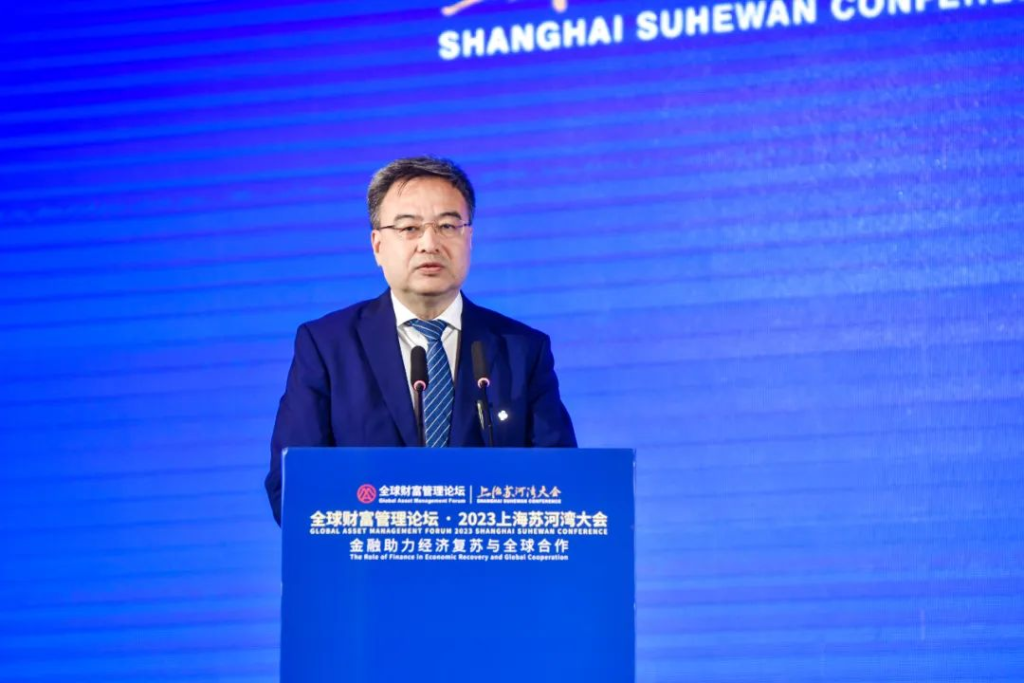
中保投资总裁贾飙在全球财富管理论坛•2023的“当前形势下长期资金管理的机遇与挑战”主题论坛上发表了演讲。
贾飙对新形势下保险资金的长期配置策略分享了自己的体会和思考。他表示,首先,全球资产管理面临的新形势、新特点,主要体现在全球经济从疫情中逐渐恢复、全球大类资产收益情况有所好转、中国资管市场短期承压、中长期向好三个方面。其次,保险资金管理出现了新变化、新挑战:一是保险资金运用规模增长、主要投资固收资产;二是投资品种不断丰富,固定收益投资更加注重安全性;三是险资股权投资呈现直接投资和间接投资并重的趋势;四是权益投资波动大、收益下滑;五是保险机构长期投资面临挑战;六是险资开展股权投资存在难点。最后,他对我国保险长期资金配置策略提出了自己的见解,即学习长期利率下行的国际经验,将固定收益投资作为压舱石,把基础设施业务当作推进器,加大指数基金的投资力度,以及通过各类基金进行股权投资。
这一环节的主题是“当前形势下长期资金管理的机遇与挑战”。我长期在原银保监会从事保险资金的监管工作,希望就此和大家分享一下我的一些体会和看法。
一、全球资产管理面临新形势、新特点
第一,全球经济从疫情中逐渐恢复。大家对于全球经济基本上已经形成共识,认为从疫情当中逐渐得到了缓慢复苏。全球经济增速2022年为3.5%,IMF预计2023—2024年将维持在3.0%的水平;发达国家通胀下降速度快于发展中国家,美国和欧元区2023年四季度将回落到3.2%和3.3%的水平;联合国预计全球贸易季度增速2023年将恢复正常。
第二,全球大类资产收益情况有所好转。大家可以看到2022—2023年全球的主要的大类资产的一些收益情况,相比于2022年,2023年全球股票指数由原来-19.8%增长到9.6%,可以感受到全球股票指数涨势不错。同时,全球债券指数跌幅正在缩小。
第三,中国资管市场短期承压、中长期向好。2022年全球资产管理规模上出现大幅下降,从2021年高点的112万亿美元下降到了98万亿美元。今年以来随着收益的好转,全球资产管理规模有所回升。贝莱德基金管理公司上半年的资产管理规模增长了10%左右。
回到中国的情况,中国资产管理规模连续3年小幅增长,基本在130万亿人民币左右。相对来讲较为稳定,但是其中各个子行业有所变化。我国的公募基金在稳步增长,现在已成为子行业当中第一大行业,同时我国保险资管的规模也在稳健持续地增长,今年上半年增长了7%,现在成为第二大的子行业。
从中国资产管理20年发展历程来看,我国的资产管理行业从零开始到2021年全球占比达到了11%。最新的IPE的统计数据来看,在全球排名前100的资产管理公司里中国占11家,第一名还是贝莱德,中国的第一名是国寿资产,管理规模达到4.8万亿元,第二名是平安资管,第三名是泰康资产,都是保险资管公司。
但是看到增长的同时,也应看到我国的资产管理公司与国际上其他资产管理公司相比,仍有很大的差距。国寿资产的规模不到贝莱德的十分之一,我国的资产管理还有很大的提升空间。从历史数据来看,我国资管市场在2012年之前增长规模速度较快,从2016年开始,我国资管市场的增长速度相对缓慢,年复合增速约为6%。展望未来,波士顿咨询预测中国资管市场的未来7年复合增速可达到9%。短期相对比较稳定,没有大幅增长,但从中长期来看还是向好的。
二、保险资金管理出现新变化、新挑战
第一,保险资金运用规模增长、主要投资固收资产。当前,保险资产管理规模达到26.97万亿元,是以固定收益资产为主的资产结构。其中,固定收益资产占到了77%。从2017年开始,债券占比从34%提高到了43%,银行存款占比持续下降,股票和基金占比一直以来比较稳定,基本在11%~13%的范围。此外,资产结构中还包括其他占比,我们这里所说的“其他占比”指的是另类投资,2017年占比达到40%为历史高点。2017年召开的全国金融工作会议开始规范金融业发展,同时也规范非标投资。险资另类投资这几年占比逐渐减小。
第二,投资品种不断丰富,固定收益投资更加注重安全性。现在险资资产配置有15个大类,就固定收益投资来说更加注重安全性。近两年投资信用债占比下降,相比2020年下降了3个百分点,同时投资利率债占比在上升,增长了6个百分点,此外投资信托计划占比下降了2.1个百分点。
第三,险资股权投资:直接和间接并重。股权投资占总投资资产比例为7.8%。我们如果除掉投的保险公司股权之外,非保险公司股权投资和间接投资比重基本上持平。我们说的间接投资是指通过VC/PE基金和股权计划进行的股权投资。
第四,权益投资波动大、收益下滑。从整个收益率来看,2022年保险资金的投资收益率为3.76%,近十年平均收益率是5.4%,与负债相匹配。去年权益投资对收益率的影响还是比较大的。
第五,保险机构长期投资面临挑战。一是股市低位震荡,二是名义利率持续走低,持有收益可能会低于负债成本。第三,企业债券,特别是城投债、信用债等,违约风险不断加大。第四,负债端成本保持刚性,虽然寿险预定利率上限由3.5%下调到3.0%,但是传导到资产端仍需一段时间。长期来看,保险机构长期投资面临较大压力,一个最大的压力源是利率走低。
第六,险资开展股权投资的难点。可投资产难觅是比较大的问题,同时内部管理上也有一些需要改进的地方,比如考核期是不是太短了,考核期应该以长周期计算。比如人才,现在股权投资、股票投资更多倾向于产业投资,这方面的人才相对也还是比较缺乏的。
三、新形势下保险资金的长期配置策略
第一,应对长期利率下行的国际经验。美国、日本、德国等主要国家,过去十年都是经历过长期利率下行的一个过程,直到2022年利率开始上行。过去十年美国、日本、德国等发达国家保险公司的一些经验和做法,做一个简单的总结。
美国的寿险业在长期低利率时代是如何做的呢?他们采用的是拉长债券久期的方式;同时,美国寿险公司资产配置股票较多,基本上维持在30%左右。日本的寿险公司主要是以投国内固收为主,同时投资外国债券的比重在不断增加。德国最主要的是增加股权投资,同时投资信用等级进行适当下沉。
简单总结,各国保险公司应对低利率市场环境,主要采用了以下方法:一是以固定收益投资为主;二是拉长债券久期;三是增加海外投资;四是信用适当下沉;五是增加另类投资。
第二,固定收益投资是压舱石。处于当前的背景下,我们需要适当借鉴国际上的一些好的做法和经验。固定收益是压舱石,这是我们的主渠道、主业,同时基于现在大环境,还是应当坚持更多以利率债为主的配置。
第三,基础设施业务是推进器。2022年基础设施投资的增速开始回升,同时从全球另类资产的增速来看,基础设施的增速仍然很快。在此背景下,基础设施仍然是险资配置的重要方向,特别是今年7月24日政治局会议以来,国家对于城市更新又有新的规划,从这个角度出发保险资金可以投资5G网络、人工智能、物联网、数据中心、云计算、智慧城市等国内新型基础设施建设,支持国家建设。
第四,加大指数基金的投资力度。2016年以来全球管理费率都在下调,我国公募基金费率也进行了调整。国际上,被动型指数基金受欢迎度不断升高。借鉴国际经验,建议可以加大被动型基金的投资力度。
第五,通过各类基金进行股权投资。股权投资对于我国实现创新驱动发展战略,支持硬核科技,破解“卡脖子”问题具有不可替代的作用。险资可以通过S基金的方式,参与早期项目投资,通过并购基金投资中期项目,通过Pre-IPO基金、战略配售基金投后期项目。
中国保险投资基金是国务院第96次常务会议批准设立的,中保投资公司是中国保险投资基金的管理人和普通合伙人,在重大基础设施、城市更新与混改重组、战略新兴行业和创新产品投资等各个方面都有很多的探索,希望与大家有进一步的合作机会。

翻译:
Jia Biao, President of China Insurance Investment: The long-term allocation strategy of insurance funds under the new situation
Jia Biao, President of China Insurance Investment Group, delivered a speech at the theme forum “Opportunities and Challenges of Long-term Money Management under the Current Situation” at the Global Wealth Management Forum 2023.
Jia Biao shared his own experience and thinking on the long-term allocation strategy of insurance funds under the new situation.
He said that first of all, the new situation and new characteristics of global asset management are mainly reflected in the gradual recovery of the global economy from the epidemic, the improvement of the return of major global assets, and the short-term pressure of China’s asset management market and the medium and long-term improvement. Secondly, there are new changes and challenges in the management of insurance funds: first, the scale of insurance funds is growing, and the main investment is fixed income assets; Second, the investment varieties are continuously enriched, and fixed income investment pays more attention to security;
Third, the equity investment of insurance capital shows the trend of both direct investment and indirect investment. Fourth, equity investment fluctuates greatly and returns decline; Fifth, insurance institutions face challenges in long-term investment; Sixth, there are difficulties in equity investment of insurance capital. Finally, he put forward his own views on China’s insurance long-term capital allocation strategy, that is, to learn the international experience of long-term interest rate decline, to use fixed income investment as ballast, to use infrastructure business as a propeller, to increase investment in index funds, and to make equity investment through various funds.
The theme of this session is “Opportunities and Challenges of long-term money Management in the current situation”. I have been engaged in the supervision of insurance funds in the former China Banking and Insurance Regulatory Commission for a long time, and I would like to share with you some of my experience and views.
First, global asset management is facing a new situation and new characteristics
First, the global economy is recovering from the pandemic. There is a general consensus that the global economy is gradually recovering slowly from the epidemic. Global economic growth will be 3.5% in 2022, and the IMF expects it to remain at 3.0% in 2023-2024. Inflation in developed countries is falling faster than in developing countries, with the US and the euro area falling back to 3.2% and 3.3% in the fourth quarter of 2023. The United Nations expects quarterly growth in global trade to return to normal by 2023.
Second, global asset returns have improved. You can see some of the returns of the world’s major categories of assets in 2022-2023, compared with 2022, the global stock index in 2023 increased from the original -19.8% to 9.6%, you can feel that the global stock index has risen well. Meanwhile, losses in global bond indices are narrowing.
Third, China’s asset management market is under pressure in the short term and improving in the medium and long term. Global assets under management (AUM) declined significantly in 2022, from a 2021 high of $112 trillion to $98 trillion. Global assets under management have rebounded this year as earnings have improved. Blackrock’s assets under management rose about 10% in the first half.
Going back to China’s situation, China’s asset management scale has increased slightly for three consecutive years, basically around 130 trillion yuan.
It is relatively stable, but there are changes in various sub-sectors. China’s public funds are growing steadily and have now become the largest industry among sub-industries, while the scale of China’s insurance asset management is also growing steadily and continuously, increasing by 7% in the first half of this year, and now becoming the second largest sub-industry.
From the perspective of the 20-year development history of China’s asset management. China’s asset management industry has reached 11% of the global share from zero to 2021. According to the latest IPE statistics, China accounts for 11 of the top 100 asset management companies in the world. The first is BlackRock, the first in China is Guoshou Asset Management, the management scale reaches 4.8 trillion yuan. The second is Ping An Asset Management, the third is Taikang Asset management, all insurance asset management companies.
However, at the same time, we should also see that there is still a big gap between China’s asset management companies and other asset management companies in the world. The scale of national life assets is less than one tenth of BlackRock, and China’s asset management still has great room for improvement. From the historical data, China’s asset management market grew rapidly before 2012, from 2016, China’s asset management market growth rate is relatively slow, the compound annual growth rate of about 6%. Looking ahead, BCG predicts that China’s asset management market will grow at a compound rate of 9% over the next seven years. The short term is relatively stable, there is no substantial growth. But it is still good in the medium and long term.
Second, new changes and challenges in insurance fund management
First, the scale of the use of insurance funds increased, mainly invested in fixed-income assets.
At present, the scale of insurance assets under management has reached 26.97 trillion yuan, which is an asset structure dominated by fixed income assets. Of this, fixed income assets accounted for 77 per cent. Since 2017, the proportion of bonds has increased from 34% to 43%, the proportion of bank deposits has continued to decline. And the proportion of stocks and funds has been relatively stable, basically in the range of 11% to 13%. In addition, the asset structure also includes other proportion, and the “other proportion” we say here refers to alternative investments, which reached a record high of 40% in 2017. The National Financial Work Conference held in 2017 began to regulate the development of the financial industry, but also regulate non-standard investment. The proportion of alternative investment in insurance capital has gradually decreased in recent years.
Second, investment varieties continue to be rich, and fixed income investment pays more attention to security.
There are now 15 broad categories of insurance asset allocation, with a greater focus on safety in terms of fixed income investments. In the past two years, the proportion of investment credit bonds decreased by 3 percentage points compared with 2020, while the proportion of investment interest rate bonds increased by 6 percentage points. In addition, the proportion of investment trust plans decreased by 2.1 percentage points.
Third, insurance equity investment: both direct and indirect.
Equity investment accounted for 7.8% of total invested assets. If we exclude the insurance company equity investment, the proportion of non-insurance company equity investment and indirect investment is basically the same. By indirect investments we mean equity investments made through VC/PE funds and equity schemes.
Fourth, equity investment fluctuates greatly and returns decline.
From the perspective of the overall return rate, the investment return rate of insurance funds in 2022 is 3.76%. And the average return rate in the past ten years is 5.4%, which matches the liabilities. Last year, the impact of equity investment on the rate of return was relatively large.
Fifth, insurance institutions face challenges in long-term investment.
First, the low volatility of the stock market, and second. The nominal interest rate continues to fall, and the holding income may be lower than the cost of debt. Third, the default risk of corporate bonds, especially urban investment bonds and credit bonds, is increasing. Fourth, the cost of the liability side remains rigid. Although the maximum predetermined interest rate of life insurance has been reduced from 3.5% to 3.0%. But it still takes some time to transmit to the asset side. In the long run, the long-term investment of insurance institutions faces greater pressure. And one of the biggest pressure sources is the low interest rate.
Sixth, the difficulty of equity investment in insurance capital.
The difficulty of finding investable products is a relatively big problem. And there are also some areas for improvement in internal management. Such as whether the assessment period is too short, and the assessment period should be calculated in a long period. For example, talent, equity investment, stock investment is more inclined to industrial investment. And talent in this area is relatively scarce.
Third, the long-term allocation strategy of insurance funds under the new situation
First, international experience in dealing with the decline in long-term interest rates.
Major countries such as the United States, Japan, and Germany have all experienced a downward trend in long-term interest rates over the past decade, until interest rates began to rise in 2022. In the past ten years, some experiences and practices of insurance companies in developed countries such as the United States, Japan and Germany are summarized briefly.
How is the American life insurance industry doing in an era of prolonged low interest rates? They do it by lengthening the duration of bonds;. At the same time, the asset allocation of American life insurance companies is more stock, which is basically maintained at about 30%. Japanese life insurance companies mainly invest in domestic fixed income, while the proportion of investment in foreign bonds is increasing. The most important thing in Germany is to increase equity investment and at the same time invest in a proper credit rating.
In summary, insurance companies in various countries mainly adopt the following methods to cope with the low interest rate market environment: first, fixed income investment; Second, lengthening the duration of bonds; Third, increase overseas investment; Fourth, credit sinks appropriately; Fifth, increase alternative investment.
Second, fixed-income investments are the ballast.
In the current context, we need to make appropriate reference to some good international practices and experience. Fixed income is the ballast, which is our main channel, the main business, and based on the current environment, or should adhere to more interest rate debt based allocation.
Third, the infrastructure business is thrusters.
The growth rate of infrastructure investment in 2022 is starting to pick up. And the growth rate of infrastructure in terms of global alternative assets is still fast. In this context, infrastructure is still an important direction of insurance capital allocation. Especially since the Political Bureau meeting on July 24 this year. The state has a new plan for urban renewal, from this point of view, insurance funds can invest in 5G networks, artificial intelligence, Internet of things, data centers, cloud computing, smart cities and other domestic new infrastructure construction to support national construction.
Fourth, increase investment in index funds.
Since 2016, the global management rate has been lowered. And the rate of public funds in China has also been adjusted. Internationally, the popularity of passive index funds is increasing. Drawing on international experience, it is suggested that the investment of passive funds can be increased.
Fifth, equity investment through various funds.
Equity investment plays an irreplaceable role in realizing our country’s innovation-driven development strategy, supporting core science and technology, and cracking the “stuck neck” problem. Insurance capital can participate in early project investment through S fund, invest in medium-term projects through merger and acquisition fund, and invest in later projects through Pre-IPO fund and strategic placement fund.
China Insurance Investment Fund was approved by the 96th Executive meeting of The State Council. As the manager and general partner of China Insurance Investment Fund. China Insurance Investment Company has a lot of exploration in major infrastructure, urban renewal and mixed reform and restructuring, strategic emerging industries and innovative product investment. We hope to have further cooperation opportunities with you.
本文由CXO UNION-CXO联盟(cxounion.cn)转载而成,来源于中国财富管理50人论坛;编辑/翻译:CXO UNIONCXO联盟小U。
如需加入CXO UNION(CXO联盟)高管社群,请联系社群小伙伴哦~
免责声明: 本网站(http://www.cxounion.cn/)内容主要来自原创、合作媒体供稿和第三方投稿,凡在本网站出现的信息,均仅供参考。本网站将尽力确保所提供信息的准确性及可靠性,但不保证有关资料的准确性及可靠性,读者在使用前请进一步核实,并对任何自主决定的行为负责。本网站对有关资料所引致的错误、不确或遗漏,概不负任何法律责任。
本网站刊载的所有内容(包括但不仅限文字、图片、LOGO、音频、视频、软件、程序等) 版权归原作者所有。任何单位或个人认为本网站中的内容可能涉嫌侵犯其知识产权或存在不实内容时,请及时通知本站,予以删除。
如需加入CXO UNION(CXO联盟)高管社群,请联系社群小伙伴哦~

免责声明: 本网站(http://www.cxounion.cn/)内容主要来自原创、合作媒体供稿和第三方投稿,凡在本网站出现的信息,均仅供参考。本网站将尽力确保所提供信息的准确性及可靠性,但不保证有关资料的准确性及可靠性,读者在使用前请进一步核实,并对任何自主决定的行为负责。本网站对有关资料所引致的错误、不确或遗漏,概不负任何法律责任。
本网站刊载的所有内容(包括但不仅限文字、图片、LOGO、音频、视频、软件、程序等) 版权归原作者所有。任何单位或个人认为本网站中的内容可能涉嫌侵犯其知识产权或存在不实内容时,请及时通知本站,予以删除。
Search
Popular Posts
-

2024数字化灯塔案例评选申报开启!
“2024数字化灯塔案例评选”于3月正式启动,诚挚欢迎业界同仁自荐和推荐,一起推动产业数字化进程,助力赋能企业…
-

2024 X-Award星盘奖申报通道已开启!
X-Award星盘奖是数字化转型服务、IT服务行业重要的商业奖项,旨在表彰行业里提供杰出数字化转型服务与IT服…
-

2024 N-Award星云奖申报通道已开启!
N-Award是数字化转型领域重要的商业奖项,旨在表彰那些以非凡的远见、超群的领导才能和卓越的成就来激励他人的…