

张勇从CFO到CEO的转型之路既有阿里巴巴平台的原因,也是自己不断寻求改变的结果,可以说是完美地验证了一句话:懂业务的CFO是接任CEO的最佳人选。
那么,如何懂业务?什么是业务思维呢?
一、财务思维与业务思维的三大区别
1. 财务思维重短期,业务思维重长期
如果画一个图,横轴是时间,纵轴是现金流的话,任何一个业务、一个企业的发展都是一个S形,一开始现金流为负,慢慢减少亏损,然后损益平衡,然后开始赚钱。有的企业是“小S”,有的是“中S”,有的是“大S”。好比不同的物种生长周期不一样。
“大S”的极致是亚马逊,连续15年亏损,资本市场还不离不弃,这和贝索斯的超强能力、魅力、说服力分不开。大部分时候,资本市场没有这么宽容仁慈,很多上市公司都被追逐短期利益的资本市场所绑架,有的甚至付出了生命的代价。CXO UNION-CXO联盟(cxounion.cn)
2. 总量最大化VS效率最大化
财务追求比率(效率)最大化,业务追求总量最大化。如果把一个企业的活动分成简单的两块,一块生产制造,一块营销销售,做出来,卖出去。生产制造效率最大化是好事,但是营销销售效率最大化后,当每千元广告投入利润、人均利润等效率指标最大化的时候,公司的总利润没有得到最大化,因为所有的投入在遵循边际效用递减的规律,总利润最大化的那一点必定发生在效率指标最大化之后。CXO UNION-CXO联盟(cxounion.cn)
3. 决策的相关成本原则
业务思维遵循决策的相关成本原则。所谓相关成本就是这项成本会随着你的决策的变化而变化,相反,不随这个决策的变化而变化的成本,对于这个决策来讲就是不相关的成本。而财务思维在决策时考虑了不相关的成本,比如沉没成本,还有不该分摊的固定成本。
我们财务与业务相背离,相冲突,往往就是两方掌握的信息和资源不同导致。财务要按照准则、税法来处理业务关系,业务则要根据实际情况,做种种变通。我们不可能要求每个业务部门都熟悉准则和税法条文,所以只有我们财务自己去更多的了解当事的业务,了解公司整体运营,了解整个行业的特点及公司所处的位置,才能在两者的权衡中,找到一个合适点。
二、如何做好财务业务一体化?
现在好多财务人员仅仅局限于单纯的财务,日常的账务核算已经越来越与企业的经营目标偏离了,进而导致会计人员也离老板的距离越来越远,这就是目前好多财务人员经常抱怨的:老板不重视财务、会计的工资最低、开会从来不让会计参加等等现象的出现。
殊不知,这一系列问题的出现究其原因是在财务本身,自己把财务与业务人为的隔离开来了,财务部门为了合规而合规,为了制度而制度,但是没有考虑合规和制度到底是为了什么。
其实,财务与业务是密不可分的,都是为了一个共同的目标,就是为企业创造价值,也就是业财融合。CXO UNION-CXO联盟(cxounion.cn)
那么,你是否具备了业务型财务思维,请认真的看看这10个问题吧!
问题1
你公司的经营产品定位在哪里?具体的业务模式、盈利模式是什么?
问题2
你公司的客户群是什么,前10大客户你都认识熟悉并做到有效的客户管理了吗?
问题3
你公司的前10大供应商你熟悉并一直在沟通着吗?
问题4
你公司产品的生产工艺、工序流程以及产品配方你了解吗?
问题5
你公司的销售绩效方案设计、公司架构、股权设计、组织制度建设、以及人员结构、薪酬设计等你是否非常清楚?CXO UNION-CXO联盟(cxounion.cn)
问题6
你公司的企业文化、专利技术、商标等无形的资产你是否清楚?
问题7
你公司未来的发展目标、公司战略规划以及下一步经营走势你是否非常清楚?
问题8
你公司的经营薄弱点或者短板在哪里?以及你公司在同行业中具有的优势在哪里?
问题9
你公司外部关系协调处理你是否做到了参与并跟踪?对于外部风险你是否能做到及时预知以及有效防范控制?
问题10
你是否把公司的财务、业务、法务、税务融为一体?并将公司信息技术融为一体?从而懂得多视角看待你所在的公司!
总结:
①财务要走向业务,一定要做到你中有我,我中有你;
②好的财务,是静待于幕后,隐藏于无形的,不能一味低头搞核算,要把财务思维带到业务中去;CXO UNION-CXO联盟(cxounion.cn)
③一个具有高附加值的财务人,应该从财务中来,到业务中去;
④业财融合,对于财务部门和财务人员来说,已经是时不我待,大势所趋!
三、业财融合的工作角色
1. 从财务分析工作看差别:
比如分析:
1. 传统财务多是财务分析,以财务数据为主要分析对象,多是分析公司层面的大的表现和问题,不深入,也难以深入。基本提不出改进建议。分析多以发现问题为主。
2. 业务财务:首先,既要有企业总体的,更要区分各个领域,有细分的。结合财务数据,业务数据(信息很细化),发现业务问题,而且需要帮助业务提建议,分析建议,大小决策支持。有些分析,甚至远远超出了传统财务的范围,比如客户价值分析等等。
2. 从库存管理工作看差别:
业务财务助力库存管理:
承上例,该公司库存一直处于较高水平,这一方面使得公司在库存方面积压了很多资金,同时有些原料还经常因为过期而造成损失。同时,在公司老产品即将退市的时候,经常有一些专用料件因停产而长期滞留在库存中。CXO UNION-CXO联盟(cxounion.cn)
传统的财务通常的做法:
1.分析原材料的库存占比,寻找占比较高的若干原材料。
2.分析原材料的库存变化,即对比不同月份原料金额情况。
3.同样对产成品做出分析。
4.计算周转率。
5.列示变质毁损原料账面金额。
6.分析占用资金的成本。
7.定期列示有问题的专用料件情况。CXO UNION-CXO联盟(cxounion.cn)
如何做的更加深入?
1.结合物料出厂时间,结合销售和生产计划,定期分析和提示有过期风险的物料情况。
2.定期结合BOM单情况,分析专用的非成套料件和价值高的非成套料件情况。
3.结合领用习惯,设计物料摆放便于实物流的“先进先出”。
4.分析为不同产品的备料情况看低价值的产品是否备货较多。
5.分析和确定安全库存。
6.定期对问题物料进行分析并协助处理。
7.结合应收款,应付款,资金情况等分析和建议备货策略。
该公司分析和确定物料库存量所考虑的因素:
1.分析安全库存
①结合供货提前期:分析不同运输方式的运输时间
②考虑生产的均衡性:不同生产需求的概率CXO UNION-CXO联盟(cxounion.cn)
③分析缺货成本
2.分析库存量
①分析库存成本
②分析不同运输方式的运输成本
③分析其他库存损失
该公司的具体做法(普通通用物料):
1.按照均衡生产每天的需求量*提前期计算备货量A1.
- 分析几个典型的运输方式的运输成本B1
- 分析A1的仓储成本B2
2.考虑为突发需求备货量,根据以往突发需求的情况,测算频率最高的突发需求量A2.
- 考虑频率最高的突发需求的缺货成本,即损失订单的毛利润,和真正出现损失的概率,计算得出缺货成本C1。CXO UNION-CXO联盟(cxounion.cn)
- 分析A2的库存成本C2
- 分析A2的其他库存损失C3
四、业财融合对财务组织结构的影响
1. 案例:某集团业务财务的设计 –组织结构示意图
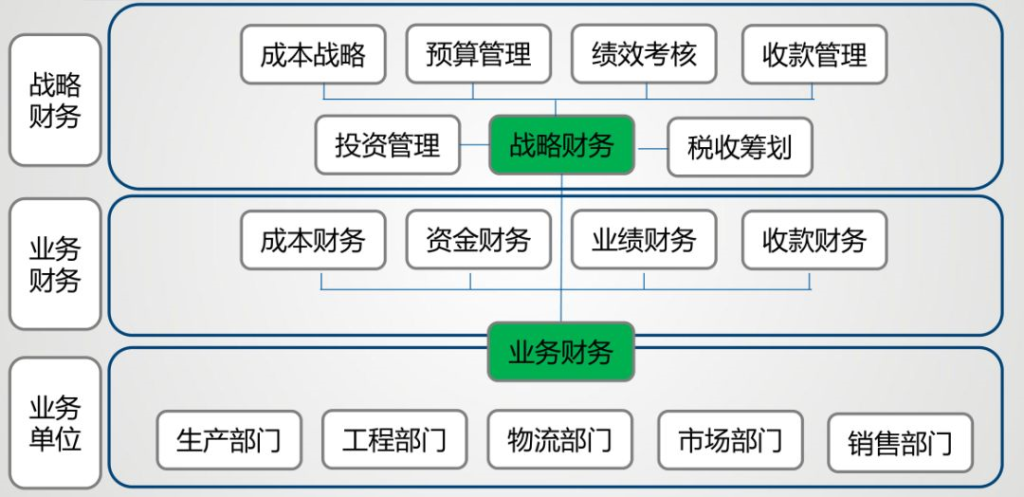
三足鼎立的结构
2. 战略财务
- 与集团战略部、绩效部门一起组成企业本部的参谋部门,把战略转化为政策,把公司意志转化为行动。CXO UNION-CXO联盟(cxounion.cn)
- 为集团经营决策提供指导,为下属企业业务财务提供支撑
- 分八个专业(对应公司的八大战略,预算、成本、材质、收购等八个领域)
- 四个研究团队(汇率、税务、风险、成本)
- 要求:要专精,比如能和国家税务总局就某一个政策进行讨论,能钻研出自己的成本管理体系来。这些往往都并非单枪匹马所能达成的。
3. 业务财务:
(销售财务,产品财务,研发财务,海外财务.. )-不作数据,把数据做成信息;不做政策,但是会把政策运用到实际中,是战略财务在业务中心的代表。CXO UNION-CXO联盟(cxounion.cn)
每个业务单位再往下细分,又配备更下一层的CFO,犹如一张细密的网。
4. 共享服务中心
- 集中处理账务和财务信息,提供个标准化报告
- 要求是标准化、专业化
5. 对业务财务的要求:
- 小CFO,具备广阔的专业知识,辅助该业务单元做经营决策的分析、产品的盈利能力分析等。
- 业务财务则必须充当通才,拥有广泛的视野和知识面;要用过公司内部的一套财务管理认证体系。
6. 业务财务的工作方式
- 走出去,坚持不懈地给其他部门沟通、交流与培训。
- 你要想开展好自己的工作,让客户理解你是非常重要的。
总结:
对组织结构的影响:
通常需要专职人员CXO UNION-CXO联盟(cxounion.cn)
通常需要统一的规划和要求
成功要素:
1. 领导大力支持
2. 业务高速发展,投入大量人力财力支持
3. 财务规划设计科学到位
4. 执行的坚决彻底

翻译:
Zhang Yong’s transformation from CFO to CEO is both the reason of Alibaba platform and the result of his own continuous pursuit of change, which can be said to be a perfect verification of a sentence: CFO who knows business is the best candidate to take over as CEO.CXO UNION-CXO联盟(cxounion.cn)
So, how do you understand business? What is business thinking?
First, the three differences between financial thinking and business thinking
1. Financial thinking is short-term, business thinking is long-term
If you draw a graph, the horizontal axis is time, the vertical axis is cash flow, any business, the development of an enterprise is an S-shape, the cash flow is negative at the beginning, slowly reduce the loss, and then the profit and loss balance, and then start to make money. Some enterprises are “small S”, some are “medium S”, and some are “big S”. It’s like different species have different growth cycles.CXO UNION-CXO联盟(cxounion.cn)
The ultimate of “big S” is Amazon, which has lost money for 15 consecutive years, and the capital market has not abandoned it, which is inseparable from Bezos’ super ability, charm and persuasion. Most of the time, the capital market is not so lenient, and many listed companies are kidnapped by the capital market chasing short-term interests, and some even pay the price of their lives.
2. Maximize total vs. maximize efficiency
Financial pursuit of maximum ratio (efficiency), business pursuit of maximum total. If the activities of an enterprise are divided into two simple pieces, one is manufacturing, one is marketing and selling, making and selling. Maximizing production and manufacturing efficiency is a good thing, but after maximizing marketing and sales efficiency, when the efficiency indicators such as profit per thousand yuan of advertising investment and per capita profit are maximized, the company’s total profit is not maximized, because all inputs follow the law of diminishing marginal utility, and the point at which the total profit is maximized must occur after the efficiency index is maximized.
3. Cost principles related to decision-making
Business thinking follows the principle of cost associated with decision making. A relevant cost is a cost that changes with your decision. Conversely, a cost that does not change with the decision is an irrelevant cost for the decision. Financial thinking, on the other hand, takes into account irrelevant costs, such as sunk costs, and fixed costs that should not be shared.CXO UNION-CXO联盟(cxounion.cn)
The deviation and conflict between our finance and business are often caused by the different information and resources held by the two parties. Finance should handle business relations in accordance with the standards and tax laws, and business should make various adaptations according to the actual situation. It is impossible for us to require each business department to be familiar with the standards and tax law provisions, so only our financial department to understand more about the business involved, understand the overall operation of the company, understand the characteristics of the entire industry and the position of the company, in order to find a suitable point in the balance between the two.
Second, how to do a good job of financial business integration?
Now a lot of financial personnel are only limited to simple finance, daily accounting has become more and more deviated from the business objectives of the enterprise, which leads to accounting personnel are also more and more distant from the boss, this is the current many financial personnel often complain: the boss does not pay attention to finance, accounting wages are the lowest, never let accounting participate in meetings and so on.CXO UNION-CXO联盟(cxounion.cn)
As everyone knows, the reason for the emergence of this series of problems is the finance itself, which artificially separates finance from business. The financial department is compliant for the sake of compliance, and the system is for the sake of the system, but it does not consider what the compliance and the system are for.
In fact, finance and business are inseparable, are for a common goal, that is, to create value for the enterprise, that is, the integration of industry and finance.
So, whether you have a business financial thinking, please carefully take a look at these 10 questions!
Question 1
What is your company’s product positioning? What is the specific business model and profit model?
Question 2
What is your company’s customer base? Do you know and manage the top 10 customers effectively?CXO UNION-CXO联盟(cxounion.cn)
Question 3
Are you familiar with your company’s top 10 suppliers and have been communicating with them?
Question 4
Do you understand the production process, process flow and product formula of your company’s products?
Question 5
Are you very clear about your company’s sales performance plan design, corporate structure, equity design, organizational system construction, personnel structure, salary design, etc.?
Question 6
Are you clear about your company’s corporate culture, patents, trademarks and other intangible assets?CXO UNION-CXO联盟(cxounion.cn)
Question 7
Are you clear about your company’s future development goals, strategic plans, and next steps?
Question 8
What are the weaknesses or weaknesses of your company? And what are the advantages of your company in the same industry?
Question 9
Are you involved and tracking external relations in your company? Are you able to predict external risks in time and effectively prevent and control them?
Question 10
Do you integrate the financial, business, legal and tax aspects of the company? And integrate corporate information technology? Learn to look at your company from multiple perspectives!CXO UNION-CXO联盟(cxounion.cn)
In SUMMARY:
① Financial to business, must be you have me, I have you;
Good finance, is waiting behind the scenes, hidden in the invisible, can not blindly bow down to do accounting, to bring financial thinking to the business;
A financial person with high added value should come from finance and go to business;
④ The integration of industry and finance, for financial departments and financial personnel, it is already time to wait for me, the trend of The Times!
Third, the work role of industry and finance integration
1. Differences from financial analysis work:
For example, analysis:CXO UNION-CXO联盟(cxounion.cn)
- Traditional finance mainly focuses on financial analysis, taking financial data as the main analysis object, and mainly analyzes big performance and problems at the company level, which is not in-depth and difficult to go deep. There are no suggestions for improvement. Analysis is mainly about finding problems.
- Business finance: First of all, it is necessary to have the overall enterprise, but also to distinguish various fields and have subdivisions. Combine financial data, business data (information is very detailed), find business problems, and need to help the business to make suggestions, analysis suggestions, big and small decision support. Some analysis, even far beyond the scope of traditional finance, such as customer value analysis and so on.
2. The difference from inventory management:
Business finance helps inventory management:
For example, the company’s inventory has been at a high level, which on the one hand makes the company backlog in inventory a lot of money, while some raw materials are often due to the expiration of the loss. At the same time, when the company’s old products are about to be delisted from the market, there are often some special materials and parts that are suspended for a long time in inventory.
Traditional financial practices are common:
- Analyze the inventory ratio of raw materials and find some raw materials with high proportion.
- Analyze the inventory changes of raw materials, that is, compare the amount of raw materials in different months.CXO UNION-CXO联盟(cxounion.cn)
- Also analyze the finished products.
- Calculate turnover.
- List the book amount of damaged raw materials.
- Analyze the cost of capital occupied.
- Regularly list the special materials with problems.
How to do more in-depth?
- Analyze and prompt materials with expired risk on a regular basis based on their delivery time, sales and production plans.
- Periodically analyze the situation of special non-complete parts and high-value non-complete parts combined with BOM.
- Combined with receiving habits, design material placement to facilitate the physical flow of “first-in-first-out”.
- Analyze the material preparation situation of different products to see whether the low-value products are stocked more.CXO UNION-CXO联盟(cxounion.cn)
- Analyze and determine safety inventory.
- Analyze and assist the disposal of problem materials regularly.
- Analyze and suggest stocking strategies based on receivables, payables, funds, etc.
The company analyses and determines the factors taken into account in the inventory of materials:
- Analyze safety inventory
① Combined with the delivery lead time: analyze the transportation time of different transportation modes
② Consider the equilibrium of production: the probability of different production demandsCXO UNION-CXO联盟(cxounion.cn)
③ Analysis of out-of-stock costs
- Analyze inventory
① Analyze inventory cost
① Analyze the transportation cost of different modes of transportation
③ Analyze other inventory losses
The company’s specific practice (common general materials) :
- Calculate stock quantity A1 according to daily demand * advance time of balanced production.
The transportation cost B1 of several typical modes of transportation is analyzed
Analyze A1’s storage cost B2
- Considering the quantity of stock for the emergency demand, calculate the emergency demand A2 with the highest frequency according to the situation of the previous emergency demand.
Taking into account the out-of-stock cost of the most frequent sudden demand, that is, the gross profit of lost orders, and the probability of actual losses, the out-of-stock cost C1 is calculated.CXO UNION-CXO联盟(cxounion.cn)
Analyze A2’s inventory cost C2
Analyze A2’s other inventory losses C3
Fourth, the impact of the integration of industry and finance on the financial organizational structure
1. Case: Business finance design of a group – schematic diagram of organizational structure
A three-legged structure
2. Strategic finance
Together with the Group Strategy Department and the performance Department, the staff department of the corporate headquarters is formed to translate the strategy into policy and the company’s will into action.
Provide guidance for the group’s business decision-making, and provide support for the business finance of subordinate enterprisesCXO UNION-CXO联盟(cxounion.cn)
Divided into eight majors (corresponding to the eight strategies of the company, eight fields such as budget, cost, material and acquisition)
Four research teams (exchange rate, tax, risk, cost)
Requirements: To be specialized, such as to be able to discuss a policy with the State Administration of Taxation, to delve into their own cost management system. None of this is often achieved by a single person.
3. Business Finance:
(Sales Finance, Product Finance, R&D Finance, Overseas finance…) – Do not make data, make data into information; Do not do policy, but will apply the policy into practice, is the representative of strategic finance in the business center.
Each business unit is further subdivided and equipped with a lower level of CFO, like a fine net.CXO UNION-CXO联盟(cxounion.cn)
4. Share the service center
Centralize accounting and financial information and provide a standardized report
The requirement is standardization and specialization
5. Requirements for business finance:
Small CFO, with broad professional knowledge, to assist the business unit to make business decision analysis, product profitability analysis, etc.
Business finance must be a generalist, with a wide range of vision and knowledge; Must use a set of internal financial management certification system.
6. How business finance works
Go out and keep communicating, communicating and training with other departments.
If you want to do your job well, it’s important that your clients understand you.
In SUMMARY:
Impact on organizational structure:
Full-time staff is usually requiredCXO UNION-CXO联盟(cxounion.cn)
Uniform planning and requirements are usually required
Success factors:
- Strong support from the leader
- The rapid development of the business, invested a lot of human and financial support
- Financial planning and design are scientific and in place
- Resolute and thorough implementation
本文由CXO UNION-CXO联盟(cxounion.cn)转载而成,来源于财务职场;编辑/翻译:CXO UNIONCXO联盟小O。
如需加入CXO UNION(CXO联盟)高管社群,请联系社群小伙伴哦~
免责声明: 本网站(http://www.cxounion.cn/)内容主要来自原创、合作媒体供稿和第三方投稿,凡在本网站出现的信息,均仅供参考。本网站将尽力确保所提供信息的准确性及可靠性,但不保证有关资料的准确性及可靠性,读者在使用前请进一步核实,并对任何自主决定的行为负责。本网站对有关资料所引致的错误、不确或遗漏,概不负任何法律责任。
本网站刊载的所有内容(包括但不仅限文字、图片、LOGO、音频、视频、软件、程序等) 版权归原作者所有。任何单位或个人认为本网站中的内容可能涉嫌侵犯其知识产权或存在不实内容时,请及时通知本站,予以删除。
如需加入CXO UNION(CXO联盟)高管社群,请联系社群小伙伴哦~

免责声明: 本网站(http://www.cxounion.cn/)内容主要来自原创、合作媒体供稿和第三方投稿,凡在本网站出现的信息,均仅供参考。本网站将尽力确保所提供信息的准确性及可靠性,但不保证有关资料的准确性及可靠性,读者在使用前请进一步核实,并对任何自主决定的行为负责。本网站对有关资料所引致的错误、不确或遗漏,概不负任何法律责任。
本网站刊载的所有内容(包括但不仅限文字、图片、LOGO、音频、视频、软件、程序等) 版权归原作者所有。任何单位或个人认为本网站中的内容可能涉嫌侵犯其知识产权或存在不实内容时,请及时通知本站,予以删除。
Search
Popular Posts
-

2024数字化灯塔案例评选申报开启!
“2024数字化灯塔案例评选”于3月正式启动,诚挚欢迎业界同仁自荐和推荐,一起推动产业数字化进程,助力赋能企业…
-

2024 X-Award星盘奖申报通道已开启!
X-Award星盘奖是数字化转型服务、IT服务行业重要的商业奖项,旨在表彰行业里提供杰出数字化转型服务与IT服…
-

2024 N-Award星云奖申报通道已开启!
N-Award是数字化转型领域重要的商业奖项,旨在表彰那些以非凡的远见、超群的领导才能和卓越的成就来激励他人的…