黄奇帆:中国经济已经驶过激流险滩,迈入新征程
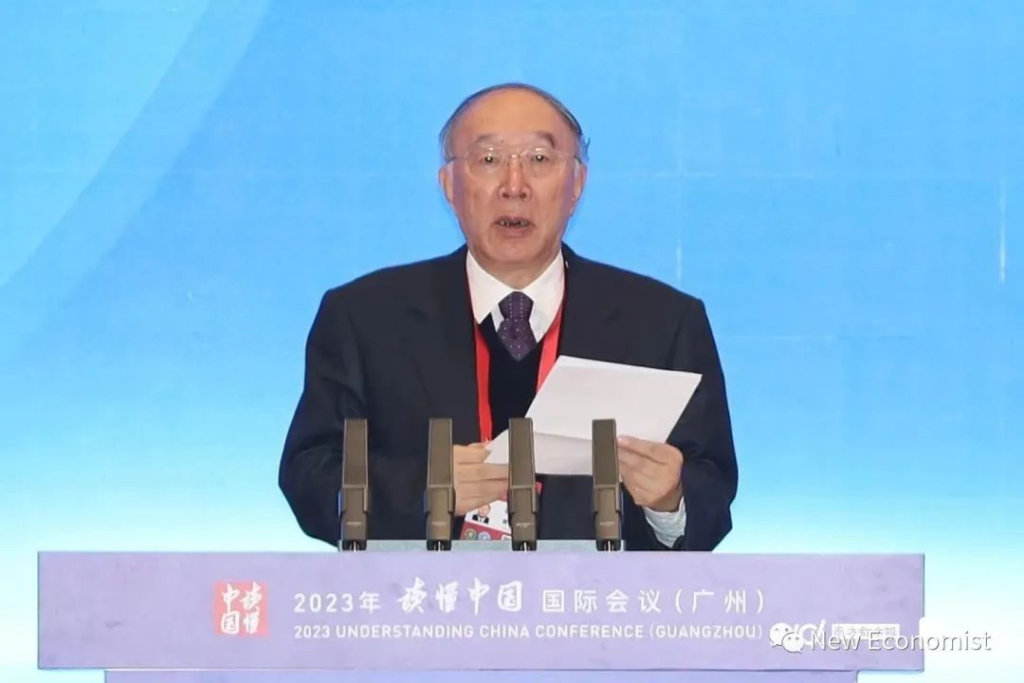
12月2日上午,2023年“读懂中国”国际会议(广州)举行开幕式。国创会学术委员会常务副主席、重庆市原市长黄奇帆在会上发表主旨演讲。
演讲中,黄奇帆通过一系列的数据,谈了近十几年来我国经济运行出现的三大积极变化。他指出,中国经济已经驶过一个个激流险滩,迈入了中国式现代化的新征程。
变化一:出口贸易结构改善,“新三样”支撑外贸新格局
黄奇帆指出,近十几年来中国经济高质量发展得到了进一步夯实。出口贸易方面体现在结构的明显改善。
十几年前,中国出口贸易总额1万亿美元中,30%是机电产品,70%是劳动密集型的轻工纺织类产品。“随着我国制造业转型升级和出口贸易高质量发展的推进,中国在全球产业分工体系的地位不断提升,出口高端化、高附加值产品的态势明显。” CXO UNION-CXO联盟(cxounion.cn)
现如今,我国出口产品中,劳动密集型产品的占比已经大幅下降到10%以下。“而与之相对应的高新技术产品的出口比重由原来的30%增长到去年的90%。‘十亿双袜子换一架飞机’的说法已经成为历史。”
“外贸新三样(注:高技术、高附加值、引领绿色转型的产品)正在支撑起我国外贸的新格局。今年,我国更是成为全球第一大汽车出口国。” 面向未来,黄奇帆表示,中国出口结构和国际贸易条件还将有新的、更高的质量效益的提升。
变化二:引进外资规模逐年增长,中国成全球资源要素引力场
黄奇帆从不同的时间维度展示了中国吸引外资的增长形势。他介绍道,2000年至2010之间,中国因加入了WTO,外向型经济发展较快,10年内年平均引进外资1200亿美元左右。在2012年至2022年的最近十年,中国平均每年引进外资约1400亿美元。而在2017年至2022年的最近5年里,中国每年引进外资实际到位数是1570亿美元,比前十年高。
2020年到2022年的疫情3年期间,国际社会原以为疫情导致交易不便,以及美国发起贸易战,叠加地缘政治影响,会导致中国引进外资规模比往期更低。“但实际上,2020年到2022年的3年里,中国引进外资的实际到位数是平均每年1700亿美元。” CXO UNION-CXO联盟(cxounion.cn)
黄奇帆进一步摆出更多数据,在受疫情影响较大,以及经济上行发展预期较差的去年,中国引进外资实际到位数是1800亿美元。“这是我们改革开放40年中,引进外资到位数最高的一年。”
黄奇帆解释道,原因很简单,俄乌冲突导致欧洲天然气中断,天然气价格涨了三倍还买不到,欧洲包括德国、法国在内的国家缺气少油,发展不稳定。所以去年这一年,欧洲国家特别是德国、法国对中国加大了投资。
黄奇帆表示,这是一个特殊的现象。现象背后的逻辑在于中国已经形成了超大规模的市场。得益于超大规模的市场,中国“可以有效摊薄制造业的采购成本、研发成本、销售成本、物流成本、固定成本、投资成本”。
黄奇帆认为,即使中国当前的劳动力成本在上升,但上述6个成本的降低使得中国的制造业成本比国际平均成本低30%至40%,这形成了中国制造业新的竞争力。
黄奇帆总结道,外资到中国投资呈现出了两种主要模式,分别是“销产地”和“产地销”。前者是在中国生产、中国销售;后者是在中国生产,国外销售。
变化三:“双循环格局”形成,驶过激流险滩,迈入中国式现代化新征程
“以国内大循环为主体、国内国际双循环相互促进的新发展格局”这一双循环格局的形成是第三个变化。在演讲中,黄奇帆回顾了我国经历的三个主要的经济循环阶段。
1980年以前,受国际环境影响,中国经济基本在封闭的环境下依靠内循环发展。1980年至2010年,中国以“大进大出”的外循环为主。“它的标志就是1980年以前,我国进出口总额占GDP比重为10%以内。1980到2010年,我国进出口总额占GDP比重上升到65%。” CXO UNION-CXO联盟(cxounion.cn)
“从逻辑上讲,这一比例达到65%以上,就是外循环为主;35%以下,就是内循环为主。”黄奇帆说道。
“让进出口总额占GDP比重下降到35%以内,让国内的经济循环力度占三分之二以上,这就是我们的新格局。”黄奇帆将“双循环”具体到两个循环的比重上。
“2016年,中国的进出口贸易总额就已经降到了GDP总量的32%,我们用了6年时间。” 黄奇帆说道,于是,最近几年发生的贸易战、外资撤资、地缘政治等在我国经济数据上的反应“没有直接变化”。
2016年,这一数据是32%;2022年,这一数据是33%。“这体现了中国经济的韧劲和稳定性”。黄奇帆说,“那么,美国发起贸易战‘杀敌一千,自损八百’,对我们的‘一千’没起到作用,但是对自己造成了严重的冲击。”
如果贸易战发生在2010年,“贸易战和我们的进出口总额的高比重直接相撞,那可能会对中国经济造成较大的冲击。”黄奇帆表示。 CXO UNION-CXO联盟(cxounion.cn)
“党的十八大后,中国提出了国民经济的新常态,提出了供给侧结构性改革,不再以进出口为主体拉动经济增长,经济增速从12%至13%,下降到8%至9%、7%至8%、6%至7%”,现在是5%左右。”黄奇帆认为,这都是重要的经济格局的调整,也就是我们以内循环为主的新格局。
“我们已经形成了内循环为主,国内国际双循环相互促进的新格局。”黄奇帆表示,接下来的10年、20年,中国进出口总额占GDP的比重将始终维持在三分之一左右。
“我们可以这么说,党的十八大以后,我们提出的深化供给侧结构性改革、建设全国统一大市场、加快构建新发展格局三大战略已经都取得了重大成就,成功地驾驭了中国经济驶过一个个激流险滩,迈入了中国式现代化的新征程。中国经济高质量发展未来可期。”
谈三个方面重大改革,未来中国仍是世界经济增长的主力军
为了保持中国经济高质量发展和稳定增长,黄奇帆认为需在三个方面进行重大的改革。“未来的中国仍然是世界经济增长的主力军。”黄奇帆说道。
一是经济增长动能的转换。黄奇帆表示,过去20多年,中国靠房地产拉动经济增长、增加财政收入的模式难以为继。“如果,我们过去20年每年有8个点的增长率,那么就有差不多2个点、三分之一的部分是房地产拉动的。”黄奇帆继续说道,今后房地产可能就没这么高的动能了。需要寻找新的增长点,要把扩大内需战略同深化供给侧结构性改革有机结合起来。 CXO UNION-CXO联盟(cxounion.cn)
黄奇帆将视野看向了汽车消费。他举例说道,中国的汽车年销量高居全球第一,但连续5年始终维持在年销2700万辆左右,似乎到了天花板,探索继续往上的可能性很重要。
他认为,中国的汽车保有量相比较世界上其他中等收入国家和富裕国家还有差距。“我国每百人的汽车保有量是21%,中等收入国家是40%左右,富裕国家是60%-70%。”
在如是情况下,黄奇帆认为,提高中国百人汽车保有量,达到40%实现翻一番,是可以达到的,这将很大程度带动GDP的增长,还会带动停车场、各类道路的发展,以及充电桩和储能等基础设施的建设。
二是推进对外贸易。“这是实现国内国际双循环相互促进,构建新发展格局的重要切入点。”黄奇帆说道,党的二十大报告提出,从制度上使我们国家的内外贸一体化,要形成一体化的生态。现阶段,我国外贸在税收政策、结算方式、质量标准、营销方式、监管标准等方面和内贸存有显著的不同。
三是逐步提高居民可支配收入占GDP的比重。黄奇帆指出,目前,我们国家居民可支配收入占GDP的比重放在全球范围内比较,相对偏低。“我们要构建新发展格局,未来消费拉动GDP增长将由现在的30%提升到50%。”
他同时提出,提高这一比重并不是靠直接发放现金,而是收入分配结构的调整,关键是要提高中等收入人群的数量,要使得现在4亿中等收入人群在今后十几年的时间里能够翻一番,达到8亿中等收入人群的数量。与此同时,6亿低收入人群要减半成3亿。 CXO UNION-CXO联盟(cxounion.cn)
“这3亿低收入人群要成为中等收入人群,那么整个结构就翻过来了。”黄奇帆指出,这是消费拉动GDP增长增加10个百分点的关键性措施。

翻译:
Huang Qifan’s latest speech: China’s economy has passed the rapids
Huang Qifan: China’s economy has crossed the turbulent waters and entered a new journey
On the morning of December 2, the opening ceremony of the 2023 “Understanding China” International Conference (Guangzhou) was held. Huang Qifan, Executive Vice Chairman of the Academic Committee and former Mayor of Chongqing, delivered a keynote speech at the meeting.
In his speech, Huang Qifan talked about the three major positive changes in China’s economic operation in the past decade through a series of data. He pointed out that the Chinese economy has passed a series of turbulent waters and entered a new journey of Chinese-style modernization.
Change 1: The export trade structure has improved, and the “new three” support the new pattern of foreign trade
Huang Qifan pointed out that the high-quality development of China’s economy has been further consolidated in the past decade. The export trade is reflected in the obvious improvement of the structure. CXO UNION-CXO联盟(cxounion.cn)
More than a decade ago, 30% of China’s total export trade of US $1 trillion was mechanical and electrical products, and 70% was labor-intensive light textile products. “With the promotion of the transformation and upgrading of China’s manufacturing industry and the high-quality development of export trade, China’s position in the global industrial division of labor system is constantly improving, and the trend of exporting high-end and high value-added products is obvious.”
Nowadays, the proportion of labor-intensive products in China’s exports has dropped significantly to less than 10%. “The corresponding proportion of high-tech exports increased from 30 percent to 90 percent last year. ‘A billion pairs of socks for a plane’ is history.”
“The new three kinds of foreign trade (note: high-tech, high value-added, leading green transformation products) are supporting the new pattern of China’s foreign trade.” This year, China has become the world’s largest auto exporter.” Facing the future, Huang Qifan said that China’s export structure and international terms of trade will also have new and higher quality and efficiency improvement.
Change 2: The scale of foreign investment has increased year by year, and China has become a gravitational field of global resource factors
Huang Qifan shows the growth situation of China’s attracting foreign investment from different time dimensions. He said that between 2000 and 2010, due to China’s accession to the WTO, the export-oriented economy developed rapidly, and the average annual foreign investment in 10 years was about 120 billion US dollars. In the most recent decade, from 2012 to 2022, China introduced an average of about $140 billion of foreign investment per year. In the last five years from 2017 to 2022, the actual annual foreign investment in China was 157 billion US dollars, higher than the previous decade.
During the three years of the epidemic from 2020 to 2022, the international community originally thought that the inconvenience caused by the epidemic and the trade war initiated by the United States, combined with the geopolitical impact, would lead to a lower scale of foreign investment in China than in the past. “But in reality, in the three years from 2020 to 2022, the actual inflow of foreign investment into China is an average of $170 billion per year.”
Huang Qifan further put out more data, last year, when the epidemic was greatly affected and the economic upward development was expected to be poor, the actual amount of foreign investment in China was 180 billion US dollars. “This is the highest number of foreign investment in the past 40 years of reform and opening up.”
Huang Qifan explained that the reason is very simple, the conflict between Russia and Ukraine has led to the interruption of natural gas in Europe, the price of natural gas has tripled, and European countries, including Germany and France, are short of gas and oil, and their development is unstable. So last year, European countries, especially Germany and France, increased their investment in China.
Huang Qifan said that this is a special phenomenon. The logic behind this phenomenon is that China has formed a hyperscale market. Thanks to its super-large market, China “can effectively spread manufacturing procurement costs, research and development costs, sales costs, logistics costs, fixed costs, investment costs.” CXO UNION-CXO联盟(cxounion.cn)
Huang Qifan believes that even if China’s current labor costs are rising, the reduction of the above six costs makes China’s manufacturing cost 30% to 40% lower than the international average cost, which forms a new competitiveness of China’s manufacturing industry.
Huang Qifan concluded that there are two main modes of foreign investment in China, namely “selling in the place of origin” and “selling in the place of origin”. The former is produced in China and sold in China; The latter is manufactured in China and sold abroad.
Change 3: The formation of the “double cycle pattern”, through the rapids and treacherous waters, into the new journey of Chinese modernization
The formation of the “new development pattern with the domestic great cycle as the main body and the domestic and international double cycles promoting each other” is the third change. In his speech, Huang Qifan reviewed the three major stages of economic cycle that China has gone through.
Before 1980, influenced by the international environment, China’s economy basically relied on internal circulation development in a closed environment. From 1980 to 2010, China was dominated by an external cycle of “great import and great export”. “Its symbol is that before 1980, China’s total imports and exports accounted for less than 10% of GDP.” From 1980 to 2010, the total value of imports and exports rose to 65 percent of GDP.” CXO UNION-CXO联盟(cxounion.cn)
“Logically speaking, this proportion reaches more than 65%, that is, the external cycle is dominated; Below 35 percent, internal circulation is dominant.” Huang Qifan said.
“Let the share of total imports and exports in GDP fall to less than 35 percent, and let the domestic economic cycle account for more than two-thirds, this is our new pattern.” Huang Qifan will “double cycle” specific to the proportion of the two cycles.
“In 2016, China’s total import and export trade fell to 32 percent of GDP. It took us six years.” Huang Qifan said that, as a result, the trade war, foreign investment withdrawal, geopolitics and other reactions in the country’s economic data in recent years “have not changed directly.”
In 2016, that figure was 32 percent; In 2022, the figure is 33%. “This shows the resilience and stability of the Chinese economy.” Huang Qifan said, “Then, the United States launched a trade war, ‘killing 1,000 enemies, self-loss of 800’, has not played a role in our ‘1,000’, but has caused a serious impact on itself.”
If the trade war had happened in 2010, “the trade war and the high proportion of our total imports and exports would have collided directly, which would have caused a big shock to the Chinese economy.” Huang Qifan said.
“After the 18th National Congress of the Communist Party of China, China put forward a new normal of the national economy, proposed supply-side structural reform, no longer import and export as the main driver of economic growth, economic growth from 12 to 13 percent, down to 8 to 9 percent, 7 to 8 percent, 6 to 7 percent,” and now it is about 5 percent. Huang Qifan believes that this is an important adjustment of the economic pattern, that is, our new pattern of internal circulation.
“We have formed a new pattern in which the internal cycle dominates and the domestic and international cycles reinforce each other.” Huang Qifan said that in the next 10 to 20 years, China’s total imports and exports will remain at about one-third of GDP. CXO UNION-CXO联盟(cxounion.cn)
“We can say that after the 18th National Congress of the Party, the three major strategies we proposed to deepen the supply-side structural reform, build a national unified large market, and accelerate the construction of a new development pattern have made significant achievements, successfully driving the Chinese economy through a torrent of rapids and into a new journey of Chinese-style modernization.” The future of high-quality development of the Chinese economy is promising.”
Talking about major reforms in three areas, China will remain the main force for world economic growth in the future
In order to maintain high-quality development and steady growth of the Chinese economy, Huang Qifan believes that major reforms are needed in three aspects. “China will continue to be the main force for world economic growth in the future.” Huang Qifan said.
First, the transformation of economic growth drivers. Huang Qifan said that over the past 20 years, China’s model of relying on real estate to drive economic growth and increase fiscal revenue is unsustainable. “If we’ve had eight points of growth a year for the last 20 years, that’s almost two points, a third of it, driven by real estate.” Huang Qifan continued that real estate may not have such a high momentum in the future. We need to find new growth areas and integrate the strategy of expanding domestic demand with deepening supply-side structural reform.
Huang Qifan turned his attention to car consumption. For example, he said that China’s annual car sales rank first in the world, but it has maintained annual sales of about 27 million units for five consecutive years, which seems to have reached the ceiling, and it is important to explore the possibility of continuing to go up. CXO UNION-CXO联盟(cxounion.cn)
He believes there is still a gap between car ownership in China and other middle-income and rich countries in the world. “Car ownership per 100 people is 21 percent in China, about 40 percent in middle-income countries, and 60-70 percent in rich countries.”
In this case, Huang Qifan believes that it is possible to double the number of cars owned by 100 people in China to 40%, which will largely drive GDP growth, but also drive the development of parking lots, all kinds of roads, and the construction of infrastructure such as charging piles and energy storage.
Second, we will promote foreign trade. “This is an important entry point for realizing the mutual promotion of the domestic and international double cycles and building a new development pattern.” Huang Qifan said that the report of the 20th National Congress of the Party proposed that the domestic and foreign trade integration of our country should form an integrated ecology from the system. At present, China’s foreign trade is significantly different from domestic trade in tax policies, settlement methods, quality standards, marketing methods, regulatory standards and other aspects.
Third, we will gradually increase the share of disposable income in GDP. Huang Qifan pointed out that at present, the proportion of disposable income in GDP in our country is relatively low compared with the global scale. “We need to build a new development pattern, and in the future, consumption-driven GDP growth will increase from the current 30 percent to 50 percent.” CXO UNION-CXO联盟(cxounion.cn)
At the same time, he pointed out that increasing this proportion is not by direct cash distribution, but by adjusting the income distribution structure, and the key is to increase the number of middle-income people, so that the current 400 million middle-income people can double in the next decade to 800 million middle-income people. At the same time, 600 million low-income people will be halved to 300 million.
“For these 300 million low-income people to become middle-income, the whole structure is flipped.” Huang Qifan pointed out that this is a key measure for consumption to boost GDP growth by 10 percentage points.
由CXO UNION-CXO联盟(cxounion.cn)转载而成,来源于商闻;编辑/翻译:CXO UNIONCXO联盟小U。
如需加入CXO UNION(CXO联盟)高管社群,请联系社群小伙伴哦~
免责声明: 本网站(http://www.cxounion.cn/)内容主要来自原创、合作媒体供稿和第三方投稿,凡在本网站出现的信息,均仅供参考。本网站将尽力确保所提供信息的准确性及可靠性,但不保证有关资料的准确性及可靠性,读者在使用前请进一步核实,并对任何自主决定的行为负责。本网站对有关资料所引致的错误、不确或遗漏,概不负任何法律责任。
本网站刊载的所有内容(包括但不仅限文字、图片、LOGO、音频、视频、软件、程序等) 版权归原作者所有。任何单位或个人认为本网站中的内容可能涉嫌侵犯其知识产权或存在不实内容时,请及时通知本站,予以删除。
如需加入CXO UNION(CXO联盟)高管社群,请联系社群小伙伴哦~

免责声明: 本网站(http://www.cxounion.cn/)内容主要来自原创、合作媒体供稿和第三方投稿,凡在本网站出现的信息,均仅供参考。本网站将尽力确保所提供信息的准确性及可靠性,但不保证有关资料的准确性及可靠性,读者在使用前请进一步核实,并对任何自主决定的行为负责。本网站对有关资料所引致的错误、不确或遗漏,概不负任何法律责任。
本网站刊载的所有内容(包括但不仅限文字、图片、LOGO、音频、视频、软件、程序等) 版权归原作者所有。任何单位或个人认为本网站中的内容可能涉嫌侵犯其知识产权或存在不实内容时,请及时通知本站,予以删除。
Search
Popular Posts
-

2024数字化灯塔案例评选申报开启!
“2024数字化灯塔案例评选”于3月正式启动,诚挚欢迎业界同仁自荐和推荐,一起推动产业数字化进程,助力赋能企业…
-

2024 X-Award星盘奖申报通道已开启!
X-Award星盘奖是数字化转型服务、IT服务行业重要的商业奖项,旨在表彰行业里提供杰出数字化转型服务与IT服…
-

2024 N-Award星云奖申报通道已开启!
N-Award是数字化转型领域重要的商业奖项,旨在表彰那些以非凡的远见、超群的领导才能和卓越的成就来激励他人的…