华为创始人、CEO任正非,曾经在不同场合、不止一次宣判:女儿孟晚舟不会接班。
语气最重的一次否定,发生在2019年2月的一次采访中。他看向BBC记者,“她永生永世不可能做接班人,因为她没有技术背景”。
四年后,情况发生了变化。从今天开始的6个月内,孟晚舟将首次当值华为轮值董事长。华为在官方声明里明确说,在这期间,她就是公司的最高领袖。
这位在任何场合都穿着精致、脚踩高跟鞋的女士,曾经被《纽约时报》描述为华为的“门面”,是这家“长期以来对外界不大透明的科技巨头里一张优雅、专业的面孔”。十年前,她首次以CFO身份亮相时,就被视作华为试图变得开放的证据之一.
如今,她跳出“创始人之女”“华为门面”的标签,开始真正参与掌控这艘巨轮,直面暴风雨.
一、接班
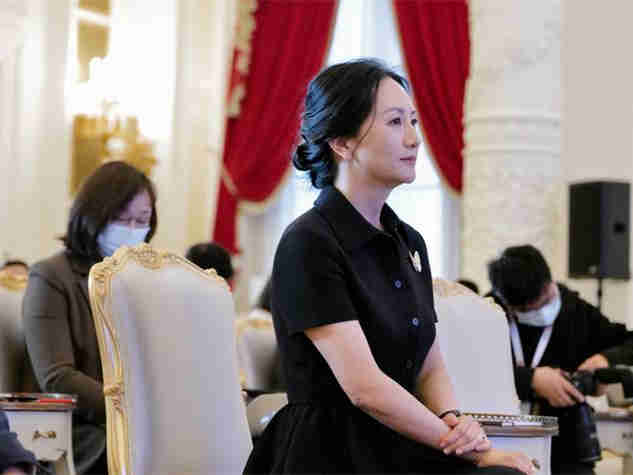
3月31日,华为深圳总部的大报告厅内,大盏的水晶吊灯高高地悬垂着。年报发布会现场,身着一袭黑色套装的孟晚舟,第一次正面回应接班问题。
“公司治理章程已经明确,我们是体制的接班,制度的接班,不是某个个人的接班”,她说,华为是集体领导,不会把公司命运系于某个人身上,“我和其他的两位轮值董事长是一样的”。
这番回应,几乎推翻了任正非此前的表态。
2018年12月孟晚舟在加拿大被拘押后,一向低调的任正非密集接受了数十家中外媒体的采访,一遍又一遍地对外声明:孟晚舟不会成为华为接班人。被问及会不会因为孟晚舟在加拿大的遭遇,重新评估她在公司的未来发展时,任正非也不松口,“回来还是做她的CFO”。
结果,CFO还在继续当,同时,孟晚舟也升了职。2022年4月1日,50岁的她接替郭平的位置,成为华为有史以来最年轻的轮值董事长,和徐直军、胡厚崑并列,并于一年后的今天正式当值。
在华为目前的组织架构中,董事长一职偏形式,更多履行的是担任法人等象征性职责。轮值董事长才是权力中心,在轮值期间是公司经营管理及危机管理的最高责任人,对公司生存发展负责。
但董事会里更引人注目的面孔是任正非。直到目前,78岁高龄的他还担任着董事和CEO的角色。重要的是,他还保留有可以被继承的一票否决权。
按任正非的说法,早在轮值董事长还被称作轮值CEO的十年前,他“实际上已经是交班了”,在华为的经营管理中并不行使决策权,只行使否决权,但在他看来,否决权就像“达摩克利斯之剑”,轻易不使用,直到2015年“没有否决过一件事情”。将来这份权力可以被继承,但继承者不会是自己的家人,而是交给公司的领导团队轮流管理。
二、从“公主”到“英雄”
任正非此前说孟晚舟不会接班,给出的理由是她不具备成为领袖的条件。
他觉得,华为的接班人一定要有技术洞察能力,以及对未来技术和客户需求的判断能力。孟晚舟“在管理上是优秀的”,但是作为领袖,要能够像灯塔一样给企业指路,要看得见十年、二十年以后的未来,这方面她“有缺点”。
很难说,孟晚舟技术背景的不足,短短几年间能不能被补齐。哪怕任正非还曾透露,她在加拿大期间自学五六门功课,“准备读一个‘狱中博士’出来”。但从结果来看,这一段特殊经历,的确让一些事情起了变化。
在中国的语境里,公众经常将企业家的子女称为“太子”和“公主”。
孟晚舟也不能免俗。一直以来,她都顶着“华为公主”的名号,连财经体系所在的办公楼,都被内部员工叫做“公主楼”。比起CFO的工作和职务,“老板女儿”的身份似乎更加突出。
但这一次从加拿大回来,她在不少人心里的形象,加上了一层“英雄”滤镜。2021年9月25日晚,深圳第一高楼平安金融中心的霓虹灯在夜空中格外醒目,上面写着“欢迎孟晚舟回家”。在加拿大经历了1028天的监视居住后,孟晚舟终于落地深圳,哽咽着和前来迎接她的人们打招呼。
一个月后的10月25日,孟晚舟回华为总部上班,现场传回的视频里,公司员工难掩兴奋,里三层外三层将她围住,不时有人高呼“女神”。
漫长的“禁闭”时光里,孟晚舟在华为的同事们,在公司心声论坛为她盖起了“高楼”。在孟晚舟2019年5月9日给所有华为人的一封信下,长达50页、3000多条的留言里,齐刷刷地写着“孟总加油”“晚舟早归”的呐喊和祝愿。
论坛的首页,至今还挂着一张飞机的图片,配文“没有伤痕累累,哪来皮糙肉厚,自古英雄多磨难”——孟晚舟在加拿大的经历,曾经被任正非形容为一次“磨难”。在他眼里,脚踝拴着电子镣铐、失去自由的女儿,就像二战中的一架轰炸机,被打得千疮百孔还在坚持飞行,“如果返航了,就是英雄了,我估计她将来有可能会当英雄”。
三、战功
“英雄”叙事里的伤痕累累,是为集体做出的牺牲。
有人想到了《战国策》名篇《触龙说赵太后》中,被齐国指定做人质的赵国王子长安君——在大臣触龙看来,即使王子地位尊贵、俸禄丰厚,没有功勋劳绩,也很难在母亲赵太后百年之后,于朝中立足。但他出质齐国,牺牲自己的自由为赵国搬来救兵、立下功劳,便没有人不服气了。
但名气终究是虚的。孟晚舟上位,或许还需要一些更扎实的东西。
在华为财经工作了近十年的程诚觉得,在老板(任正非)心中,比起女儿的前程,企业可能会更重要一些,“那是他的毕生心血,如果孟总已经准备好了,我觉得(接班)就水到渠成的事儿,如果孟总自己业务上的东西没起来,相信任总也不会做这个决定”。
可以作为参照的例子,是孟晚舟的弟弟任平。
早在2010年左右,任正非有意让儿子任平接棒的流言传得沸沸扬扬,华为官方辟谣也没用。那年冬天,财新传媒创始人胡舒立当面询问任正非,后者“有些激动地讲了儿子的成长故事,他的爱好、志向和特点,表示绝无可能”。后来,孟晚舟就任CFO后还专门澄清过,任平去了华为旗下慧通公司当总经理,和华为主营业务没有关系。
华为前副总裁刘平在《华为往事》里比较过这姐弟俩。他去华为的时候,中学毕业的孟晚舟在公司前台当接待员,“一看就知道是任总的女儿,长得酷似任总”,待人随和,毫无老板女儿的架子,重点是非常勤奋,一边工作、一边读书。而任平“没有他姐姐那么勤奋”,有一次打电话给任正非,“爸,告诉你一个好消息,这次考试我有一门课考了60分”。
孟晚舟刚进入华为时,也没有受到“老板女儿”的身份庇护。1993年,21岁的她从最基础的“杂活儿”做起,先是坐在前台当电话接线员,慌乱的时候老是拨错号码。后来接触了财务,出差去莫斯科,将几十捆卢布换成美钞时,还少换了100美金。
一路磕磕绊绊,历任公司国际会计总监、华为香港公司首席财务官、账务管理部总裁后,她才在2011年坐上CFO的位子。
据华为官方讲述,从2003年起,孟晚舟先是建立起全球统一的华为财经组织架构、流程、制度和IT平台,后来又在华为全球推行IFS(集成财经服务)变革,主导建立了五个华为的账务共享中心,覆盖和支撑了华为全球的会计核算工作,并推动华为全球集中支付中心在深圳落成。
财经系统建立的意义在于,用更高的效率、更低的成本,运转起这个庞大帝国的吞吐。2017年新年,孟晚舟回顾华为财经取得的成绩时,不无骄傲:“账务核算已经实现了7X24小时循环结账机制,充分利用了我们共享中心的时差优势,在同一数据平台、同一结账规则下,共享中心接力传递结账作业,极大缩短了结账的日历天数。24小时系统自动滚动调度结账数据,170+系统无缝衔接,每小时处理4000万行数据,共享中心‘日不落’地循环结账,以最快的速度支撑着130多家代表处经营数据的及时获取。”
系统节约了人的时间,华为的财务们有更重要的任务。
经历过全过程的程诚说,任正非和孟晚舟的要求是,所有财务都要懂业务,“能够往前扑到客户那儿去”,不论是跟客户谈判、优化合同条款,还是跑银行、盯重点项目的融资,这些在别的公司或许是客户经理和产品经理的活儿,华为的财务都要做,不少BP岗位还背着经营的绩效KPI。
在他看来,这和华为内部讲究战功的文化紧密相关,“所谓战功就是你能不能搞定客户”,搞定了一切封赏、升迁都好说。反之,如果客户没搞定,目标没达成,“就非常尴尬了”。在程诚看来,华为财经的风格和整个公司高度一致,“下了目标死都要完成,否则‘提头来见’,你这个人就要被干掉了”。
什么是称职的CFO?任正非说,“是CEO下台,CFO可以随时接任CEO”,这样才算合格。这句话,恰恰是孟晚舟如今的处境。
四、暴风雨中掌舵
制裁的巨雷劈下之后,华为陷入了至暗时刻。
2022年3月28日,孟晚舟回国后第一次公开亮相,华为交出了一份收入大跌28.6%的年报,很重要的一个原因是供应链持续承压,遭遇了美国多轮的制裁,华为手机、PC等业务受到了很大的影响。
同年8月,暑热还未散尽的时候,任正非宣布,整个公司的经营方针要从追求规模转向追求利润和现金流,“把活下来作为最主要纲领,边缘业务全线收缩和关闭”,让不少人倒吸好多口凉气。
“我们身处暴风雨之中,但我们继续在雨中奔跑。”3月31日的年报会上,即将结束这一任期轮值的徐直军,给华为的2023年定了调子。虽然去年底,他曾表示华为正退出 “危机模式”,但交到孟晚舟手里的华为,仍然要在风浪中穿行。
最受关注的,是财报上的核心数字。收入几乎没变,净利润却下降了68.7%,只剩356亿。这还没扣除去年出售子公司的持续性收入,扣了的话利润的数字将更加惨淡。
具体看各个板块,整个2022年,贡献超过四成的运营商业务,增长几乎停滞;华为手机等硬件在内的终端业务收入,下降12%至2145亿元。只有包括云计算、ICT硬件等在内的企业业务收入,还算华为年报中的亮点,同比增长了30%到1332亿元,贡献率持续提高。
年报发布前夕,华为新一届董事会选举出来了,更多的新面孔跻身权力中心。从入选董事会的新成员看,多是华为核心业务的一把手,涉及华为云、数字能源、软硬件、ICT解决方案、HR人力资源、供应等部门。
华为希望调拨精兵强将“多打粮食”的心,摆到了台面上。而推至华为管理层面前的难题,只多不少。芯片存货接近用完,有记者催问这些年老生常谈,却也是大家最关注的问题——华为手机什么时候能用上5G芯片?徐直军套话都不愿意多说,直接表示:这要看美国商务部什么时候许可了,许可了,华为立马整5G,还能做折叠屏。
正式掌舵前,孟晚舟也频繁出现在各种场合,提前进入了轮值董事长的角色。
今年2月7日这一天,她在北京带队走访了两家央企,先和全球最大的综合性建材产业集团中国建材集团签订了战略合作协议,又拜访了中国华能集团,希望华能给华为“出题目”,双方能在数字化、煤炭、新能源等领域持续深入合作——过去,这些拜访重量级客户的场合,一般都是任正非亲自出马;如今,给华为拓展朋友圈的重任交给了孟晚舟。
某种程度上,以孟晚舟目前的影响力,她已经可以独当一面。虽然华为最有权势的人还是任正非,但进入了最高决策圈的孟晚舟,已经不仅仅是任正非的女儿,她已经可以代表华为。
任正非的“寒气论”说了没多久,她在去年9月开学季,回到位于贵州的母校都匀一中,通过一场演讲为收缩战线的大方向做了注脚,“未来不是省出来的,未来靠持续的投入,和人才的持续奋斗得来”。换句话说,华为依然需要人才,依然会投入精力吸引人才,但人才也要能够持续奋斗、为结果负责。
程诚的观察是,孟晚舟在对外表态中,既延续了任正非的思想,又形成了自己的风格。任正非喜欢用很通俗很粗的话,告诉员工一个很深的道理,但孟晚舟似乎打算将小清新贯彻到底,几乎每次演讲、发文章都会引用古诗词,或者铺大段大段的排比,文绉绉的。
五、傀儡与影子
2019年11月接受欧洲新闻台采访时,任正非再次被问及,你想看到将来谁来接替你?
“如果说交接班,其实我们已经完成很多年了,不是现在才交接班。”他的回答听上去有点倦了,“公司一直在运转,我只是悬在中间的一个傀儡。不要操心这个问题”。
“傀儡”的角色据他理解,是在与不在,对公司都没有太大影响。华为的管理制度是向IBM学的,当时对方顾问向任正非提了一个问题:管理变革最终就是把你“杀”掉,让你没有权力,你有没有这个决心?他的答案是肯定的。
但从华为的实际运转看,任正非却像影子一样,无处不在。
公司陷入危急时刻,他冲到了舆论第一线。在华为创立的前20多年,任正非极其低调,几乎没有接受过媒体访谈,直到2013年才露了第一次面。但孟晚舟被拘捕后的2019年,时年75岁的他让华为的公共关系部给他安排了30多场采访,文字整理出来超过20万字。其中,来自华为制裁方美国的媒体比例最高。
他告诉记者,这么做是因为“我在危难时期要挺身而出,为华为公司正确地做一些宣传”。
而当内部战略出现分歧时,也是他出来一锤定音。2020年11月,任正非签发文件强调“华为不造车”,同时,措辞非常严厉地表示,“以后谁再建言造车,干扰公司,可调离岗位,另外寻找岗位”,并在文章底部标明,本文从发文之日起生效,有效期为3年。
就在3月31日,距离上一份文件失效还有几个月的时候,任正非再次签发决策公告,强调“华为不造车”,“有效期5年”,并且严格要求不能让“华为”或“HUAWEI”出现在整车宣传和外观上,“华为问界”、“HUAWEI AITO”都不行。
这个决策直接指向了负责问界品牌的华为智选车业务部,早在2月份的时候,问界的不少宣传物料,已经带上了“HUAWEI”字样。负责人余承东似乎有点气不过,当晚跑到心声论坛相关帖子下留言:“这个时代变了,这只会让我们更加艰难!若干年后,大家都会看明白的!留给时间去检验吧!”过了一会儿,这一条又消失了。
华为或许可以离开任正非,但任正非却无法完全抛下华为,而孟晚舟离真正可以掌舵华为,还有很长很长的路要走。
翻译:
Ren Zhengfei, founder and CEO of Huawei, has declared on different occasions and more than once that his daughter Meng Wanzhou will not take over the leadership.
One of the strongest negatives came in an interview in February 2019. He looked at the BBC reporter. “She will never be able to succeed her because she has no technical background.”
Four years later, things have changed. Meng Wanzhou will be Huawei’s rotating chairwoman for the first time in six months from today. Huawei made it clear in its official statement that she was the company’s top leader during this period.
The woman, who dresses delicately and in high heels for every occasion, was once described by The New York Times as the “face” of Huawei, the “elegant, professional face of a tech giant that has long been opaque to the outside world.” When she made her debut as CFO a decade ago, she was seen as evidence that Huawei was trying to be open.
Now, she has stepped out of the label of “daughter of the founder” and “face of Huawei”, and started to truly participate in steering the ship and facing the storm.
Succession
A crystal chandelier hangs high in the lecture hall at Huawei’s headquarters in Shenzhen, on March 31. At the annual report conference, Meng Wanzhou, dressed in a black suit, addressed the succession issue for the first time.
“The corporate governance charter has made it clear that we are the successor of the system, the system, not an individual,” she said, adding that Huawei is a collective leader and will not tie the fate of the company to any one person. “I am the same as the other two rotating chairmen.”
The response all but reversed Mr Ren’s previous statements.
After Meng Wanzhou was detained in Canada in December 2018, the normally low-key Ren Zhengfei gave interviews to dozens of Chinese and foreign media, repeatedly stating that Meng Wanzhou would not be the successor of Huawei. When asked whether he would reassess Meng’s future at the company because of her experience in Canada, Ren said, “I will still be her CFO.”
As a result, Meng stayed on as CFO and was promoted. On April 1, 2022, at the age of 50, she took over Guo Ping’s position as Huawei’s youngest ever rotating chairman, tied with Xu Zhijun and Hu Houkun, and officially took office one year later today.
In the current organizational structure of Huawei, the position of chairman is more formal and performs more symbolic duties such as acting as a legal person. The rotating chairman is the power center. During the rotating period, he is the highest responsible person for the company’s operation and crisis management and responsible for the company’s survival and development.
But the more prominent face on the board is Ren Zhengfei. Until now, the 78-year-old has held the roles of director and CEO. Importantly, he retains a veto that can be inherited.
According to Ren Zhengfei, ten years before the rotating chairman was called the rotating CEO, he “actually took over”. He did not exercise decision-making power in Huawei’s operation and management, but only exercised veto power. However, in his opinion, veto power was like the “sword of Damocles”, which was easily not used. In the future, this power can be inherited, but it will not be inherited by one’s family. Instead, it will be handed to the company’s leadership team in turn.
From “Princess” to “Hero”
Mr. Ren previously said Ms. Meng would not take over, citing the fact that she didn’t have what it takes to be a leader.
He believes that the successor to Huawei must have technical insight and the ability to judge future technologies and customer needs. Meng is “excellent in management”, but as a leader, she has “shortcomings” in being able to act as a beacon to guide the company and to see beyond 10 or 20 years.
It is hard to say whether Meng’s lack of technical background can be made up in just a few years. Ren even revealed that she taught herself five or six courses during her stay in Canada and “planned to do a ‘doctor in prison’”. But as it turned out, this particular experience did change things.
In the Chinese context, the public often refers to the children of entrepreneurs as “prince” and “princess”.
Meng Wanzhou is not immune. For a long time, it has been under the name of “Princess of Huawei”. Even the office building where the financial system is located is called “Princess Building” by internal employees. Her role as the boss’s daughter is more prominent than her job and title as the CFO.
But this time back from Canada, her image in many people’s minds, added a layer of “hero” filter. On the evening of Sept 25, 2021, the neon sign of Ping An Finance Center, the tallest building in Shenzhen, stands out in the night sky, reading “Welcome home Meng Wanzhou”. After 1,028 days under surveillance in Canada, Meng Wanzhou finally landed in Shenzhen, where she sobbed as she greeted the crowds who came to greet her.
A month later, on October 25, Meng went back to work at Huawei headquarters.
In the video sent back from the scene, employees could not hide their excitement and surrounded her on the third floor and the third floor. Some people shouted “goddess” from time to time.
During her long confinement, Meng’s colleagues at Huawei built a “tower” for her on the company’s voice forum. Under Meng Wanzhou’s letter to all Huawei employees on May 9, 2019, more than 3,000 messages in 50 pages were written with shouts and wishes of “Come on, General Manager Meng” and “Late boat and early return”.
On the front page of the forum, there is still a picture of an airplane with the caption, “No scars, no rough skin, thick flesh, heroes of ancient times suffer more” — Meng Wanzhou’s experience in Canada was once described by Ren Zhengfei as an “ordeal”. In his eyes, his daughter, chained electronically to her ankles and free, is like a bomber in World War II, riddled with holes and still flying. “If she turns back, she’ll be a hero, and I think she might be one in the future.”
War achievements
The scars in the “hero” narrative are the sacrifices made for the collective.
Some people think of the famous article of the War State Policy, Touching the Dragon Says to the Empress Dowager Zhao. In the opinion of the minister, Touching the Long, Prince Chang ‘an of the State of Zhao, who was appointed as a hostage by the State of Qi, even if the prince had a noble status and a rich salary, without merit and service, it would be difficult for him to stand a foothold in the court after his mother, the Empress Dowager Zhao, for one hundred years. However, he sacrificed his own freedom to help the state of Qi and made great contributions to the state of Zhao. No one was displeased with him.
But fame is false. Ms. Meng may need something more solid.
Cheng Cheng, who has worked in Huawei Finance for nearly ten years, thinks that in the boss’s (Ren Zhengfei) heart, the enterprise may be more important than his daughter’s future, “It is his life’s work, if Meng is ready, I think (succession) will come naturally, if Meng’s own business things do not rise, I believe Ren will not make this decision”.
A case in point is Ren Ping, Meng Wanzhou’s brother.
As early as around 2010, rumors circulated that Ren Zhengfei intended to appoint his son Ren Ping to take over, and Huawei’s official denial of the rumors was useless. That winter, Hu Shuli, the founder of Caixin Media, confronted Ren, who “somewhat excitedly told his son’s growing up story, his hobbies, ambitions and characteristics, and said it was impossible.” Later, Meng Wanzhou made it clear that Ren Ping went to work as the general manager of Huitong, a subsidiary company of Huawei, which had nothing to do with Huawei’s main business.
Former Huawei vice President Ping Liu compared the two siblings in “Once Upon a Time in Huawei.” When he went to Huawei, Meng Wanzhou, who graduated from middle school, worked as a receptionist at the reception desk of the company. “I could tell at a glance that she was the daughter of Ren, who looks like Ren.” She was easy-going and had no AIRS like the boss’s daughter. Ren Ping, “not as diligent as his sister”, once called Ren Zhengfei and said, “Dad, I have a good news for you. I got 60 points in one course of this exam.”
Nor was Ms. Meng shielded from the “boss’s daughter” status when she first joined Huawei.
In 1993, at the age of 21, she started with basic chores, working at the front desk as a telephone operator and constantly dialing wrong numbers in a panic. Later, I got in touch with the financial department. When I went on a business trip to Moscow, I changed dozens of bundles of rubles into American notes, but I was short of 100 dollars.
After a bumpy career as the company’s international accounting director, chief financial officer of Huawei’s Hong Kong operations and president of accounting management, she was appointed CFO in 2011.
According to Huawei’s official story, since 2003, Meng Wanzhou first established the global unified financial organization structure, process, system and IT platform of Huawei. Later, she carried out the reform of IFS (integrated financial services) in Huawei worldwide, led the establishment of five accounting sharing centers of Huawei, covering and supporting the accounting work of Huawei worldwide. And promote Huawei global centralized payment center in Shenzhen.
The point of the financial system was to run the vast empire with greater efficiency and lower costs. In the New Year of 2017, when reviewing the achievements of Huawei Finance, Meng Wanzhou was not without pride: “Accounting has realized the 7X24 hours circular settlement mechanism, making full use of the advantage of time difference of our shared center. Under the same data platform and the same settlement rules, the shared center relays settlement operations, greatly shortening the calendar days of settlement. 24 hours system automatic rolling scheduling checkout data, 170+ system seamless connection, processing 40 million lines of data per hour, sharing center ‘never sets’ cycle checkout, with the fastest speed to support the timely acquisition of business data of more than 130 representative offices.
The system saves people’s time, and Huawei’s accountants have more important tasks.
Mr. Cheng, who has been through the whole process, said that Ren and Meng’s requirements were that all financial staff should understand business and “be able to jump forward to customers.” Whether it was negotiating with customers, optimizing contract terms, or going to the bank to focus on financing key projects, Huawei’s financial staff would do all the work that might be done by account and product managers at other companies. Many BP positions also carry performance KPIs of management.
In his opinion, this is closely related to the internal culture of Huawei, which values meritorious service. “The so-called meritorious service is whether you can win the customer or not.” On the other hand, if the client doesn’t close and the goal isn’t met, “it’s very embarrassing.” In Cheng Cheng’s view, the style of Huawei finance and the whole company is highly consistent, “under the target to complete, otherwise ‘raise the head to see’, you this person will be killed”.
What makes a good CFO? Ren Zhengfei said, “If the CEO steps down, the CFO can take over the CEO at any time.” These words are precisely Meng’s current situation.
Steer through a storm
After the great thunder of sanctions fell, Huawei fell into the darkest hour.
On March 28, 2022, when Meng Wanzhou made her first public appearance after returning to China, Huawei submitted an annual report with a revenue drop of 28.6%. One important reason is that the supply chain is under continuous pressure and Huawei suffered multiple rounds of sanctions from the United States, which greatly affected Huawei’s mobile phone and PC businesses.
In August of the same year, before the summer heat was over, Ren Zhengfei announced that the company’s management policy would shift from the pursuit of scale to the pursuit of profit and cash flow. “Survival will be the most important program, and all marginal businesses will shrink and close down,” which made many people gasp.
“We were in the middle of a storm, but we kept running through the rain.” At the annual report on March 31, Xu Zhijun, who will soon end his term, set the tone for Huawei’s 2023. Although he said late last year that Huawei was exiting “crisis mode”, the company in Meng’s hands still has to navigate stormy waters.
Most attention is paid to the core numbers in the earnings report.
Revenue barely budged, but net profit fell 68.7% to $35.6 billion. That is before continuing gains from the sale of subsidiaries last year, which would have made the profit figure even bleaker.
Looking at each sector specifically, in 2022, the growth of the carrier business, which contributed more than 40%, almost stagnated; Revenue from Huawei’s terminal business, which includes hardware such as phones, fell 12 percent to 214.5 billion yuan. Only enterprise revenue, which includes cloud computing and ICT hardware, was a bright spot in Huawei’s annual report, growing 30 percent year on year to 133.2 billion yuan.
On the eve of the annual report, Huawei’s new board of directors was elected, bringing more new faces into the power center. Most of the new board members are leaders in Huawei’s core businesses. Including Huawei Cloud, digital energy, hardware and software, ICT solutions, HR and supply departments.
Huawei hopes to mobilize talented troops to “more grain” heart, put on the table. Huawei’s management faces only a few more difficult questions. As the stock of chips is running out, a reporter asked the perennial question. But also the most concerned question — when will Huawei phones be able to use 5G chips? “It depends on when the U.S. Department of Commerce will approve it,” Xu said. “When it does, Huawei will immediately complete 5G and make folding screens.”
Before taking the helm, Meng also appeared frequently on various occasions and entered the role of rotating chairman in advance.
On February 7 this year, she led a team to visit two state-owned enterprises in Beijing.
First, she signed a strategic cooperation agreement with China National Building Materials Group. The world’s largest comprehensive building materials industry group. And then visited China Huaneng Group, hoping that Huaneng could “show problems” to Huawei. And the two sides could continue to deepen cooperation in the fields of digitalization, coal and new energy. These visits to heavyweight clients are usually made by Ren himself;. Now it is Meng Wanzhou who is responsible for expanding Huawei’s circle of friends.
To some extent, with her current clout, Ms. Meng can stand alone. Although Ren Zhengfei is still the most powerful man at Huawei, Meng Wanzhou, who has entered the highest decision-making circle, is no longer just Ren’s daughter. She can now represent Huawei.
Not long after Ren Zhengfei’s “chilling theory” was said. She returned to her Alma mater Duyun No. 1 Middle School in Guizhou Province in September last year and made a note of the general direction of shrinking the front through a speech. “The future is not saved, the future depends on continuous investment and continuous struggle of talents.” In other words, Huawei will still need talent, and will still invest in attracting talent, but they will also need to be able to work consistently and take responsibility for results.
Cheng’s observation is that Meng has not only continued Ren Zhengfei’s thoughts, but also formed her own style. Ren likes to use very vulgar words to tell employees a profound truth. But Meng seems to plan to follow through on the small fresh, almost every speech and article will quote ancient poetry, or write a long paragraph of comparison, literary.
Puppets and Shadows
In an interview with Euronews in November 2019,. Ren was asked again who would you like to see succeed you in the future?
“If we talk about the transition, we have done it for many years, not just now.” “The company has been running,” he says, sounding tired. “I’m just a puppet in the middle. Don’t worry about it.”
The role of the “puppet”, as he understood it, was in and out, and had little impact on the company. Huawei learned its management system from IBM. At that time, the consultant of IBM put a question to Ren Zhengfei:. Management reform will ultimately “kill” you and leave you without power. Do you have this determination? His answer is yes.
But from the actual operation of Huawei, Ren Zhengfei is like a shadow, everywhere.
When the company was in crisis, he rushed to the front line of public opinion. For the first two decades of Huawei’s existence, Ren kept an extremely low profile, giving few media interviews until 2013. But in 2019, after Ms. Meng’s arrest, Mr. Meng, then 75, had Huawei’s public relations department arrange more than 30 interviews with more than 200,000 words. Among them, the media from the United States, where Huawei has been sanctioned, has the highest proportion.
He told reporters that he did so because “I wanted to stand up and do some proper publicity for Huawei during the crisis”.
And when internal strategies diverged, it was he who made the final call. In November 2020, Ren Zhengfei issued a document emphasizing that “Huawei does not build cars”. At the same time, he expressed in very strict terms that “anyone who proposes to build cars again and disturbs the company in the future can be transferred from his post and find another position”. At the bottom of the article, he indicated that this article would take effect from the date of publication and be valid for three years.
On March 31, a few months before the previous document was due to expire. Ren Zhengfei issued a decision notice again, emphasizing that “HUAWEI does not build cars”, “valid for five years”, and strictly requiring that “HUAWEI” or “Huawei” should not appear on the vehicle’s publicity and appearance. And that “Huawei Wenjie” and “HUAWEI AITO” would not be allowed.
This decision is directly directed at the car selection department of HUAWEI, which is in charge of the Q brand. As early as February, many of the promotional materials of Q brand had already been printed with the word “Huawei”. Yu Chengdong, the head of the company, seemed to be a little angry. That night, he left a comment on a related post on the Inner Voice forum:. “Times have changed, and this will only make it harder for us! In a few years, everyone will see! Leave it to time to find out!” After a while, this one disappeared again.
Huawei may be able to get rid of Ren, but Ren can’t completely get rid of Huawei. And Meng still has a long, long way to go before she can really take the helm of Huawei.
本文由CXO UNION-CXO联盟(cxounion.cn)转载而成,来源于网络;编辑/翻译:CXO UNIONCXO联盟小C。
如需加入CXO UNION(CXO联盟)高管社群,请联系社群小伙伴哦~
免责声明: 本网站(http://www.cxounion.cn/)内容主要来自原创、合作媒体供稿和第三方投稿,凡在本网站出现的信息,均仅供参考。本网站将尽力确保所提供信息的准确性及可靠性,但不保证有关资料的准确性及可靠性,读者在使用前请进一步核实,并对任何自主决定的行为负责。本网站对有关资料所引致的错误、不确或遗漏,概不负任何法律责任。
本网站刊载的所有内容(包括但不仅限文字、图片、LOGO、音频、视频、软件、程序等) 版权归原作者所有。任何单位或个人认为本网站中的内容可能涉嫌侵犯其知识产权或存在不实内容时,请及时通知本站,予以删除。
如需加入CXO UNION(CXO联盟)高管社群,请联系社群小伙伴哦~

免责声明: 本网站(http://www.cxounion.cn/)内容主要来自原创、合作媒体供稿和第三方投稿,凡在本网站出现的信息,均仅供参考。本网站将尽力确保所提供信息的准确性及可靠性,但不保证有关资料的准确性及可靠性,读者在使用前请进一步核实,并对任何自主决定的行为负责。本网站对有关资料所引致的错误、不确或遗漏,概不负任何法律责任。
本网站刊载的所有内容(包括但不仅限文字、图片、LOGO、音频、视频、软件、程序等) 版权归原作者所有。任何单位或个人认为本网站中的内容可能涉嫌侵犯其知识产权或存在不实内容时,请及时通知本站,予以删除。
Search
Popular Posts
-

2024数字化灯塔案例评选申报开启!
“2024数字化灯塔案例评选”于3月正式启动,诚挚欢迎业界同仁自荐和推荐,一起推动产业数字化进程,助力赋能企业…
-

2024 X-Award星盘奖申报通道已开启!
X-Award星盘奖是数字化转型服务、IT服务行业重要的商业奖项,旨在表彰行业里提供杰出数字化转型服务与IT服…
-

2024 N-Award星云奖申报通道已开启!
N-Award是数字化转型领域重要的商业奖项,旨在表彰那些以非凡的远见、超群的领导才能和卓越的成就来激励他人的…