一、不是CIO一个人战斗,需要排兵布阵闭环
当今时代,已不用讨论要不要数字化转型,而是怎么转的问题。人在事先,首先就要明确参与者。通常大家理所当然地认为,这不就是CIO(首席信息官)或CDO(首席数字官)的事吗?然而数字化转型99%的失败率用惨痛的事实告诉我们,还真不能全靠CIO及其带领的团队。西天取经的路上,还需要各路神仙CXO们的保驾护航。
在笔者十余年头部企业经营管理、创业、数字化转型的经历中,负责过运营、供应链、BI、财务、融资、战略等各种部门,与各种CXO都直接打过交道,深刻感受到转型其实也是一部各种“O”们的相爱相杀史。
接下来我们就由表及里来看转型到底包括哪些,哪些是CIO力所能及的,哪些是需要其他部门岗位配合的,最终环环相扣拼成一个完整闭环,将各路CXO排兵布阵于闭环上,而不是毫无章法一起往前冲打乱仗,方可完成转型大业。每一个点怎么做不难找到答案,但拼凑起的豪华阵容为什么仍然打败仗?CXO常有,而把CXO这些珍珠串起来的线不常有,这条线就是闭环。
先从一个看似离奇而值得深思的故事讲起。有一天知名企业家、联想控股陈绍鹏先生邀请笔者,在联想佳沃集团管委会年中大会上,做“数字化转型”的演讲。笔者之前从未认为自己是专门做“数字化转型”的,甚至也没管过研发部门。
原来在别人看来,笔者之前干的是“数字化转型”,从表面来看确实是用了一些数字化、数据的思维与工具来改造传统行业,从而实现了盈利的提升、估值的上涨、融资的成功,但这只是IT技术层面的事吗?
实际上在那4小时的演讲中,讲的是技术、业务、组织、文化等各个环节的配合,才有了最终转型的成果,当然这也正是邀请人的用意,想让高层拉齐认知。1.0版的数字化转型闭环就这么诞生了。
二、从商业价值倒推应用化,CEO/CFO双向奔赴
那次演讲更令人万万没想到的,在开头一个多小时里,主要讲的是财务模型/商业计划。这好像离数字化就更远了,特别是集团和子公司这些高管、企业家,需要用年中大会的时间来学财务吗?
但这部分恰恰成了反响最强烈的,实际上当时讲的是如何以终为始,从商业战略的量化表达形式,也就是财务模型、盈利模型,一步步倒推出真正有效的业务措施、运营模式,直至有效的数字化抓手建设。通过贯穿技术、业务、财务/战略的视角,尽量做到定量衡量数字化建设的终极价值:盈利与市值估值的提升空间。
做正确的事,比正确地做事更重要。要数字化转型,首先要搞清终极目的是什么,可以分为三个层次境界。
- 最表面的两个层次,对内是技术先进,对外是提高用户体验。但商业决策从来都是投入产出的权衡,不计成本的“极致用户体验、提升技术”都是耍流氓,光靠烧钱的企业近年已死掉一大批。
- 也有人意识到数字化要满足业务需求,但这就是终局了吗?现实中,有的业务指标提升并不等于盈利的提升,甚至起反作用,例如在UE(单位盈利模型)没有跑通的情况下盲目扩大规模,卖得越多亏得越多、死得越快;有的业务效率提升,同样不见得是盈利关键,例如产品滞销库存一大堆,这时候去优化生产系统、提高作业效率,南辕北辙。一些企业认知的“效率”只是狭义的执行效率,而不包括决策效率;认知的“业务指标”也是狭义的。
- 由此可见,不仅技术存在自嗨,业务同样也存在,有效的业务模式、指标、效率,需要通过盈利这个终极目的来反推,华为的IPD里“客户商业模式成功”才是最高级的客户成功。
CIO需要参与到企业的商业模式设计中来,数字化要融入盈利模型、商业计划里,当然这对往往技术背景出身的CIO有挑战,一方面要靠自身的商业领域学习,另一方面CEO、CFO(首席财务官)也要了解数字化,向CIO靠拢,而不是只能把数字化投入当成无法衡量商业价值的无底洞“跟着感觉走”,CIO与CEO/CFO“双向奔赴”才是王道。
三、从应用化倒推数据化,CMO/COO开飞机谁来造飞机
完成了从盈利算账倒推业务应用场景、运营措施的第一步,是不是就万事大吉了呢?
不少公司看到了同行引入了互联网大厂的数字化业务“应用型”高手,例如CMO(首席营销官)领头的数字化营销、CGO(首席增长官)为代表的增长团队、COO(首席运营官)下辖的运营或线下团队,表面上看就是有了这些人,数字化就见效了。于是依葫芦画瓢,但很快发现不过是空掌握了一身“屠龙术”,豪华阵容很快离去。
因为这些“光杆司令”过去的能力是建立在互联网大厂成熟的数据基础和配套团队之上的,也许他们是优秀的“飞行员”,但不是造飞机的“工程师”,更缺少BI“地勤团队”的指引。而数据平台的搭建,并没有想象中“照着天猫京东后台做一个”那么简单,否则也不会有那么多大公司甚至互联网巨头,虽然有自己强大的产研团队,但依然会采购第三方的数据产品和服务了。
数字化的CMO、CGO、COO,与BI团队、数据平台产品研发团队是相互成就的,好的飞行员需要先进的飞机,好的飞机也需要优秀的飞行员来驾驶。
四、从数据化倒推信息化,CTO大禹治水
经历了第二个坑,开始老老实实搭建数据平台了,但第三个坑接踵而至。
传统行业与纯互联网企业的数据治理基础很不一样,本身信息化基础就比较薄弱,很多数据没有埋点、拿不到,或者要从ERP等信息化IT系统中获取“水源”原始数据后,才能用算法模型做进一步加工,而不少源头本身就脏乱差。特别是当信息化系统发生问题、瘫痪,就会波及它的下游——DT数据化系统。这样的情况屡见不鲜。
即使是顶级的数据服务商,也难以解决信息化系统本身的问题,“造飞机”也分是造“战斗机”DT系统,还是制造给战斗机提供信息源燃料的“加油机”IT系统,很多传统企业分不清这两个的区别,酿成惨剧。进一步,“加油机”还分加什么型号的油——不同的数据类型,是“柴油”行为数据,还是“汽油”交易数据……
所以在这个闭环中的技术层面,针对转型企业特别区分了数据化和信息化两个不同环节,其系统、用人往往都有区别,信息化往往是数据化的前提,水源治理好了,用好水质才能烹饪出美味,CTO就是治水的“大禹”。
五、从信息化匹配流程化,COO请就位
越过了第三道坎,信息化源头也治理好了,是不是数字化就可以落地了呢?
IT系统用不起来是一个常见现象。不论在上市公司,还是创业公司,笔者都碰到过这样的问题,究其原因,既不是系统本身有bug,也不是操作培训不够,甚至还不是不用系统对业务没影响——因为人工操作已经发生过严重事故。最后发现,头痛医头站在信息化的层面是解决不了问题的。“三节课”平台还让笔者把这一系列经验录制成了课程。
信息化的本质往往是流程化的线上化、电子化。回想一下,财务软件,把记账报表搬到线上,但会计准则是没变的;OA报销,该谁审批还是谁审批,流程节点没变;ERP,采购生产也是类似。所以首先就要搞清楚、梳理好业务本身的流程,包括度量衡等标准的统一。
流程是个业务问题,CIO爱莫能助,特别在传统产业不像互联网业务那么“轻”,如果迷信“用工具就能倒逼流程”要吃大亏,甚至停工。COO这时候就要就位了。系统最终能用起来,无不是先匹配调整好了业务流程,然后系统才顺利落地。
流程化的需求有多大呢?德国公司Celonis通过数据挖掘、机器学习等分析手段,对企业软件和信息系统里的日志进行分析,从而发现、检测和改善真实的业务流程,提高业务效率,估值已超过130亿美元,可见流程化也是数字化转型的重要一环,可以诞生千亿级公司。
六、流程化匹配组织化,CHO缺不了
经历了第四难,请出了COO来解决业务流程问题,就成功取到真经了吗?
流程的调整,背后涉及的其实是组织岗位对应的职责范围,组织是骨架,而流程是附着其上的肌肉、血管。所以调整较大时,组织也要做相应的匹配,否则“叫破了嗓子也没人理你”。
组织的优化,从数字化转型的视角来看有一个衡量标准,是否有利于流程的优化进而使流程进系统、系统用起来。如果违背了这个原则,盲目照搬别的公司、互联网大厂的组织架构,往往画虎类犬适得其反。比如盲目“去中心化”反而把流程搞乱,盲目“赛马”让不同部门在同一渠道售卖相同产品、连售后服务标准都不一样,反而让用户品牌认知紊乱。
流程化最直接受组织架构影响、在数字化的过程中尤其明显,CHO责无旁贷。
七、组织化匹配文化,从一把手开始
第五关也闯过了,不少公司又很快发现,组织架构的模仿,学得了形但学不了神,一时的新鲜过后很快又变回了原样,甚至高价挖来的新人迅速又变旧人,因为文化土壤没变。
以史为鉴,人的认知就是从只学器物不变制度的技术层面开始的,结果发现先进工具先进武器依然会惨败;然后进行了业务层面、战法制度的变革,又是昙花一现;进而认知升级到组织层面,变革了架构,但依然不彻底;最终认知到文化层面才是根本的改变。
文化并不只是狭义的“使用数据、使用系统的习惯”,更深层的是人的文化诉求。在今年笔者与神策数据创始人专场直播”PK”,发布的2.0版数字化转型闭环中,用大量篇幅讲了文化→组织→业务→技术层面的层层渗透,例如OKR系统为何落不了地,显然不是缺乏使用习惯能够解释的,深层来自靠不透明的信息垄断建立等级秩序、靠神秘性彰显权威性的内心诉求。毫无疑问,文化是一个一把手工程,从上至下渗透,但最终全员参与。
八、数字化转型太极闭环与CXO图鉴
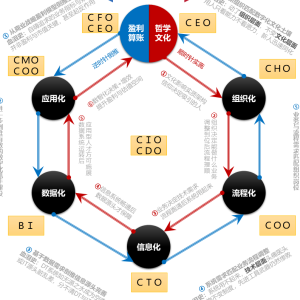
于是通过上面六个环节,如下图以终为始一步步倒推出了方案。从盈利算账反推到应用化业务场景,从应用又反推到支撑其模式的数据化抓手,从数据化倒推出需要的信息化基础与源头,进而匹配与信息化适应的流程化梳理,然后又匹配出流程化与组织化的调整,最后组织的变革还需文化土壤改良。
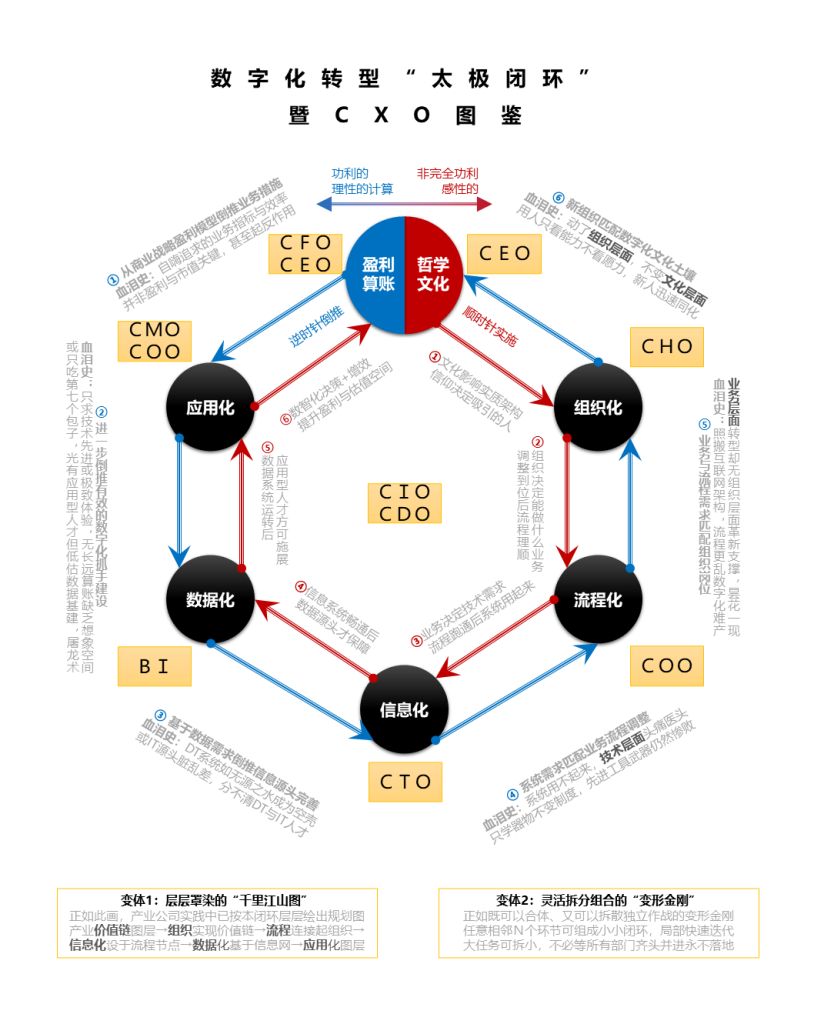
实施则是正向的,什么样的哲学文化决定了吸引什么样的人、有什么组织,组织又决定了能做什么业务、调整到位流程跑通,流程通畅了才能进系统让信息化落地,信息化源头保障了才有数据化平台的运转,进而数据与数字化工具能支撑新的业务场景与运营措施,最终有效的业务应用达到盈利与市值空间提升的目的。
正如太极云手,一手逆时针、一手顺时针,最终都能交汇。转型就是经营变革,而企业经营的原点,无论稻盛和夫先生所说的“一手抓哲学、一手抓算盘”、松下幸之助的“一手论语、一手算盘”,还是许多企业家提倡的“理念+算账”,都是类似的观点:一端是功利的、理性计算的盈利算账,另一端是非完全功利的、感性的哲学文化。企业有自己的使命愿景价值观,并非只求利益的团伙,“本我”的动物性与“超我”的神性,才组成“自我”的人性。
双原点组成了所谓企业战略,层层渗透到闭环每个节点、每位CXO的地盘,正反不断往复、相互转化,企业经营乃至人生的追求都是如此一个过程,如果只追求一端我们发现有时候会陷入无解的境地,这就是3.0版数字化转型闭环(俗称太极闭环)的核心。
沿着旧地图,找不到新大陆。希望这个闭环暨CXO图鉴,能让大家更清晰地看到数字化转型的“排兵布阵图”,掌握合力让企业数字化转型这个大盘转起来的方法,也希望有更多加入到完善这个闭环的事业中来,太极生两仪、两仪生四象,这个母体可以演变出不同细分版本,最终实现企业成功转型的美好未来!

翻译:
Love and kill, 9 CXO ICONS in Digital transformation
First, the CIO is not a person to fight, need to platoon closed loop
In today’s era, it is no longer a question of whether to digitally transform, but how to transform. In advance, we must first identify the participants. Isn’t it often taken for granted that it’s all about the CIO or the CDO? However, the 99% failure rate of digital transformation shows us that we can’t rely on the CIO and the team that leads it. On the way to the west, we also need the escort of various celestial CXOs.
In the author’s more than ten years of experience in business management, entrepreneurship, and digital transformation, he has been responsible for various departments such as operations, supply chain, BI, finance, financing, and strategy, and has directly dealt with various CXOs, deeply feeling that transformation is actually a history of love and killing among various “O”.
Next, we will look from the outside to the inside to see what the transformation includes, which is what the CIO can do, which is the need for other departments to cooperate with, and finally interlocking into a complete closed loop, the CXO platoon is deployed in the closed loop, rather than rushing forward without any rules to fight a disorderly war, in order to complete the transformation. How to do each point is not difficult to find the answer, but why did the luxury lineup still lose the battle? CXO often, and the CXO these pearls are not often strung together, this line is the closed loop.
Let’s start with a story that seems bizarre and worth thinking about.
One day, Mr. Chen Shaopeng, a well-known entrepreneur and Legend Holdings, invited me to give a speech on “digital transformation” at the mid-year general meeting of the Management Committee of Lenovo Gavo Group. I never thought of myself as a “digital transformation” guy, or even in charge of R&D.
Originally in the view of others, the author did before is “digital transformation”, from the surface point of view is indeed the use of some digital, data thinking and tools to transform the traditional industry, so as to achieve the improvement of profit, valuation rise, financing success, but this is only the IT technical level of things?
In fact, in the four-hour speech, it was about the cooperation of technology, business, organization, culture and other links that led to the final transformation, and of course, this was the intention of the inviter, who wanted to make the senior Raqi understand. Version 1.0 of the digital transformation closed loop was born.
Second, from the business value backward application, CEO/CFO two-way
What was even more surprising was that the first hour or so of the presentation was devoted to financial models/business plans. This seems to be further away from digitalization, especially the group and subsidiaries of these executives, entrepreneurs, need to use the time of the mid-year conference to learn finance?
But this part has precisely become the most intense response, in fact, it was about how to start from the end, from the quantitative expression of business strategy, that is, financial models, profit models, step by step to introduce truly effective business measures, operating models, until effective digital grasp construction. Through technical, business, financial/strategic perspectives, we try to quantitatively measure the ultimate value of digital construction: the room for improvement in earnings and market capitalization.
Doing the right thing is more important than doing it right. To digital transformation, we must first understand what the ultimate purpose is, which can be divided into three levels.
The two most superficial levels are technologically advanced internally and improve user experience externally. However, business decisions are always a trade-off between input and output, regardless of the cost of “extreme user experience, improve technology” are rogue, and a large number of companies have died in recent years by burning money alone.
There’s also the realization that digitization is about meeting business needs, but is that the end game?
In reality, the improvement of some business indicators is not equal to the improvement of profits, and even counterproductive, for example, in the case of UE (unit profit model) without running through the blind expansion of scale, the more sell the more loss, the faster the death; Some business efficiency improvement, the same is not necessarily the key to profitability, such as a large number of products unsalable inventory, this time to optimize the production system, improve operational efficiency, the opposite. The “efficiency” of some enterprises’ cognition is only the execution efficiency in a narrow sense, but does not include the decision-making efficiency. Cognitive “business indicators” are also narrow.
It can be seen that not only technology exists, but also business. Effective business model, indicators, and efficiency need to be reversed through the ultimate purpose of profit. In Huawei’s IPD, “customer business model success” is the highest customer success.
CIO needs to participate in the business model design of the enterprise, digitalization should be integrated into the profit model, business plan, of course, this often technical background of CIO has challenges, on the one hand to rely on their own business field learning, on the other hand, the CEO, CFO (CFO) also need to understand the digital, close to the CIO, Rather than treating digital investment as a bottomless pit that cannot measure business value, “go with your gut”, CIO and CEO/CFO “go both ways” is king.
Third, from application to data, CMO/COO fly the aircraft who will build the aircraft
After completing the first step of reversing business application scenarios and operational measures from profit accounting, is everything all right?
Many companies have seen peers introduce digital business “application” masters of the Internet giant, such as the digital marketing led by the CMO (chief marketing officer), the growth team represented by the CGO (Chief growth officer), the operation or offline team under the command of the COO (Chief operating officer), and the surface is that with these people, digitalization will take effect. So in accordance with the gourd, but soon found that it is only empty master a “dragon slaying”, the luxury lineup soon left.
Because the past capabilities of these “bare rod commanders” are based on the mature data base and supporting teams of Internet giants, perhaps they are excellent “pilots”, but not “engineers” who build aircraft, and lack the guidance of BI “ground crew”. The construction of the data platform is not as simple as “do one according to the background of Tmall Jingdong” in imagination, otherwise there will not be so many big companies or even Internet giants, although they have their own strong production and research team, but they will still purchase third-party data products and services.
Digital CMO, CGO, COO, BI team, data platform product development team is mutual achievement, good pilots need advanced aircraft, good aircraft also need excellent pilots to drive.
Fourth, from the data backward push information, CTO Dayu water control
After the second pit, I began to build a data platform honestly, but the third pit came one after another.
The data governance foundation of traditional industries and pure Internet enterprises is very different, the information foundation is relatively weak, many data are not buried, can not get, or to obtain the “water source” original data from ERP and other information IT systems, in order to use the algorithm model to do further processing, and many of the source itself is dirty and bad. Especially when the information system has problems and paralysis, it will spread to its downstream – DT data system. This happens all the time.
Even the top data service providers, IT is difficult to solve the problem of the information system itself, “aircraft” is also divided into the “fighter” DT system, or the “tanker” IT system that provides information source fuel for fighter jets, many traditional enterprises can not tell the difference between the two, resulting in a tragedy. Further, what type of oil is added to the “refueling machine” – different data types, whether it is “diesel” behavior data, or “gasoline” transaction data…
Therefore, at the technical level of this closed loop, for the transformation of enterprises to distinguish the data and information two different links, the system, the use of personnel are often different, information is often the premise of data, water treatment, good water quality to cook delicious, CTO is the “Dayu” of water control.
Fifth, from the information matching process, COO please be in place
Crossed the third hurdle, the source of information is also well governed, is it not digital can land?
IT’s a common phenomenon that IT systems don’t work. Whether in a listed company, or a startup company, the author has encountered such a problem, the reason is neither the system itself has a bug, nor the lack of operational training, nor even the use of the system has no impact on the business – because manual operation has occurred serious accidents. Finally, it is found that the problem cannot be solved at the level of information technology. The “Three Lessons” platform also allows me to record this series of experiences into a course.
The nature of information is often the process of online, electronic.
Recall that financial software moved the bookkeeping reports online, but accounting standards remained the same; OA reimbursement, who should approve or approve, the process node has not changed; ERP, procurement and production are similar. Therefore, we must first understand and sort out the process of the business itself, including the unification of standards such as weights and measures.
The process is a business problem, the CIO can not help, especially in the traditional industry is not as “light” as the Internet business, if the superstition “can force the process with tools” to suffer big losses, and even shut down. The COO will be in place by now. The system can eventually be used, and all the business processes are matched and adjusted first, and then the system can be successfully landed.
How much is the need for streamlining? German company Celonis through data mining, machine learning and other analytical means to analyze the logs in the enterprise software and information system, so as to find, detect and improve the real business process, improve business efficiency, the valuation has been more than 13 billion US dollars, it can be seen that the process is also an important part of the digital transformation, can be born hundreds of billions of companies.
Sixth, process matching organization, CHO can not be missing
After experiencing the fourth difficulty, we asked the COO to solve the business process problem. And we successfully obtained the truth?
The adjustment of the process is actually related to the scope of responsibility corresponding to the organization post, the organization is the skeleton, and the process is the muscle and blood vessel attached to it. Therefore, when the adjustment is large, the organization must also make the corresponding match, otherwise, “no one cares about you when you break your throat.”
The optimization of the organization, from the perspective of digital transformation, has a measurement criterion. Whether it is conducive to the optimization of the process and then the process is used in the system. If you violate this principle and blindly copy the organizational structure of other companies and Internet giants. It is often counterproductive. For example, blind “decentralization” will confuse the process, blind “horse racing” so that different departments sell the same products in the same channel, and even the after-sales service standards are different, but the user’s brand cognition is disordered.
The process is most directly affected by the organizational structure, especially in the digital process, CHO is responsible.
Organization and matching culture, starting from the first leader
The fifth pass has also broken through, and many companies soon found that the imitation of the organizational structure, learning shape but not learning God, a moment of freshness soon changed back to the original, and even the new people dug up at high prices quickly changed back to the old people, because the cultural soil has not changed.
Taking history as a mirror, people’s cognition starts from the technical level of learning only the same system of objects, and the result is that advanced tools and advanced weapons will still fail miserably; Then it carried out the reform of the business level and the law of war system, but it was a flash in the pan again. Then the cognitive upgrade to the organizational level, change the structure, but still not completely; Finally, the fundamental change is to recognize the cultural dimension.
Culture is not only the narrow sense of “the use of data, the use of system habits”. More deeply is the cultural demands of people. In this year’s special live broadcast “PK “, the 2.0 version of digital transformation closed loop released by the author and the founder of Shenze Data, I used a lot of space to talk about the layers of penetration of culture → organization → business → technology, such as why the OKR system can not fall to the ground, obviously not the lack of use habits can explain. Deep from the opaque information monopoly to establish a hierarchical order. The use of mystery to highlight the authority of the inner appeal. There is no doubt that culture is a one-man project that permeates from the top down. But ultimately involves all the staff.
Eight, digital transformation Tai Chi closed loop and CXO guide
Therefore, through the above six links, the following figure is introduced step by step, starting with the end. From profit accounting to applied business scenarios, and from application to data starting point to support its model. The necessary information foundation and source are introduced from data. And then the process combing of information adaptation is matched. And then the process and organizational adjustment are matched, and finally the cultural soil improvement is needed for organizational reform.
Implementation is positive, what kind of philosophy and culture determines what kind of people to attract. What kind of organization, the organization determines what kind of business can be done, the adjustment is in place, the process runs through, the process smooth can enter the system to let the informationization landing, the informationization source guarantees the operation of the data platform. And then the data and digital tools can support new business scenarios and operational measures. Finally, the effective business application achieves the purpose of increasing profit and market value space.
Just like Taiji Yunshou, one hand counterclockwise, the other hand clockwise, eventually can converge.
Transformation is business change, and the origin of business management. Whether Mr. Inamori Kazuo said “grasp philosophy, grasp the abacus”, Matsushita Konosuke “one hand analects, one hand abacus”, or many entrepreneurs advocate “concept + accounting”, are similar views:. At one end is the utilitarian, rational calculation of profit accounting. And at the other end is the non-completely utilitarian, perceptual philosophical culture. Enterprises have their own mission, vision and values, not only for the interests of the gang. The animal nature of the “self” and the divine nature of the “super self”, to form the “self” of humanity.
The double origin constitutes the so-called enterprise strategy. Which penetrates into each node of the closed loop and each CXO’s site, reciprocating and transforming each other. The pursuit of business operation and even life is such a process. If we only pursue one end, we find that sometimes we will fall into a situation without solution. Which is the core of the 3.0 version of digital transformation closed loop (commonly known as Tai Chi closed loop).
You can’t find the new world on the old map. I hope that this closed-loop and CXO guide can make everyone more clearly see the “platoon map” of digital transformation, master the method of working together to make the enterprise digital transformation turn up, and hope that more people will join in improving the cause of this closed-loop, Tai Chi has two instruments, two instruments have four images, and this matrix can evolve into different subdivisions. Finally realize the bright future of the successful transformation of the enterprise!
本文由CXO UNION-CXO联盟(cxounion.cn)转载而成,来源于王际洲的W宇宙;编辑:CXO UNIONCXO联盟小U。
如需加入CXO UNION(CXO联盟)高管社群,请联系社群小伙伴哦~
免责声明: 本网站(http://www.cxounion.cn/)内容主要来自原创、合作媒体供稿和第三方投稿,凡在本网站出现的信息,均仅供参考。本网站将尽力确保所提供信息的准确性及可靠性,但不保证有关资料的准确性及可靠性,读者在使用前请进一步核实,并对任何自主决定的行为负责。本网站对有关资料所引致的错误、不确或遗漏,概不负任何法律责任。
本网站刊载的所有内容(包括但不仅限文字、图片、LOGO、音频、视频、软件、程序等) 版权归原作者所有。任何单位或个人认为本网站中的内容可能涉嫌侵犯其知识产权或存在不实内容时,请及时通知本站,予以删除。
如需加入CXO UNION(CXO联盟)高管社群,请联系社群小伙伴哦~

免责声明: 本网站(http://www.cxounion.cn/)内容主要来自原创、合作媒体供稿和第三方投稿,凡在本网站出现的信息,均仅供参考。本网站将尽力确保所提供信息的准确性及可靠性,但不保证有关资料的准确性及可靠性,读者在使用前请进一步核实,并对任何自主决定的行为负责。本网站对有关资料所引致的错误、不确或遗漏,概不负任何法律责任。
本网站刊载的所有内容(包括但不仅限文字、图片、LOGO、音频、视频、软件、程序等) 版权归原作者所有。任何单位或个人认为本网站中的内容可能涉嫌侵犯其知识产权或存在不实内容时,请及时通知本站,予以删除。
Search
Popular Posts
-

2024数字化灯塔案例评选申报开启!
“2024数字化灯塔案例评选”于3月正式启动,诚挚欢迎业界同仁自荐和推荐,一起推动产业数字化进程,助力赋能企业…
-

2024 X-Award星盘奖申报通道已开启!
X-Award星盘奖是数字化转型服务、IT服务行业重要的商业奖项,旨在表彰行业里提供杰出数字化转型服务与IT服…
-

2024 N-Award星云奖申报通道已开启!
N-Award是数字化转型领域重要的商业奖项,旨在表彰那些以非凡的远见、超群的领导才能和卓越的成就来激励他人的…