第一部分:不断变化的增长格局
简而言之:在数字转型时代,经济的永久性转变迫使企业在实现增长的方式上进行永久性转变,从主要的有机增长到明显的无机增长;由于这种转变,企业需要开发新的技能和能力,并建立新的基础设施来执行。
过去几年里,关于数字化转型的广泛讨论,给真正的问题蒙上了阴影:转型本身并不是目标,而是实现长期价值增长的一种手段。正如我们在最初的这篇文章中所描述的,数字化转型的四种类型,数字化转型不是单一的——它涉及的远不止数字化后台处理过程。数字化转型的最大前景在于利用不断发展的尖端技术来释放新的收入、商业模式和市场。为了抓住这种增长,企业正在投资于本土解决方案——启动创新实验室,建立创新文化,授权员工成为创新者。但数字时代也开辟了大量新的外部增长来源——初创公司、生态系统和第三方解决方案在其中所占的份额日益引人注目,如果不是占主导地位的话。这是增长格局的一次永久性重组,对企业增长剧本有着深远的影响。从历史上看,增长主要是由内部和有机的因素决定的,而未来,增长剧本必须更多地从外部看。要想在这个新时代取得成功,企业需要做的不仅仅是用不同的方式思考增长:它们需要开发新的技能和能力,并建立新的基础设施来执行。
第二部分:不断扩大的增长前景
传统上,ceo们依靠三种主要的增长战略:市场渗透,巩固和扩展到邻近的业务。市场渗透推动了现有市场份额的增长。合并合并竞争对手,以增加收入,加强市场领导地位,并推动成本和规模优势。邻接增长包括进入新的产品和解决方案类别、客户细分和/或市场,提供补充性的新产品。 CXO UNION-CXO联盟(cxounion.cn)
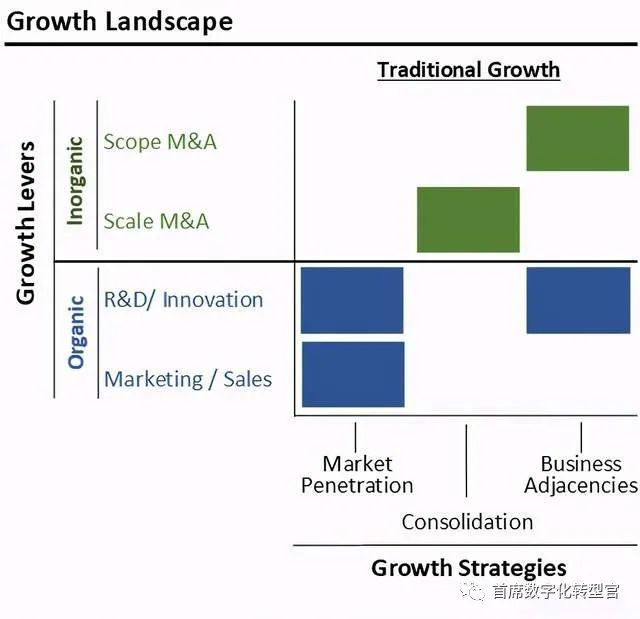
为了实现这些战略,CEO们依赖于一个简短的增长杠杆列表(见插图)。市场渗透是通过对市场营销和销售的投资以及改进现有产品的价值主张实现的。整合是通过聚焦于规模的并购来实现的。周边业务主要由内部研发和创新小组的工作激活,以创造新产品和/或接触新客户;有时,相邻业务通过收购互补业务(即所谓的“范围”交易)来实现。这些策略和杠杆或多或少就是公司实现增长的方式。 CXO UNION-CXO联盟(cxounion.cn)
但数字转型时代开启了三种新的增长战略,激活了三种新的增长杠杆。
“企业可采用的增长战略的转变,加上新的增长杠杆的效力,永远地改变了增长前景……”
第三部分:新增长战略
没有必要深究数字转型的含义;那个故事已经讲过了。但我们将强调数字转型对增长的重要性。
技术正在模糊产品和服务、价值链和整个行业之间的传统界限,这迫使企业不仅重新思考业务流程,而且重新思考业务模式和业务的基本范围。这些都是增长的机会。此外,这不是一次性事件;技术的不断进步将迫使公司继续发展。正如战略家丽塔•麦格拉思(Rita McGrath)所写的那样,我们今天所处的时代已经迎来了持续竞争优势的终结。为了成功地前进,企业必须是灵活的和适应的,并实现增长,企业将需要不断重塑他们的业务以改变市场。
为了应对这些机遇,企业正在实施三种新的战略(以下将对这些战略进行更详细的描述:四种数字转型):
- 技术驱动的增长:新技术使企业能够从根本上重塑业务流程,在某种程度上,前几代技术无法将这些改进转化为增长。这些新技术允许企业改善客户体验,扩大价值主张,并以新的方式接触新客户。这方面的一个例子是Domino的AnyWare应用程序,该应用程序允许客户从任何设备上订购,并帮助该公司的销售额超过必胜客。
- 商业模式创新:商业模式创新不是专注于业务流程,而是通过使用技术改变价值的基本构成要素来推动新的增长。一个很好的例子就是汽车保险供应商从固定的每月合同向按英里分装的合同的转变。技术首次使汽车保险公司能够基于消费者行为来理解合同并为其定价,从而开辟了向客户提供价值的新途径。
- 领域扩展:技术还能让企业重新考虑业务边界,并进入远离其核心业务的市场空间。这不是传统的邻接增长;这种方法需要将公司的核心产品带到新的分销渠道、地区或客户群;创建与新产品相关的产品(例如IBM从IT产品转移到IT服务);并扩展到价值链上与新事物相关的点(比如产品制造商转向拥有其产品的零售分销)。相反,领域扩展是在远离核心业务的基础上,基于全新的(通常是技术支持的)能力的增长。一个经常被引用的例子是亚马逊创造了云计算,提供亚马逊网络服务——在一个需要全新能力的全新市场空间里的全新业务。
确保这些增长的方法对公司来说一直都是可行的。但在数字转型的时代,这些战略比以往任何时候都更加强大和重要。它们如此强大的一个重要原因是,今天的企业可以追求它们。 CXO UNION-CXO联盟(cxounion.cn)
“企业增长战略的转变,加上新的增长杠杆的效力,永远地改变了增长格局……”
第四部分:新的增长杠杆
数字时代激活了新的外部增长杠杆。与新的增长战略一样,这些杠杆对企业来说也是长期可用的。但数字经济让它们变得更加普遍和强大:
- 范围并购:范围并购一直是一个增长杠杆,但数字增长时代已经活跃和扩大了它的重要性。根据贝恩的数据,2018年,范围交易(相对于规模交易)的比例上升为企业交易的多数,2019年达到了全部交易的58%。我们看到范围并购既关注新技术能力的增长,也关注纯粹的业务扩展。针对能力的范围并购可以通过FrontDoor收购初创公司Streem来证明。前门(FrontDoor)是一家大型的家庭维修服务提供商,收购这家初创公司是为了获得“……计算机视觉技术(可以)自动检测部件或电器的品牌和型号”,这大大减少了技术人员在家中的时间,并使前门能够通过价值推动增长。扩大业务范围的并购可以从UnitedHealth收购DaVita medical clinics中看出来,把它的业务扩展到直接面向消费者的服务。此次收购是大型健康保险公司联合健康(UnitedHealth)更广泛战略的一部分,该公司正寻求利用医疗服务市场不断增长的利润池,因为该市场因技术而发生变化。
- 风险投资:低启动成本,普及的技术和商业建设专业知识,以及融资渠道使得启动一个技术风险比以往任何时候都更容易。与此同时,世界各地的市政当局斥巨资将创业创新带到他们的城市,将创业经济与数百个地方经济交织在一起。这些趋势共同催生了一个巨大的、全球性的风险投资领域,以及企业成长所需的变革性解决方案的持久新来源。企业正在认识到这一转变。根据Global Corporate Venturing的数据,过去10年,企业风险投资从2010年的约500亿美元增长到2019年的近3000亿美元;此外,企业风险投资目前占所有风险投资的近25%。企业将风险投资视为一个强大的增长杠杆,因为它让企业能够在不需要拥有它们的情况下(现在,或者可能永远不会拥有它们),尽早、快速地获得前沿技术。投资将企业和初创企业的经济利益结合起来,为企业创造机会来引导解决方案的开发,并为以后的开发创造增长选择。冒险也是一种有效的方式来筛选那些日后可能成为收购目标的公司;从很多方面来说,风险生态系统的增长推动了范围并购的增长。(我们已经就企业与风险投资的关系谈了很多,这里是“如何与企业风险投资合作”)。
- 生态系统建设:第三个增长杠杆在数字时代变得更加强大:生态系统。世界上许多最有价值的公司,如苹果、谷歌、亚马逊,之所以如此有价值,是因为它们创造了生态系统。商业战略家詹姆斯·摩尔在1993年提出了生态系统的概念:“在商业生态系统中,公司围绕着一种新的创新共同发展能力:他们以合作和竞争的方式工作,以支持新产品,满足客户的需求,并最终融入下一轮的创新。“生态系统不仅仅是一种接触更多客户的方式,也是商业模式中一个基本的、差异化的元素。”它们往往具有低/零关系成本和规模成本、丰富的数据、强大的网络效应和有效扩展价值主张的能力。尽管生态系统现象已经存在了很长时间,但它们的重要性在今天比以往任何时候都要大。企业正在注意到这一点。BCG/Henderson的数据显示,截至2019年,“生态系统”一词出现在企业年度报告中的次数比10年前多了13次。为什么生态系统是如此好的增长动力?它们使公司能够利用第三方资产和组织力量有效地扩展和扩展产品的价值主张。它们的规模扩大得很快,即使有几十个参与者也能有效运作。与并购或冒险不同,生态系统关系或更灵活的财务,可以随着商业环境的变化而随时间调整。其中一个例子就是美国政府和电信巨头AT&T的合作伙伴FirstNet,这是一家重要的年轻公司,旨在革新应急人员的沟通和工作方式。FirstNet的核心目标是建立一个全国性的蜂窝网络(具有新的5G能力),专门用于公共安全响应。在早期,该公司就意识到,如果网络不仅能够更好地沟通,而且能够为应急人员提供更好的解决方案,那么它对社会将变得更有价值。因此,该公司正努力建立一个强大的合作伙伴生态系统——包括各种财务和非财务关系——这些合作伙伴正在创造新的工具,比如能够穿透墙壁的摄像头,以及能够利用该网络跟踪消防员运动的传感器。由此产生的生态系统解决方案将彻底改变公共安全。
外部增长杠杆使企业能够利用资产负债表上的资本,而不是支出,来推动新的增长。这是在切实推动创新和增长的同时,将对运营收入的冲击降至最低的唯一途径。”
这三种新的生长杠杆的共同之处在于它们都是外部的/无机的生长。相对于有机增长,无机增长有几个优势,尤其是在数字时代。首先,外部增长扩大了机会的范围。虽然有机创新可能会面临实际的限制,即什么技术可以追求(因为所需的专业知识根本不存在),但外部并不存在这样的限制。实际上,任何技术、能力或解决方案都可以从外部创新大学获得、获得、投资,而且成本和风险也越来越合理。在某些情况下,外部创新可能是追求某些机会的唯一可行选择。其次,外部创新缩短了发展时限,提高了效率。采用外部创新的公司会利用强大的新解决方案和技术来节省飞行时间和资源,并可能避免昂贵的失败(如果是内部开发的)。数字时代变化的速度使得创新的速度非常重要。第三,外部增长杠杆可以使企业利用资产负债表上的资本(而不是支出)来推动新的增长。这是有意义地推进创新和增长,同时将对运营收入的冲击降到最低的唯一途径。在盈利压力下,企业(尤其是上市公司)常常感到被迫限制创新,而资本驱动的(外部)创新则能够推动增长和创新继续下去。
“……当企业认识到外部创新所带来的一系列扩大的增长机会——全新的技术、解决方案、商业模式的改变和范围扩展的机会——它们就会以它们原本想不到的方式扩大自己的增长议程。”
第五部分:新的增长格局
企业增长战略的转变,加上新的增长杠杆的效力,永远地改变了增长格局。在数字时代,在数字增长和外部(无机)执行的交叉口,现在出现了机会的“绿色海洋”。这种新的景观在外部/无机路径中提供了比内部/有机路径更多的入口点。这并不是要贬低有机驱动的增长和创新的价值。内部创新实验室、数字增长努力和其他本土活动是数字时代整体增长战略的重要组成部分。相反,我们的目标是指出,外部格局已经变得多么重要和广泛,并指出,我们认为,这种格局的转变是机遇集的永久性重组。 CXO UNION-CXO联盟(cxounion.cn)
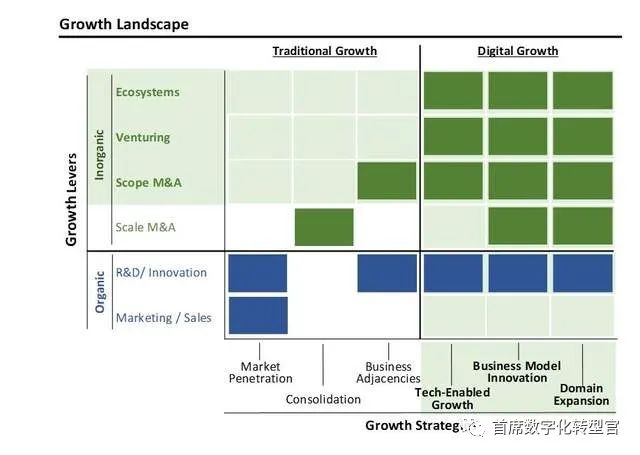
在这种情况下,忽视外部增长的企业将错失创造价值的成熟机会。随着竞争对手越来越善于利用这种增长方式,不跟风的公司就有落后的风险。展望未来,企业需要积极地重新平衡增长份额和外部机会。
第六部分:新的增长
当企业认识到外部创新所带来的一系列扩大的增长机会——全新的技术、解决方案、商业模式的改变和范围扩展的机会——他们就会以他们原本认为不可能的方式扩大他们的增长议程。为了抓住增长的战略机遇,我们往往会看到公司同时使用多个增长杠杆,而不是一个。最聪明的公司明白并购、风险投资、生态系统建设和内部创新的相对重要性和贡献。他们还构建了组织能力,使他们能够成功地将各个部分编织在一起。我们曾与许多公司合作,并观察到它们正以这种方式追求增长:
- 卡车制造商-技术驱动的增长:一家主要的卡车制造商,将人工智能驱动的预测式维护作为其卡车产品差异化和加速增长的一种方式。为了推出这款新产品,公司内部进行了大量的创新工作,但该公司也投资了几家企业,这些企业正在开发更广泛的解决方案的不同方面。风险投资使公司能够获得具有挑战性的新技术,并开启了正在进行的合作开发和知识产权许可关系,这将加速产品的发布。
- 广播产品制造商-商业模式创新:许多公司正在利用新的杠杆,通过商业模式的改变来推动增长。一家公司正在将其媒体和广播设备业务从仅仅的硬件业务转变为平台驱动的“X-as-a-Service”业务,使it将服务与设备销售捆绑在一起,从而获得更大的利润份额。虽然该公司在核心媒体技术方面拥有很高的技能,但该公司正在利用风险投资、并购和生态系统建设来创建一种新的商业模式,在这种模式下,硬件系统通过软件和服务来增强,从而使广播变得“智能”。“其中一项风险投资是一家视频成像公司,该公司能够自动识别人和优化面试场景;双方的关系从投资开始,但预计将发展到最终的收购。其他的风险投资也能与其他广播设备实现无缝互操作性。此外,该公司正在构建一个由第三方组成的生态系统,以向平台贡献其他以客户为中心的工具和解决方案(如转录服务)。
- 建筑公司领域扩展:还有其他公司寻求扩展业务范围。有一家建筑公司,为了在传统的重型设备业务之外寻求增长,在传统核心业务之外,还开展了施工协调、沟通和规划业务。这个新的业务提供资产跟踪,鸟瞰建筑工地,和软件工具,以集成和协调推动建筑工作的无数活动。由于这项业务与其核心业务如此不同,该公司被迫以不同的方式追求增长。作为架构师,公司已经决定了新业务的哪些部分应该通过并购、风险合作、生态系统伙伴关系和内部创新来实现。作为工程师,公司正在建设的新业务选择并购交易,将核心功能平台,一系列风险投资下一代无人机和启用映射和态势感知和雷达技术,构建推托生态系统合作伙伴提供互补的产品像资产跟踪。如果这个附加的新业务的完整愿景可以简单地被收购,公司就会这样做。但是因为它不能(没有目标可用),这种架构师/工程师的商业建设方法是公司抓住这个机会的最快和最有效的途径。 CXO UNION-CXO联盟(cxounion.cn)
第七部分:建立新的公司基础设施以实现增长
无机增长一直是增长的杠杆。但是,除了最贪婪、最熟练的公司之外,除了所有公司之外,这只是一种零星的贡献。企业发展——无机增长的传统所有者——是一个小型但有效的机构,致力于追求这类机会。但在一个无机增长成为成功更重要关键的世界里,企业需要建立新的能力,以扩展和补充企业发展的传统技能。它们需要采取新的战略方法来实现增长。他们需要建立新的力量,包括为并购带来新的技能,采用我们所说的“增长冒险”,并获得生态系统建设技能,比如学习同步经济关系与生态系统合作伙伴。他们需要建立组织结构和流程,无缝地将外部成长融入到他们日复一日的核心成长方式中。在本文的第2部分中,我们将探讨公司增长基础设施需要如何更改。

翻译:
CXO Must read, a new playbook for growth in the age of digital transformation
Part 1: The changing growth pattern
In short: in the age of digital transformation, a permanent shift in the economy forces a permanent shift in the way businesses achieve growth, from primarily organic to clearly inorganic; As a result of this shift, businesses need to develop new skills and capabilities and build new infrastructure to perform.
The widespread discussion of digital transformation over the past few years has overshadowed the real issue: transformation is not an end in itself, but a means to long-term value growth. As we described in this original article, there are four types of digital transformation, and digital transformation is not monolithic – it involves much more than a digital back-office process. The greatest promise of digital transformation lies in harnessing ever-evolving cutting-edge technologies to unlock new revenues, business models and markets. To capture this growth, companies are investing in homegrown solutions – launching innovation LABS, building an innovation culture, and empowering employees to become innovators.
But the digital age has also opened up plenty of new external sources of growth – of which startups, ecosystems, and third-party solutions account for an increasingly compelling, if not dominant, share. This is a permanent realignment of the growth landscape with profound implications for the corporate growth playbook. Historically, growth has been largely determined by internal and organic factors, and in the future, the growth playbook must be viewed more externally. To succeed in this new era, businesses need to do more than just think differently about growth: they need to develop new skills and capabilities, and build new infrastructure to execute.
Part 2: Expanding growth prospects
Traditionally, ceos have relied on three main growth strategies: market penetration, consolidation, and expansion into neighboring businesses. Market penetration drives the growth of existing market share. Merge competitors to increase revenue, strengthen market leadership, and drive cost and scale advantages. Adjacent growth includes entry into new product and solution categories, customer segments and/or markets, offering complementary new products.
To achieve these strategies, ceos rely on a short list of growth levers (see illustration). Market penetration is achieved through investment in marketing and sales and improving the value proposition of existing products. Consolidation is achieved through mergers and acquisitions focused on scale. The peripheral business is primarily activated by the work of internal R&D and innovation groups to create new products and/or reach new customers; Sometimes, adjacent businesses are realized by acquiring complementary businesses (so-called “scope” transactions). These strategies and levers are more or less how companies achieve growth.
But the era of digital transformation has opened up three new growth strategies and activated three new growth levers.
“The shift in the growth strategies available to companies, combined with the potency of new growth levers, has changed the growth landscape forever…” CXO UNION-CXO联盟(cxounion.cn)
Part 3: New growth strategy
There is no need to delve into the implications of digital transformation; That story has already been told. But we will emphasize the importance of digital transformation for growth.
Technology is blurring the traditional boundaries between products and services, value chains, and entire industries, forcing companies to rethink not only business processes, but also business models and the fundamental scope of their business. These are opportunities for growth. Moreover, this is not a one-off event; The continuous advancement of technology will force the company to continue to grow. As strategist Rita McGrath has written, the era we live in today has ushered in the end of sustained competitive advantage. In order to move forward successfully, businesses must be flexible and adaptable and achieve growth, and businesses will need to constantly reinvent their business to change the market.
To address these opportunities, businesses are implementing three new strategies (described in more detail below: Four digital transformations):
Technology-driven growth: New technologies enable businesses to fundamentally reshape business processes in a way that previous generations of technology could not translate these improvements into growth. These new technologies allow businesses to improve the customer experience, expand the value proposition, and reach new customers in new ways. An example of this is Domino’s AnyWare app, which allows customers to order from any device and has helped the company surpass Pizza Hut in sales.
Business model innovation: Instead of focusing on business processes, business model innovation drives new growth by using technology to change the fundamental building blocks of value. A good example is the shift by auto insurance providers from fixed monthly contracts to mile-by-mile contracts. For the first time, technology is enabling auto insurers to understand and price contracts based on consumer behavior, opening up new ways to deliver value to customers.
Domain expansion: Technology also allows companies to rethink business boundaries and enter market Spaces far from their core business. This is not traditional contiguous growth; This approach requires bringing the company’s core products to new distribution channels, geographies, or customer bases; Creating products associated with new products (such as IBM moving from IT products to IT services); And extend to points along the value chain that are relevant to new things (such as the shift of product manufacturers to owning retail distribution of their products). In contrast, domain expansion is the growth of entirely new (often technology-enabled) capabilities away from the core business. One oft-cited example is Amazon’s creation of cloud computing to deliver Amazon Web Services – a brand new business in a brand new market space that required brand new capabilities.
The way to ensure these increases has always been feasible for the company.
But in the age of digital transformation, these strategies are more powerful and important than ever. A big reason they are so powerful is that businesses today can pursue them.
“The shift in corporate growth strategies, combined with the potency of new growth levers, has changed the growth landscape forever…” CXO UNION-CXO联盟(cxounion.cn)
Part 4: New growth leverage
The digital age has activated new external growth levers. As with new growth strategies, these levers are also available to businesses over the long term. But the digital economy has made them even more pervasive and powerful:
Scope M&A: Scope M&A has always been a growth lever, but the era of digital growth has enlivened and expanded its importance.
According to Bain, the proportion of scope deals (as opposed to size deals) rose to the majority of corporate deals in 2018, reaching 58% of all deals in 2019. We see scope M&A focusing both on the growth of new technology capabilities and pure business expansion. A range of acquisitions targeting capabilities can be demonstrated through FrontDoor’s acquisition of startup Streem.
FrontDoor, a large home repair service provider, acquired the startup in order to gain “… Computer vision technology [can] automatically detect the make and model of a component or appliance, “significantly reducing the time technicians spend at home and enabling the front door to drive growth through value. The expansion of acquisitions can be seen in UnitedHealth’s acquisition of DaVita medical clinics, expanding its business into direct-to-consumer services. The acquisition is part of a broader strategy by large health insurer UnitedHealth, which is looking to tap into a growing profit pool in the medical services market as it changes due to technology.
Venture Capital: Low start-up costs, widespread technical and commercial construction expertise, and access to financing make launching a technology venture easier than ever.
At the same time, municipalities around the world are spending heavily to bring entrepreneurial innovation to their cities, intertwining the entrepreneurial economy with hundreds of local economies. Together, these trends have spawned a huge, global field of venture capital and a lasting new source of transformative solutions that businesses need to grow. Companies are recognising the shift. According to Global Corporate Venturing, corporate venture capital has grown over the past decade from about $50 billion in 2010 to nearly $300 billion in 2019; In addition, corporate venture capital now accounts for nearly 25% of all venture capital investment. CXO UNION-CXO联盟(cxounion.cn)
Companies see venture capital as a powerful growth lever because it gives them early, fast access to cutting-edge technologies without having to own them (now, or perhaps never). Investments align the economic interests of businesses and start-ups, creating opportunities for businesses to steer the development of solutions and create growth options for later development. Taking risks is also an effective way to screen out companies that might become acquisition targets later on. In many ways, the growth of the risk ecosystem has driven the growth of scope M&A. (We’ve talked a lot about the relationship between business and venture capital, here’s “How to Work with corporate venture capital.”)
Ecosystem building: The third growth lever has become more powerful in the digital age: the ecosystem.
Many of the most valuable companies in the world, such as Apple, Google, Amazon, are so valuable because they create ecosystems. Business strategist James Moore proposed the concept of an ecosystem in 1993:. “In a business ecosystem, companies co-develop capabilities around a new kind of innovation: they work cooperatively and competitively to support new products, meet customer needs, and ultimately incorporate the next round of innovation.” “The ecosystem is not just a way to reach more customers, it’s a fundamental, differentiating element in the business model.”
They tend to have low/zero relationship costs and cost of scale, rich data, powerful network effects, and the ability to effectively extend the value proposition. Although ecosystem phenomena have been around for a long time, their importance is greater today than ever before. Companies are taking note. BCG/Henderson data shows that as of 2019, the word “ecosystem” appears 13 more times in companies’ annual reports than it did a decade ago. CXO UNION-CXO联盟(cxounion.cn)
Why are ecosystems such good growth drivers?
They enable companies to leverage third-party assets and organizational forces to effectively scale and extend the value proposition of their products. They scale up so quickly that they can operate effectively even with dozens of participants. Unlike mergers and acquisitions or risk-taking, ecosystem relationships, or more flexible finances, can be adjusted over time as the business environment changes. One example is FirstNet, a partnership between the U.S. government and telecommunications giant AT&T, an important young company that aims to revolutionize the way first responders communicate and work.
FirstNet’s core goal is to build a nationwide cellular network (with new 5G capabilities) dedicated to public safety response. Early on, the company realized that the network would become more valuable to society if it could not only communicate better. But also provide better solutions for first responders. So the company is working to build a strong ecosystem of partners – a variety of financial and non-financial relationships – who are creating new tools. Such as cameras that can penetrate walls and sensors that can use the network to track firefighters’ movements. The resulting ecosystem solutions will revolutionize public safety.
External growth leverage enables companies to use capital on their balance sheets, rather than spending, to fuel new growth.
This is the only way to minimize the impact on operating income while actually driving innovation and growth.”
What these three new growth levers have in common is that they are all external/inorganic growth. Inorganic growth has several advantages over organic growth, especially in the digital age.
First, external growth expands the range of opportunities. While organic innovation may face practical constraints on what technology can be pursued (because the required expertise simply doesn’t exist). No such constraints exist externally. Virtually any technology, capability or solution can be acquired, acquired, invested in from an external innovative university. And the costs and risks are increasingly reasonable. In some cases, external innovation may be the only viable option to pursue certain opportunities. CXO UNION-CXO联盟(cxounion.cn)
Second, external innovations shorten development timelines and improve efficiency. Companies that adopt external innovations take advantage of powerful new solutions and technologies to save flight time and resources. And potentially avoid costly failures if developed in-house. The speed of change in the digital age makes the speed of innovation very important.
Third, external growth leverage allows companies to use capital on their balance sheets (rather than spending) to fuel new growth. This is the only way to meaningfully drive innovation and growth while minimizing the impact on operating income. Under earnings pressure, companies (especially public companies) often feel forced to limit innovation. Whereas capital-driven (external) innovation can drive growth and innovation to continue.
“… When companies recognize the expanded set of growth opportunities that external innovation offers – new technologies, solutions, business model changes. And scope expansion opportunities – they expand their growth agenda in ways they might not have thought possible.”
Part 5: New growth pattern
The shift in corporate growth strategies, combined with the potency of new growth levers, changed the growth landscape forever. In the digital age, at the intersection of digital growth and external (inorganic) execution, a “green ocean” of opportunities now emerges. This new landscape provides more entry points in the external/inorganic path than the internal/organic path. This is not to diminish the value of organically driven growth and innovation. In-house innovation LABS, digital growth efforts. And other local activities are important components of an overall growth strategy in the digital age. Rather, our goal is to point out how important and extensive the external landscape has become. And to point out that we see this shift as a permanent realignment of the set of opportunities.
In this case, businesses that ignore external growth will miss out on a ripe opportunity to create value. As competitors become more adept at exploiting this type of growth, companies that don’t follow suit risk being left behind. Looking ahead, companies need to actively rebalance their share of growth and external opportunities.
Part 6: New growth
When companies recognize the range of expanded growth opportunities offered by external innovation-new technologies, solutions, business model changes. And scope extension-they expand their growth agenda in ways they might not have thought possible. To capture strategic opportunities for growth, we tend to see companies use multiple growth levers at once, not just one. The smartest companies understand the relative importance and contribution of mergers and acquisitions, venture capital, ecosystem building, and internal innovation. They also build organizational capabilities that allow them to successfully weave the pieces together. We have worked with many companies and observed that they are pursuing growth in this way: CXO UNION-CXO联盟(cxounion.cn)
Truck Manufacturer – Technology-Driven Growth: A major truck manufacturer is looking to AI-driven predictive maintenance as a way to differentiate its truck offerings and accelerate growth.
A lot of innovative work has gone on internally to launch this new product. But the company has also invested in several businesses that are developing different aspects of the broader solution. Venture capital gives companies access to challenging new technologies and opens up ongoing collaborative development and intellectual property licensing relationships that will accelerate product launches.
Broadcast product Manufacturers – Business Model Innovation: Many companies are using new leverage to drive growth through business model changes.
One company is transforming its media and broadcast equipment business from a mere hardware business to a platform-driven “X-as-a-Service” business, enabling it to bundle services with device sales and thus capture a larger share of profits. While the company is highly skilled in core media technologies, the company is using venture capital, mergers and acquisitions. And ecosystem building to create a new business model in which hardware systems are augmented by software and services that make broadcasting “smart.” “One of the ventures is a video imaging company that automatically identifies people and optimizes interview scenarios;. The relationship began as an investment, but is expected to grow into an eventual acquisition. Other ventures can also seamlessly interoperate with other broadcast devices. In addition. The company is building an ecosystem of third parties to contribute other customer-focused tools and solutions (such as transcription services) to the platform.
Construction companies expanding: There are other companies looking to expand their reach.
One construction company, looking for growth outside of its traditional heavy equipment business, has branched out into construction coordination, communication and planning in addition to its traditional core business. This new business provides asset tracking, a bird’s eye view of construction sites. And software tools to integrate and coordinate the myriad activities that drive construction work. Because this business is so different from its core business. The company has been forced to pursue growth in a different way. CXO UNION-CXO联盟(cxounion.cn)
As architects, the company has decided which parts of the new business should be realized through mergers and acquisitions, venture partnerships, ecosystem partnerships, and internal innovation. As an engineer, the company is building new business options for M&A deals, incorporating core functionality platforms. A range of venture capital investments in next-generation UAVs and enabling mapping and situational awareness and radar technologies to build promotive ecosystems with partners providing complementary products like asset tracking. If the complete vision for this additional new business could simply be acquired, the company would do so. But because it can’t (no goals are available), this architect/engineer approach to commercial construction is the fastest and most effective way for companies to seize this opportunity.
Part 7: Building new corporate infrastructure for growth
Inorganic growth has been the lever for growth. But this is a piecemeal contribution to all but the greediest and most skilled companies. Enterprise Development – the traditional owner of inorganic growth – is a small but effective institution dedicated to pursuing such opportunities. But in a world where inorganic growth is a more important key to success. Businesses need to build new capabilities that extend and complement traditional skills for business growth. They need to take a new strategic approach to growth. CXO UNION-CXO联盟(cxounion.cn)
They need to build new strengths, including bringing new skills to M&A, adopting what we call “growth risk-taking,” and acquiring ecosystem building skills, such as learning to synchronize economic relationships with ecosystem partners. They need to establish organizational structures and processes that seamlessly integrate external growth into their core growth approach day in and day out. In Part 2 of this article, we’ll explore how the company’s growth infrastructure needs to change.
本文由CXO UNION-CXO联盟(cxounion.cn)转载而成,来源于首席数字化转型官;编辑:CXO UNIONCXO联盟小U。
如需加入CXO UNION(CXO联盟)高管社群,请联系社群小伙伴哦~
免责声明: 本网站(http://www.cxounion.cn/)内容主要来自原创、合作媒体供稿和第三方投稿,凡在本网站出现的信息,均仅供参考。本网站将尽力确保所提供信息的准确性及可靠性,但不保证有关资料的准确性及可靠性,读者在使用前请进一步核实,并对任何自主决定的行为负责。本网站对有关资料所引致的错误、不确或遗漏,概不负任何法律责任。
本网站刊载的所有内容(包括但不仅限文字、图片、LOGO、音频、视频、软件、程序等) 版权归原作者所有。任何单位或个人认为本网站中的内容可能涉嫌侵犯其知识产权或存在不实内容时,请及时通知本站,予以删除。
如需加入CXO UNION(CXO联盟)高管社群,请联系社群小伙伴哦~

免责声明: 本网站(http://www.cxounion.cn/)内容主要来自原创、合作媒体供稿和第三方投稿,凡在本网站出现的信息,均仅供参考。本网站将尽力确保所提供信息的准确性及可靠性,但不保证有关资料的准确性及可靠性,读者在使用前请进一步核实,并对任何自主决定的行为负责。本网站对有关资料所引致的错误、不确或遗漏,概不负任何法律责任。
本网站刊载的所有内容(包括但不仅限文字、图片、LOGO、音频、视频、软件、程序等) 版权归原作者所有。任何单位或个人认为本网站中的内容可能涉嫌侵犯其知识产权或存在不实内容时,请及时通知本站,予以删除。
Search
Popular Posts
-

2024数字化灯塔案例评选申报开启!
“2024数字化灯塔案例评选”于3月正式启动,诚挚欢迎业界同仁自荐和推荐,一起推动产业数字化进程,助力赋能企业…
-

2024 X-Award星盘奖申报通道已开启!
X-Award星盘奖是数字化转型服务、IT服务行业重要的商业奖项,旨在表彰行业里提供杰出数字化转型服务与IT服…
-

2024 N-Award星云奖申报通道已开启!
N-Award是数字化转型领域重要的商业奖项,旨在表彰那些以非凡的远见、超群的领导才能和卓越的成就来激励他人的…