导语
数智时代是以数字化和智能化为典型特征的新经济时代。数智技术的广泛应用对领导力的时代内涵和实现途径提出了更高要求。本文深入分析了数智时代新的组织管理特征对领导力在认知、行为、人际三个方面所形成的挑战,同时指出在带来挑战的同时,数智技术也将通过硬技能和软技能赋能领导力,并据此提出,领导者可以通过认知变革、人际优化与工作设计三个方面进阶数智领导力。只有回归领导力的初心,才能借助数智技术实现绩效、健康、福祉、向善的领导力,在科技浪潮中实现组织持续创新与发展。
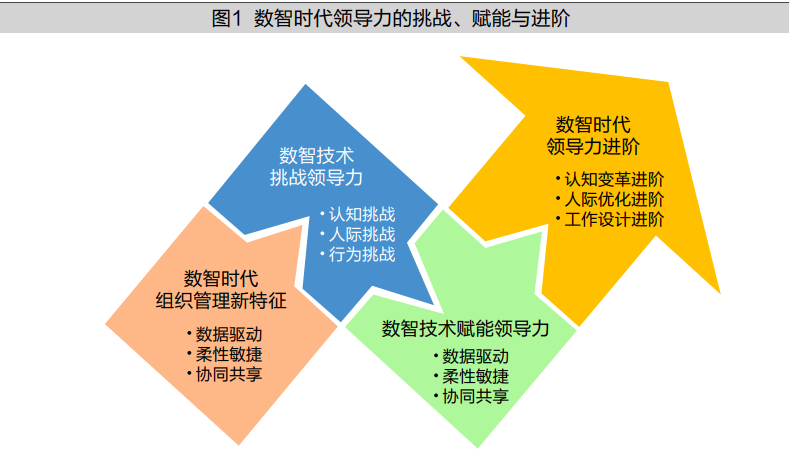
以数字化和智能化为典型特征的数智时代已然到来。根植于此时代背景,数智技术被认为是关键的生产要素,它指一系列能够自动化或半自动化执行与工作相关的复杂行为的技术或系统,包括人工智能、大数据、云计算、机器人、区块链和算法。随着数智技术运用的实践愈发常态化,组织管理呈现出数据驱动、柔性敏捷、协同共享等新特征。
在数智时代背景下,领导者是带领组织追赶科技浪潮的主导力量。面对新的组织管理特征,领导力所面临的机遇和挑战是史无前例的。研究发现,一方面,数智技术的引入能够协助领导者用先进科学的方式履行职能,更有效地发挥领导力;同时,数智技术还能释放简单繁琐的工作事务,将领导力重心转移到更具变革性的事务中,助推组织目标的实现;另一方面,新工作常态对领导力的丰富性和复杂性提出了更高的要求。甲骨文公司和未来职场公司2019年联名发起的一项针对10个国家8000多名人员的调研显示,82%的受访者认为机器人可以比他们的经理更好地完成某种类型的工作,64%的受访者表示他们更信任机器人而不是经理。一些研究也指出,由于技术发展和群体才智的提升,领导的比较优势正在被侵蚀,现在再也不是以前那个命令控制的时代了。基于此,领导如何发挥“人脑+机脑”的协同优势,在时代潮流中持续进阶与更新领导力,灵活有效地应对时代要求,是数智时代的一道必答题。
一、数智技术对领导力的挑战
领导者在与数智技术并肩协作的过程中,除了要熟悉与了解技术,适应与传统人-人沟通截然不同的人-技术交互方式,还要协调人-技术-人之间的多重关系,从中寻找新的平衡点。面对刻有时代烙印的新组织生态和工作模式,领导力的顺利履行存在多重挑战。通过梳理现有文献,本文拟从认知、人际和行为三个方面阐述数智技术给领导者带来的挑战,以期识别领导者在运用数智技术过程中面临的挑战,从而为实践带来启示与指引。
1. 认知层面的挑战
在运用数智技术的过程中,领导者认知层面所面临的首要挑战是技术素养不足。数智技术正处于蓬勃发展的阶段,具有更迭快、计算复杂和智能化等特征。随着发展进程的推进,数智技术在应用过程中甚至出现了“黑箱运转”的情况,即便是专业的技术人员也无法得知数智技术的运作逻辑和规律。领导者要理解并应用这些新兴的数智技术并非易事。虽然领导者并不需要成为熟练掌握技术的专业人员,但是具备一定的技术素养却是必需的。倘若对数智技术一无所知,领导者将无法理解技术的潜力和应用场景,评估技术对组织和员工的影响时可能会出现偏差,进而影响决策。其次,技术知识不足会导致领导无法准确地表达技术需求和期望,同时也较难理解技术团队提供的建议,由此领导将难以实现与技术团队的高效沟通与合作,这会阻碍项目推进和想法落地。再者,不熟悉数智技术的领导难以评估甚至忽视技术所带来的风险,如数据泄露、信息安全、算法偏见等问题,这对于组织的稳定发展是巨大的隐患。
此外,不确定性增加也是发挥领导力过程中面临的认知挑战。数智技术通常涉及复杂的概念、理论和技术,加之其不断演进和更迭,领导较难精准把握技术的发展方向,增加了对数智技术认识上的不确定性。而且,数智技术的使用依赖于数据分析,但数据往往来源丰富、成分复杂、完整性欠缺,导致在对数据分析结果进行解读时存在不确定性。还有,数智技术的使用会带来一些潜在的风险和伦理问题,增加了领导使用数智技术进行决策的不确定性。种种不确定性让领导在关注、选择、引入、使用、管理数智技术的过程中面临巨大挑战,很难以“一劳永逸”的决策方式应对瞬息万变的数智技术。 CXO UNION-CXO联盟(cxounion.cn)
2. 人际层面的挑战
权力松动是领导使用技术过程中面临的人际挑战,也是学界和实践届聚焦的热点话题。在数字经济背景下,掌握技术象征着成员在组织中的权威性和合法性,是成员获得权力的重要来源。由于组织人事结构的变化,成员的内涵逐渐扩大,其不仅包括人类员工,还包括数智技术。首先,领导者无法腾出足够的时间精力熟练掌握某项精专技术,只能委任专职的技术人员来操控数智技术。这意味着技术人员掌握了组织中他人所没有却非常宝贵的资源,即与数智技术相关的知识和技能,他们在组织中能够通过分析与解读数据提升影响力,凸显自己的绝对优势,进而获得权力,这可能会威胁领导者在组织中的权力稳固性。其次,除了专业人员,数智技术的运用也可能对领导者的权力带来影响。前文提及甲骨文和未来职场公司的联名调研发现,82%的受访者认为机器人可以比他们的领导者更好地完成某些类型的工作。人们倾向认为,领导者适合换位思考、培训员工、营造工作氛围等工作,而机器人适合提供无偏差信息、维护工作流程、解决问题等工作;50%的员工表明他们会向机器人而不是领导者寻求建议。这表明人机协同过程中,领导者的影响力正在逐步下降,他们将部分工作让渡给数智技术的同时,很可能也将权力双手拱让给数智技术的操控者。
同样地,数智技术的引入还可能在组织中掀起一波信任危机。上述联名调研还发现,高达64%的受访者表示他们更信任机器人而不是领导,近25%的人表示他们“总是”或“经常”向人工智能提问,而不是询问领导。现有文献强调,员工对领导者的信任是非常重要的,它能够促进员工与领导者之间的沟通,增强追随意愿,并且强化员工的工作投入度,提升工作绩效。然而,随着数智技术在工作中的使用,其(相对)理性、客观、严谨、科学的功能会让员工更多地依赖与信任“人工智能”,转而质疑领导者在决策中的合理性和科学性,以及处理问题的能力,这对于领导力发挥是极大的阻碍。
除此之外,学者们对于数智技术如何影响领导-成员交换关系的质量存有不同的见解。有些学者认为数智技术可以通过捕捉与分析社交媒体、即时沟通软件、邮件等信息提供客观、多方位的数据结果,领导者借此能够更加深入全面地理解员工的需求和情绪,因人而异地提供个性化支持,并在员工面临困难时及时干预,这有利于双方关系的提升。相反,有些学者提出数智技术的运用如算法管理,被认为是领导加强对员工控制的“创新方式”,无时无刻的监控会让员工产生不被信任的感觉,认为自主权和隐私权被剥夺,使得领导和员工之间的矛盾加剧,甚至演变为敌对关系。此外,一些学者也提出由于领导者和员工的立场不同,对数智技术的使用态度与看法也存在差异,如领导迫切希望员工通过采用高新技术提高工作效率,但员工却认为学习相关知识与处理技术故障给自己添加不必要的工作量,双方的认知不一致可能会加剧彼此关系的摩擦。 CXO UNION-CXO联盟(cxounion.cn)
3. 行为层面的挑战
在行为层面,数智技术的使用可能会让领导面临任务分配不清的困境。任务分配不清的问题不仅存在于“人-技术”之间,还存在于“人-技术-人”之间。具体而言,随着数智技术在组织中的应用愈发普遍,以往由领导者所承担的职能逐渐让渡给数智技术,如日程安排、预算分配和报告撰写等简单重复的任务。一个典型的例子是,过往协调和组织工人的任务是中层经理的工作,如今基于算法的平台承担了这项工作,并且工作的效率和效果胜于人类。一些研究也指出,人类和数智技术各有所长,应当分别执行不同类型的工作任务,具体而言,数智技术应负责思维类任务,人类负责感知类任务。可见,数智技术的应用让领导者重新反省与思考领导的角色范畴:哪些任务可交由数智技术自动化处理?哪些任务需要人类与机器共同协作?哪些任务仍然离不开人类的全程监督与参与?这样的思考是有价值且必须的,只有当领导者厘清自己的角色范畴,他们才能充分利用数智技术的优势,释放机械耗时的任务,腾出更多时间履行关键的领导职能,真正发挥“人-技术”的互补优势。
除了领导和数智技术之间的任务分配,领导或许还要重新思考自己和专业员工之间的任务分配。领导者受繁重的任务和有限的精力所困,不可能对数智技术的掌握面面俱到。要想在竞争激烈、变化迅速的市场中夺得制高点,仅靠单打独斗是远远不够的。在人工智能支持日常管理决策的组织里,“放手”是非常重要的,虽然领导可能会感到不舒服和不适应,但只有与不同的人分享决策权,发挥群体的聪明才智,才能和参与者共创未来。可见,数智时代的领导者需要改变传统的控制管理方法,以开放的心态和员工合作,学会将权力授予擅长数智技术的员工,从而充分实现“人-技术-人”的强强联合。 CXO UNION-CXO联盟(cxounion.cn)
二、赋能领导力的硬技能和软技能
虽然数智技术的使用对领导力在认知、人际和行为层面带来挑战,但与此同时,数智技术凸显的优势也在扩大领导力的影响范围,加深领导力的影响深度。领导的核心任务包括“管人”和“理事”两方面,要想优质高效地完成这两项核心任务,离不开硬技能和软技能的辅助。硬技能是指完成任务所需要具备的专业知识和技术能力,通常是可以被量化的,如专业技术水平、外语能力、计算机水平等等。硬技能可以通过教育、培训等渠道进行提升。软技能包括调整自我和协调人际关系的能力,大多数情况下是无法被量化的,如自我调节能力、沟通技巧、团队协作能力等等。软技能可以通过观察学习、拓展经历等方式提升。虽然硬技能和软技能在许多方面存在差异,对于“管人”和“理事”发挥的效果也不尽相同,但这两者并非互相排斥,而是在发挥领导力的过程中相辅相成。举个例子,领导者在制定与推进部门季度生产计划的过程中,既需要拥有对市场变化的敏锐性、对提高生产效率的专业性、对部门表现的熟悉度(即发挥硬技能),同时也需要深谙调动部门员工积极性的技巧,善于根据员工特长分配任务,形成良好的部门氛围(即发挥软技能)。
一直以来,硬技能和软技能被视为提升领导力的重要武器。数智技术的出现及应用,为领导者履行职能与管理员工提供了重要工具。下面,我们分别从硬技能和软技能强化领导力两个方面进行阐述。
1. 提升硬技能
领导可以借助数智技术在决策质量、工作监控和绩效管理等方面提升硬技能。首先,数智技术能够对大规模数据进行高效分析,提供相对客观的评估,这为领导者做出科学可靠的决策提供参考依据。例如,部门经理在做出管理决策前,可以向预先训练好的智能程序输入不同年份、地区、部门的运营数据,根据需求设定数据的优先级和分析方式。随后智能程序根据指令进行分析,并以指定的方式呈现结果。智能程序通过提供更加精确、全面、客观的分析结果,延展了部门经理原本的知识范畴,提升了原有的分析水平,有利于部门经理做出更高质量的管理决策。
此外,数智技术利用多种媒介(如摄像头和网站访问)记录员工在工作中的表现,将这些信息进行量化,并且予以分析,提供关于员工的工作反馈。领导者在掌握了这些客观的反馈数据后,能够及时监控员工行为和工作进展,在必要时做出调整。优步(Uber)、亚马逊劳务众包平台(Amazon Mechanical Turk)等公司已经深入使用这项技术,领导者通过该技术可以实时监控工作进展,识别表现不佳的员工,促进组织核心功能的高效运转。
还有,数智技术的引入使得领导者在绩效管理方面更为有效。董毓格等学者提出数智技术的飞速发展改变了传统的绩效管理方式,如领导者可以利用算法设定数智目标,根据信息提供数智反馈与指导,依靠大数据对绩效进行数智评估,结合人工智能分析进行数智奖惩。多元化的数智技术为领导者管理绩效、为组织降本增效提供有力支撑。
2. 数智技术提升软技能
除了提升硬技能,数智技术还在识别情绪、沟通技巧等方面提升领导者的软技能。虽然数智技术被认为缺乏自主意识,无法对人类的情感感同身受,但其追踪和分析数据的能力能够帮助领导者更好地识别员工的情绪,及时提供人际支持。比如,数智技术可以对员工在社交媒体、邮件、即时沟通软件等平台上发表的内容进行文本挖掘分析,识别员工的情绪、态度。结合数智技术的分析结果,领导可以更加直观、清晰地了解员工的心理需求,并且予以有针对性的关怀和支持。 CXO UNION-CXO联盟(cxounion.cn)
此外,数智技术缺乏同理心和情绪的特征,在某些情况下却能转化为优势,帮助领导者在人际互动中解决一些棘手的问题。人们普遍认为数智技术在进行分析和决策时不掺杂个人利益与情感,提供相对客观的反馈。一些研究指出,数智技术在与人类员工进行沟通时,可以避免人际冲突等问题,减少消极情绪和报复行为的产生。研究者通过多项实验发现,个体在接收负面消息时,如果发现传达方是数智技术(而非人类),那么他们能更容易接受这一结果,负面情绪和抱怨也会大幅减少;个体接收正面消息时,如果发现传达方是人类(而非数智技术),那么他们所体验的满意度会更强。这意味着有了数智技术的协助,领导者可以聪明地选择“有所为,有所不为”,学会挑选与信息内容、性价匹配的表达主体和传递方式,这能有效缓解人际间的摩擦,促进高效流畅的人际交流。
三、数智时代的领导力进阶路径
数智技术对领导力产生的利与弊兼而有之。领导者若要更好地发挥数智技术对领导力的积极助推作用,需要精确捕捉数智技术在每次迭代升级中呈现的特性,摸清人类和技术之间的交互模式,并以此持续提升领导力。我们提出,领导者可以从认知变革、人际优化与工作设计三个层面进阶自身领导力,帮助员工适应数智时代的变革以应对挑战和把握机遇。
1. 认知变革进阶
在认知层面,领导者需要丰富自身的数智技术知识,理解数智技术的潜力和限制。虽然领导者不需要像技术人员一样深入和熟练地掌握如开源、数据处理等精细的技术,但要履行好相关职责,领导者需要理解数智技术背后的运行逻辑和使用目的,以确保在有需求的工作流程或者业务环节中引入匹配的数智技术,并且实现和员工之间的高效沟通。此外,理解数智技术有利于领导者探索新的商业机会,引领组织适应新的数智技术和工作方式。
此外,领导者要转变传统的管理决策模式,采用适合数智时代的变革决策思维。领导者也要意识到发挥领导力的重点不在于数智技术本身,而在于如何通过数智技术推动组织目标实现和保障员工权益。因此,在数智时代,领导可以采取数据事实驱动型、自动化高效型与预见未来型等决策思维。数据驱动决策思维指领导依靠数据和事实进行决策,而不仅仅依赖直觉和经验,并借助数据分析和可视化工具来支持决策过程;自动化高效型决策思维强调领导从繁杂重复的决策中挣脱,通过数智技术构建自动化决策支持系统,根据预设规则和算法对日常事务进行自动化决策和授权,从而使管理决策及其执行更加高效;预见未来型决策思维是指领导利用机器学习和预测模型对管理决策的结果进行趋势预测,提升决策的精准性和可实现性,避免决策失误造成的损失。 CXO UNION-CXO联盟(cxounion.cn)
2. 人际优化进阶
在人际层面,领导者可以在组织中建立数智发展愿景和目标战略的共享心智,帮助员工理解组织相关举措的用意,以此减缓信息壁垒所造成的人际冲突。组织引入数智技术是一个势不可挡的过程,然而领导者与下属对数智化变革却不一定持有相同的认知和态度,这不仅会对人际关系和团队凝聚力产生破坏作用,还在很大程度上阻碍数智化战略的成功实施。因此,领导者应当明确与组织成员沟通和传达组织在数智时代的发展愿景和目标,争取所有组织成员都能理解和共享这些与数智化相关的战略目标。例如,Meta公司创始人马克·扎克伯格除了会在公开场合访谈中谈及其对人工智能的喜爱,也会积极与同事分享人工智能相关的新闻。阿里巴巴集团创始人马云也曾要求公司将人工智能相关的元素整合到公司内部的装饰中,以反映公司以创新为中心的企业价值观。通过打破组织中的信息壁垒,与成员共享组织的数智发展愿景和目标,领导者不仅可以帮助员工更进一步认识组织相关举措的用意,尽可能消除信息不对称所引发的消极影响,也可以让员工以更加开放积极的心态接纳数智技术,减缓人际冲突,使得组织数智化的转型过程更加顺利。
其次,随着组织人事架构发生变化,领导者需要平衡不同主体之间(如人-技术、人-技术-人)之间的关系。在人-技术方面,领导者需要协助员工更好地认识与理解数智技术,通过举办专题讲座、工作坊和研讨会等活动,让组织上下逐渐适应与数智技术并肩协作的新工作模式。在人-技术-人方面,虽然数智技术越来越多地渗透到组织管理的各个环节,其重要性日益彰显,但不可否认的是,目前与数智技术互动仍不能模仿或者替代人类之间的互动,而后者所带来的人际需求满足是人类所必须且重要的。研究发现,经常在工作时使用数智技术的员工会感到更加孤独,并在下班后产生更多的失眠症状和酗酒行为。这说明,员工在和数智技术交互的过程中,可能无法满足人际方面的需求,从而产生不适反应。领导者应该意识到该问题的严重性,在强调数智技术的同时,依然要坚持“以人为本”的原则,关注员工在人际方面的需求,如鼓励团队成员之间的合作、主动提供人际支持,以此平衡人-技术-人的关系。
3. 工作设计进阶
领导者还可以基于工作设计理论对员工与数智技术的工作协同进行优化。根据奥尔德姆和弗莱德的工作设计理论,任务自主性、技能多样性、任务意义、任务认同和反馈等工作任务的特定特征会对员工的工作体验和绩效产生影响。基于此,领导者要设计有意义的工作角色和任务分配,根据人类员工和数智技术的不同能力优势,仔细规划和设计双方协作过程中的不同职能。 CXO UNION-CXO联盟(cxounion.cn)
在任务自主性方面,领导者可以给予员工一定程度的自主权和决策权,使其能够在完成任务时有更大的自主性。在基于数智技术的工作任务中,领导者可以确保员工有权利参与任务规划、设置目标,并在必要时对数智技术的执行进行调整。在技能多样性方面,领导者可以为员工提供不同类型的任务和活动,增加工作的多样性和挑战性。在基于数智技术的工作环境中,领导者可以设计任务,使员工能够参与涉及不同技能和知识领域的工作,以保持他们的兴趣和动力。有研究发现,在与数智技术协作时,拥有多种技能的员工在后续与客户的销售说服中展现出更多的创造力,进而获得更高的销售额。在任务意义方面,数智时代员工的工作意义感与工作认同感的下降对于领导力进阶也提出了新的要求。2019年盖洛普调查显示,全世界只有5%的人觉得自己的工作是非常理想的好工作,这似乎与人类学家大卫·格雷伯(David Graeber)发表的著作名称——《狗屁工作》遥相呼应。因此,在人类与数智技术的协同中,领导者可以强调工作对组织和他人的影响与价值,让员工能够认识到他们的工作对整体目标的重要性;领导者还可以与员工分享关于数智技术的使用和其对组织效益的积极影响,以激发员工对任务的意识和责任感。在任务认同方面,领导者在基于数智技术的工作任务中,可以协调和整合不同的任务,确保员工能够参与到一个完整的任务过程中,并能够看到自己工作的成果。在反馈方面,领导者要及时为员工提供反馈和评估,让员工能够了解自己的工作表现和改进方向。领导者可以借助数智技术的数据分析功能,提供员工关于工作表现和结果的反馈,帮助他们调整和改进工作方式。
结合工作设计理论所提出的数智时代领导力进阶模式,有助于领导者在设计和分配基于数智技术的工作任务时充分考虑员工的需求和动机,提供有意义、有挑战性和有成就感的工作体验。这不仅可以提高员工的工作满意度和投入度,还可以促进创新和个人发展,从而提升整体工作绩效和组织竞争力。
四、结语:回归领导力初心
综上,本文首先对数智技术对领导力所带来的认知、人际和行为方面的挑战进行了深入分析,在带来挑战的同时,也指出数智技术也将通过硬技能和软技能赋能领导力。在此基础上,结合数智时代组织管理特点和领导者面临的挑战,设计领导力的进阶路径,即通过认知变革、人际优化与工作设计三个方面进阶数智领导力(见图1)。
数智时代掀起的科技浪潮是史无前例的,它携卷着人们领略曼妙的风光,抵达新奇的科技高地,但同时也让人们见识强大的科技力量,警惕未知的风险。作为这个旅程的领航员和掌舵者,领导者面临前所未有的机遇与挑战。回归领导力的初心,或对领导者关于如何带领组织和员工在数智时代中蓬勃发展有一定的启发。
首先,领导力的本质是发挥影响力以实现组织的共同目标。组织推动数智化转型,本意在于提高生产效率、优化资源配置、促进变革创新,最终实现企业长青。因此,领导者在推动数智技术的应用过程中,要以此为决策的参考标准,发挥数智技术的正面效应,规避其带来的负面作用,进而带领团队实现共同发展。
其次,领导力的核心是保障员工的健康和福祉。虽然数智化管理能提高“理事”效率,但是在“管人”方面,效果却不一定尽如人意,员工的满意度也不一定得到提升。数智化管理可能带来的对个人隐私的侵犯、对员工的过度管控、以及把人看成集成数据的窄化思维,反而对激发人的内在工作动力和热情产生负面影响。任何时候,数智技术的引入不是也不能破坏“以人为本”的基本原则,其目的在于根据员工需求和工作情况,优化员工的工作体验,实施个性化的人才发展计划和福利政策,最终提高员工的身心健康水平。 CXO UNION-CXO联盟(cxounion.cn)
最后,道德内涵亦是领导力不容忽视的组成部分。在数智时代,科技向善是领导者需要考虑和落地的重要内容。领导者在推动数智化改革的同时,要考虑科技的伦理和社会责任,在组织内部和外部促进公平、公正和包容的科技创新,与各主体共同推动科技应用向造福人类和社会的方向发展。只有回归领导力的初心,才能借助数智技术实现绩效、健康、福祉、向善的领导力,最终在科技浪潮中实现组织持续创新与发展。

翻译:
The challenge and advancement of leadership in the age of digital intelligence
lead
The age of digital intelligence is a new economic era characterized by digitalization and intelligence. The wide application of digital intelligence technology puts forward higher requirements for the connotation of The Times and the way of realization of leadership. This paper deeply analyzes the challenges posed by the new organizational management characteristics in the digital-intelligence era to leadership in cognitive, behavioral and interpersonal aspects, and points out that digital-intelligence technology will also empower leadership through hard and soft skills while bringing challenges. Accordingly, it is proposed that leaders can advance digital-intelligence leadership through cognitive change, interpersonal optimization and job design. Only by returning to the original intention of leadership can we achieve performance, health, well-being and good leadership with the help of digital intelligence technology, and achieve continuous innovation and development of the organization in the tide of science and technology.
The era of digital intelligence with the typical characteristics of digitalization and intelligence has arrived. Rooted in this era, digital intelligence technology is considered a key factor of production, which refers to a range of technologies or systems capable of automating or semi-automating complex work-related behaviors, including artificial intelligence, big data, cloud computing, robotics, blockchain, and algorithms. With the practice of the application of digital intelligence technology becoming more and more normal, organizational management presents new characteristics such as data-driven, flexible and agile, and collaborative sharing.
In the era of digital intelligence, leaders are the dominant force leading organizations to catch up with the wave of science and technology. In the face of new organizational management characteristics, leadership is faced with unprecedented opportunities and challenges. It is found that, on the one hand, the introduction of digital intelligence technology can help leaders to perform their functions in an advanced scientific way and exert their leadership more effectively; At the same time, digital intelligence technology can also release simple and cumbersome work affairs, shift the focus of leadership to more transformative affairs, and promote the realization of organizational goals; On the other hand, the new work norm puts higher demands on the richness and complexity of leadership. A 2019 survey of more than 8,000 people in 10 countries by Oracle and Future Workplace found that 82 percent of respondents believed a robot could do a certain type of job better than their manager, and 64 percent said they trusted a robot more than their manager. Some studies also point out that the comparative advantage of leadership is being eroded by technological advances and increased group intelligence, and that it is no longer the command-and-control era. Based on this, how to give play to the synergistic advantages of “human brain + computer brain”, continue to advance and update leadership in the trend of The Times, and flexibly and effectively respond to the requirements of The Times is a must answer in the era of digital intelligence. CXO UNION-CXO联盟(cxounion.cn)
The challenge of digital intelligence technology to leadership
In the process of working side by side with digital intelligence technology, leaders should not only be familiar with and understand the technology, but also adapt to the human-technology interaction mode which is completely different from the traditional human-human communication, but also coordinate the multiple relationships between people, technology and people to find a new balance point. In the face of the new organizational ecology and work mode with the brand of The Times, there are multiple challenges to the smooth performance of leadership. By combing through the existing literature, this paper intends to expound the challenges brought by digital intelligence technology to leaders from three aspects: cognition, interpersonal and behavior, in order to identify the challenges faced by leaders in the process of using digital intelligence technology, so as to bring enlightenment and guidance to practice.
1. Cognitive challenges
In the process of applying digital intelligence technology, the primary challenge that leaders face at the cognitive level is the lack of technical literacy. Digital intelligence technology is in the stage of vigorous development, with the characteristics of rapid change, complex calculation and intelligence. With the advancement of the development process, there is even a situation of “black box operation” in the application process of digital intelligence technology, even professional technical personnel can not know the operation logic and law of digital intelligence technology. It is not easy for leaders to understand and apply these emerging digital intelligence technologies. While leaders do not need to be tech-savvy professionals, a certain level of technical literacy is required. Without knowledge of smart technology, leaders will be unable to understand the potential and application scenarios of the technology, and may be biased in assessing the impact of the technology on the organization and its employees, which in turn affects decisions. Secondly, the lack of technical knowledge will make the leader unable to accurately express the technical needs and expectations, and it is difficult to understand the suggestions provided by the technical team. Therefore, it will be difficult for the leader to achieve efficient communication and cooperation with the technical team, which will hinder the project promotion and the implementation of the idea. Moreover, leaders who are not familiar with digital intelligence technology are difficult to evaluate or even ignore the risks brought by technology, such as data leakage, information security, algorithm bias and other problems, which is a huge hidden danger for the stable development of the organization.
In addition, increased uncertainty is also a cognitive challenge in the leadership process. Digital intelligence technology usually involves complex concepts, theories and technologies, coupled with its continuous evolution and change, it is difficult for leaders to accurately grasp the development direction of technology, increasing the uncertainty in the understanding of logarithmic intelligence technology. Moreover, the use of digital intelligence technology depends on data analysis, but the data is often rich in sources, complex in composition, and lack of integrity, resulting in uncertainty in the interpretation of data analysis results. In addition, the use of digital intelligence technology will bring some potential risks and ethical issues, increasing the uncertainty of leaders using digital intelligence technology to make decisions. All kinds of uncertainties make leaders face great challenges in the process of concern, selection, introduction, use and management of digital intelligence technology, and it is difficult to deal with the rapidly changing digital intelligence technology in a “once and for all” decision-making way. CXO UNION-CXO联盟(cxounion.cn)
2. Interpersonal challenges
Power loosening is the interpersonal challenge that leaders face in the process of using technology, and it is also a hot topic in academia and practice. In the context of digital economy, mastering technology symbolizes the authority and legitimacy of members in the organization, and is an important source of power for members. Due to the change of organizational personnel structure, the connotation of members has gradually expanded, including not only human employees, but also digital intelligence technology. First of all, leaders cannot spare enough time and energy to master a specific technology, and can only appoint full-time technicians to control digital intelligence technology. This means that technical personnel have a valuable resource that others in the organization do not have, that is, knowledge and skills related to digital intelligence technology. They can enhance their influence in the organization through analysis and interpretation of data, highlight their absolute advantages, and then gain power, which may threaten the power stability of leaders in the organization. Second, in addition to professionals, the use of digital intelligence technology may also have an impact on the power of leaders. A study by Oracle and Future Workplace found that 82 percent of respondents believe robots can do certain types of work better than their leaders. People tend to think that leaders are good for empathy, training employees, and creating a working atmosphere, while robots are good for providing unbiased information, maintaining workflow, and solving problems. 50% of employees said they would seek advice from a robot rather than a leader. This shows that in the process of human-machine collaboration, the influence of leaders is gradually declining, and they are likely to hand over some of their work to the digital intelligence technology at the same time, it is also likely to give power to the digital intelligence technology operator.
Similarly, the introduction of digital intelligence technology can also trigger a crisis of trust in organizations. The survey also found that a whopping 64 percent of respondents said they trust robots more than leaders, and nearly 25 percent said they “always” or “often” ask questions of AI rather than leaders. Existing literature emphasizes that employees’ trust in leaders is very important, which can promote the communication between employees and leaders, enhance the willingness to follow, strengthen employees’ work engagement, and improve work performance. However, with the use of digital intelligence technology in work, its (relatively) rational, objective, rigorous and scientific functions will make employees rely on and trust “artificial intelligence” more, and turn to question the rationality and science of leaders in decision-making, as well as the ability to deal with problems, which is a great obstacle to leadership. CXO UNION-CXO联盟(cxounion.cn)
In addition, scholars have different views on how digital intelligence techniques affect the quality of leader-member exchange relationships. Some scholars believe that digital intelligence technology can provide objective and multi-dimensional data results by capturing and analyzing information such as social media, instant communication software and emails, so that leaders can have a more in-depth and comprehensive understanding of employees’ needs and emotions, provide personalized support according to different people, and intervene in time when employees face difficulties, which is conducive to the improvement of the relationship between the two sides. On the contrary, some scholars have proposed that the application of digital intelligence technology, such as algorithm management, is considered to be an “innovative way” for leaders to strengthen their control over employees. The constant monitoring will make employees feel untrusted and think that their autonomy and privacy are deprived, which will aggravate the contradiction between leaders and employees and even evolve into a hostile relationship. In addition, some scholars also pointed out that due to the different positions of leaders and employees, there are also differences in attitudes and views on the use of log-wise technology. For example, leaders are eager for employees to improve work efficiency by adopting high and new technologies, but employees think that learning relevant knowledge and dealing with technical faults will add unnecessary workload to them, and the cognitive inconsistency between the two sides may aggravate the friction between them.
3. Behavioral challenges
At the behavioral level, the use of digital intelligence technology can make leaders face the dilemma of unclear task allocation. The problem of unclear task distribution exists not only between “people and technology”, but also between “people – technology – people”. Specifically, as digital intelligence becomes more widely used in organizations, functions once performed by leaders are gradually being transferred to digital intelligence, such as simple and repetitive tasks such as scheduling, budget allocation and report writing. A classic example is that the task of coordinating and organizing workers was once the job of middle managers, and now algorithm-based platforms take over this job and do it more efficiently and effectively than humans. Some studies also point out that human beings and digital intelligence technology have their respective strengths and should perform different types of work tasks, specifically, digital intelligence technology should be responsible for thinking tasks, and human beings are responsible for perceptual tasks. It can be seen that the application of digital intelligence technology makes leaders rethink and think about the role of leadership: What tasks can be handled automatically by digital intelligence technology? What tasks require humans and machines to work together? What tasks still require full human supervision and participation? This kind of thinking is valuable and necessary, and only when leaders clarify their roles can they fully utilize the advantages of digital intelligence technology, free up mechanical time-consuming tasks, free up more time to perform key leadership functions, and truly leverage the complementary advantages of “people-technology”.
In addition to the division of tasks between leaders and digital intelligence, leaders may have to rethink the division of tasks between themselves and their professional employees. Leaders are constrained by heavy tasks and limited energy, and it is impossible to master all aspects of intellectual technology. It takes more than going it alone to gain a commanding position in a highly competitive and rapidly changing market. In organizations where AI supports day-to-day management decisions, “letting go” is very important, and while leaders may feel uncomfortable and out of place, it is only by sharing decision-making power with different people and leveraging the wisdom of the group that they can create a future with participants. It can be seen that leaders in the digital intelligence era need to change the traditional control and management methods, cooperate with employees with an open mind, and learn to grant power to employees who are good at digital intelligence technology, so as to fully realize the “human-technology-human” strong combination. CXO UNION-CXO联盟(cxounion.cn)
Hard and soft skills that enable leadership
Although the use of digital intelligence technology brings challenges to leadership at the cognitive, interpersonal and behavioral levels, at the same time, the outstanding advantages of digital intelligence technology are also expanding the scope and deepening the depth of leadership influence. The core tasks of leadership include “managing people” and “managing director”. To accomplish these two core tasks efficiently and efficiently, hard skills and soft skills are indispensable. Hard skills refer to the professional knowledge and technical ability needed to complete the task, which can usually be quantified, such as professional technical level, foreign language ability, computer level and so on. Hard skills can be improved through education, training and other channels. Soft skills include the ability to adjust oneself and coordinate interpersonal relationships, which in most cases cannot be quantified, such as self-regulation, communication skills, teamwork skills, and so on. Soft skills can be improved through observation and experience expansion. While hard and soft skills differ in many ways and have different effects on people managers and directors, they are not mutually exclusive; they complement each other in the process of leadership. For example, in the process of making and promoting the quarterly production plan of the department, the leader should not only be sensitive to market changes, professional in improving production efficiency, and familiar with the performance of the department (that is, to exert hard skills), but also have a deep understanding of the skills of mobilizing the enthusiasm of the department employees, and be good at assigning tasks according to the strengths of employees. Create a good department environment (i.e. use soft skills).
Hard and soft skills have long been seen as important tools for leadership. The emergence and application of digital intelligence technology provide important tools for leaders to perform functions and manage employees. The following, we respectively from the hard skills and soft skills to strengthen the two aspects of leadership. CXO UNION-CXO联盟(cxounion.cn)
1. Improve your hard skills
Leaders can use digital intelligence to improve hard skills in areas such as decision quality, job monitoring, and performance management. First, digital intelligence technology can efficiently analyze large-scale data and provide a relatively objective assessment, which provides a reference basis for leaders to make scientific and reliable decisions. For example, before making management decisions, department managers can input operational data for different years, regions, and departments into a pre-trained intelligent program, and set priorities and analysis methods for the data according to needs. The intelligent program then analyzes the instructions and presents the results in a specified way. By providing more accurate, comprehensive and objective analysis results, the intelligent program extends the original knowledge scope of the department manager and improves the original analysis level, which is conducive to the department manager to make higher quality management decisions.
In addition, digital intelligence technology uses multiple media (such as cameras and website visits) to record employees’ performance at work, quantify this information, and analyze it to provide feedback about employees’ work. With this objective feedback data in hand, leaders can monitor employee behavior and work progress in a timely manner and make adjustments when necessary. Companies such as Uber and Amazon Mechanical Turk are already heavily using the technology, which allows leaders to monitor work progress in real time, identify underperforming employees and facilitate the efficient functioning of core organizational functions. CXO UNION-CXO联盟(cxounion.cn)
Moreover, the introduction of digital intelligence technology has made leaders more effective in performance management. Dong Yuge and other scholars proposed that the rapid development of digital intelligence technology has changed the traditional performance management methods. For example, leaders can use algorithms to set digital intelligence goals, provide digital intelligence feedback and guidance based on information, rely on big data to evaluate performance, and combine artificial intelligence analysis to reward and punish digital intelligence. Diversified digital intelligence technologies provide strong support for leaders to manage performance and reduce costs for organizations to increase efficiency.
2. Digital intelligence improves soft skills
In addition to improving hard skills, digital intelligence technology also improves leaders’ soft skills in identifying emotions, communication skills, and so on. While digital intelligence technology is thought to lack autonomy and empathy for human emotions, its ability to track and analyze data can help leaders better identify employees’ emotions and provide timely interpersonal support. For example, digital intelligence technology can carry out text mining analysis on the content published by employees on social media, email, instant communication software and other platforms to identify employees’ emotions and attitudes. Combined with the analysis results of digital intelligence technology, leaders can more intuitively and clearly understand the psychological needs of employees, and provide targeted care and support. CXO UNION-CXO联盟(cxounion.cn)
In addition, the lack of empathy and emotional characteristics of digital intelligence technology can be turned into an advantage in some cases, helping leaders solve some difficult problems in interpersonal interactions. It is widely believed that digital intelligence technology can provide relatively objective feedback without mixing personal interests and emotions in analysis and decision-making. Some studies have pointed out that digital intelligence technology can avoid interpersonal conflicts and reduce negative emotions and retaliatory behavior when communicating with human employees. Through a number of experiments, researchers have found that when individuals receive negative news, they are more likely to accept the result, and their negative emotions and complaints are significantly reduced if they are found to be delivered by digital intelligence technology (rather than humans). When individuals receive positive news, they experience greater satisfaction if it is delivered by a human (rather than digital intelligence). This means that with the assistance of digital intelligence technology, leaders can intelligently choose “something to do, something not to do”, and learn to choose the expression subject and transmission mode that match the information content and sexual value, which can effectively alleviate interpersonal friction and promote efficient and smooth interpersonal communication.
The advanced path of leadership in the age of numerical intelligence
Digital intelligence technology has both advantages and disadvantages for leadership. If leaders want to better play the positive role of digital intelligence technology in promoting leadership, they need to accurately capture the characteristics of digital intelligence technology in each iteration and upgrade, find out the interaction mode between human and technology, and continue to improve leadership. We propose that leaders can improve their own leadership from the three levels of cognitive change, interpersonal optimization and job design, and help employees adapt to the changes in the digital intelligence era to deal with challenges and seize opportunities.
1. Advanced cognitive change
At the cognitive level, leaders need to enrich their knowledge of digital intelligence technology and understand its potential and limitations. Although leaders do not need to be as in-depth and skilled as technicians in mastering fine technologies such as open source and data processing, in order to perform relevant responsibilities, leaders need to understand the operation logic and purpose behind digital intelligence technology, so as to ensure the introduction of matching digital intelligence technology in the required workflow or business links, and achieve efficient communication with employees. In addition, understanding digital intelligence enables leaders to explore new business opportunities and lead organizations to adapt to new digital intelligence technologies and ways of working.
In addition, leaders should change the traditional management decision-making mode and adopt the change decision-making thinking suitable for the age of digital intelligence. Leaders should also realize that the focus of leadership is not digital intelligence technology itself, but how to use digital intelligence technology to promote the realization of organizational goals and protect employee rights. Therefore, in the age of number intelligence, leaders can adopt data-fact-driven, automated and efficient decision-making thinking, and so on. Data-driven decision thinking means that leaders rely on data and facts to make decisions, rather than just intuition and experience, and use data analysis and visualization tools to support the decision-making process. Automated and efficient decision thinking emphasizes that leaders should break away from complicated and repetitive decisions, build an automated decision support system through digital intelligence technology, and automate decision-making and authorization of daily affairs according to preset rules and algorithms, so as to make management decisions and their execution more efficient. Foreseeing future-oriented decision thinking means that leaders use machine learning and predictive models to predict the trend of the results of management decisions, improve the accuracy and realizability of decisions, and avoid losses caused by decision-making errors. CXO UNION-CXO联盟(cxounion.cn)
2. Advanced interpersonal optimization
At the interpersonal level, leaders can build a shared mind of digital intelligence development vision and goal strategy in the organization, help employees understand the purpose of the organization’s relevant initiatives, and thus mitigate the interpersonal conflict caused by information barriers. The introduction of digital intelligence technology into an organization is an unstoppable process. However, leaders and subordinates do not necessarily share the same cognition and attitude towards digital intelligence change, which will not only destroy interpersonal relations and team cohesion, but also hinder the successful implementation of digital intelligence strategy to a large extent. Therefore, leaders should clearly communicate and convey the development vision and goals of the organization in the era of digital intelligence to the members of the organization, so that all members of the organization can understand and share these strategic goals related to digital intelligence. For example, Meta founder Mark Zuckerberg not only talks about his love for artificial intelligence in public interviews, but also actively shares AI-related news with colleagues. Alibaba Group founder Jack Ma has also asked the company to integrate AI-related elements into the decoration inside the company to reflect the company’s innovation-centric corporate values. By breaking the information barrier in the organization and sharing the vision and goal of the organization’s digital intelligence development with members, leaders can not only help employees further understand the intention of relevant measures of the organization and eliminate the negative impact caused by information asymmetry as much as possible, but also enable employees to accept digital intelligence technology with a more open and positive attitude to reduce interpersonal conflicts. It makes the transformation process of organizational digital intelligence more smooth. CXO UNION-CXO联盟(cxounion.cn)
Second, as the organization’s personnel structure changes, leaders need to balance the relationship between different subjects (such as human-technology, human-technology-people). On the people-technology side, leaders need to help employees better understand digital intelligence, and through seminars, workshops and seminars, the organization will gradually adapt to the new work model of working side by side with digital intelligence. In the aspect of human-technology-people, although digital intelligence technology is increasingly penetrating into every link of organization management and its importance is becoming increasingly evident, it is undeniable that the interaction with digital intelligence technology still cannot imitate or replace the interaction between human beings, and the latter brings about the satisfaction of interpersonal needs is necessary and important for human beings. Research has found that employees who regularly use digital intelligence at work feel more lonely and have more insomnia symptoms and alcohol abuse after work. This shows that employees may not be able to meet interpersonal needs in the process of interacting with digital intelligence technology, resulting in uncomfortable reactions. Leaders should be aware of the seriousness of this problem, while emphasizing digital intelligence technology, they should still adhere to the principle of “people-oriented” and pay attention to the needs of employees in interpersonal aspects, such as encouraging cooperation among team members and actively providing interpersonal support, so as to balance the relationship between people, technology and people.
3. Advanced work design
Leaders can also optimize work collaboration between employees and digital intelligence technology based on job design theory. According to Oldham and Fried’s job design theory, specific characteristics of job tasks such as task autonomy, skill diversity, task meaning, task identification and feedback will have an impact on employees’ work experience and performance. Based on this, leaders need to design meaningful job roles and task assignments, carefully plan and design different functions in the collaborative process according to the different capabilities of human employees and digital intelligence technology.
In terms of task autonomy, leaders can give employees a degree of autonomy and decision-making power that allows them to have greater autonomy in completing tasks. In work tasks based on digital intelligence technology, leaders can ensure that employees are empowered to participate in task planning, set goals, and adjust the execution of digital intelligence technology when necessary. In terms of skill diversity, leaders can provide employees with different types of tasks and activities, increasing the diversity and challenge of work. In a work environment based on digital intelligence technology, leaders can design tasks that enable employees to engage in work involving different skill and knowledge areas to keep them interested and motivated. Research has found that when working with digital intelligence technology, employees with multiple skills show more creativity in subsequent sales persuasion with customers, which leads to higher sales. In the aspect of task meaning, the declining sense of job meaning and job identity of employees in the age of digital intelligence also put forward new requirements for the advancement of leadership. According to a 2019 Gallup survey, only 5 percent of people around the world think their job is a very good job, which seems to echo the title of the book published by anthropologist David Graeber, “Bullshit Job.” Therefore, in the synergy of human and digital intelligence technology, leaders can emphasize the impact and value of work to the organization and others, so that employees can recognize the importance of their work to the overall purpose; Leaders can also share with employees about the use of digital intelligence technology and its positive impact on organizational effectiveness to inspire employee awareness and responsibility for the task. In terms of task identification, leaders can coordinate and integrate different tasks in work tasks based on digital intelligence technology to ensure that employees can participate in a complete task process and can see the results of their work. In terms of feedback, leaders should provide feedback and evaluation to employees in a timely manner, so that employees can understand their work performance and improvement direction. Leaders can use the data analytics capabilities of digital Intelligence technology to provide employees with feedback on performance and results, helping them adjust and improve the way they work.
The advanced leadership model in the digital-intelligence era proposed by combining the theory of job design can help leaders fully consider the needs and motivations of employees when designing and distributing work tasks based on digital-intelligence technology, and provide meaningful, challenging and fulfilling work experience. This not only increases employee job satisfaction and engagement, but also promotes innovation and personal development, thereby enhancing overall job performance and organizational competitiveness. CXO UNION-CXO联盟(cxounion.cn)
Conclusion: Return to the original intention of leadership
To sum up, this paper first makes an in-depth analysis of the cognitive, interpersonal and behavioral challenges brought by the log-intelligence technology in leadership. While bringing challenges, it also points out that the log-intelligence technology will also empower leadership through hard and soft skills. On this basis, combined with the characteristics of organizational management in the digital-intelligence era and the challenges faced by leaders, the advanced path of leadership is designed, namely, the advanced digital-intelligence leadership through three aspects: cognitive change, interpersonal optimization and job design (see Figure 1).
The wave of science and technology set off in the age of digital intelligence is unprecedented, it brings people to appreciate the beautiful scenery and reach the novel scientific and technological highlands, but at the same time, it also lets people see the powerful scientific and technological power, and be alert to unknown risks. As the pilot and steerer of this journey, leaders face unprecedented opportunities and challenges. Return to the original intention of leadership, or leaders on how to lead the organization and employees to flourish in the age of digital intelligence has a certain inspiration.
First, the essence of leadership is to exert influence to achieve the common goals of the organization. The purpose of the organization to promote the transformation of digital intelligence is to improve production efficiency, optimize resource allocation, promote change and innovation, and ultimately realize the long-term development of enterprises. Therefore, in the process of promoting the application of digital intelligence technology, leaders should take this as the reference standard for decision-making, give play to the positive effects of digital intelligence technology, avoid the negative effects brought by it, and then lead the team to achieve common development.
Second, at the core of leadership is the health and well-being of employees. Although the digital intelligent management can improve the efficiency of “directors”, the effect is not necessarily satisfactory in the aspect of “management”, and the satisfaction of employees is not necessarily improved. The invasion of personal privacy, excessive control over employees, and narrow-minded thinking that regards people as integrated data may be brought about by the intelligent management of numbers, but it has a negative impact on stimulating people’s inner motivation and enthusiasm for work. At any time, the introduction of digital intelligence technology does not and cannot undermine the basic principle of “people-oriented”, which aims to optimize the work experience of employees according to their needs and work conditions, implement personalized talent development plans and welfare policies, and ultimately improve the physical and mental health of employees.
Finally, the moral connotation is also a component of leadership that cannot be ignored. In the age of digital intelligence, the advancement of science and technology is an important content that leaders need to consider and implement. While promoting digital intelligence reform, leaders should consider the ethical and social responsibility of science and technology, promote fair, just and inclusive scientific and technological innovation within and outside the organization, and work with various entities to promote the application of science and technology in the direction of benefiting mankind and society. Only by returning to the original intention of leadership can we achieve performance, health, well-being and good leadership with the help of digital intelligence technology, and finally achieve continuous innovation and development of the organization in the tide of science and technology.
由CXO UNION-CXO联盟(cxounion.cn)转载而成,来源于清华管理评论,作者李馨;编辑/翻译:CXO UNIONCXO联盟小U。
如需加入CXO UNION(CXO联盟)高管社群,请联系社群小伙伴哦~
免责声明: 本网站(http://www.cxounion.cn/)内容主要来自原创、合作媒体供稿和第三方投稿,凡在本网站出现的信息,均仅供参考。本网站将尽力确保所提供信息的准确性及可靠性,但不保证有关资料的准确性及可靠性,读者在使用前请进一步核实,并对任何自主决定的行为负责。本网站对有关资料所引致的错误、不确或遗漏,概不负任何法律责任。
本网站刊载的所有内容(包括但不仅限文字、图片、LOGO、音频、视频、软件、程序等) 版权归原作者所有。任何单位或个人认为本网站中的内容可能涉嫌侵犯其知识产权或存在不实内容时,请及时通知本站,予以删除。
如需加入CXO UNION(CXO联盟)高管社群,请联系社群小伙伴哦~

免责声明: 本网站(http://www.cxounion.cn/)内容主要来自原创、合作媒体供稿和第三方投稿,凡在本网站出现的信息,均仅供参考。本网站将尽力确保所提供信息的准确性及可靠性,但不保证有关资料的准确性及可靠性,读者在使用前请进一步核实,并对任何自主决定的行为负责。本网站对有关资料所引致的错误、不确或遗漏,概不负任何法律责任。
本网站刊载的所有内容(包括但不仅限文字、图片、LOGO、音频、视频、软件、程序等) 版权归原作者所有。任何单位或个人认为本网站中的内容可能涉嫌侵犯其知识产权或存在不实内容时,请及时通知本站,予以删除。
Search
Popular Posts
-

2024数字化灯塔案例评选申报开启!
“2024数字化灯塔案例评选”于3月正式启动,诚挚欢迎业界同仁自荐和推荐,一起推动产业数字化进程,助力赋能企业…
-

2024 X-Award星盘奖申报通道已开启!
X-Award星盘奖是数字化转型服务、IT服务行业重要的商业奖项,旨在表彰行业里提供杰出数字化转型服务与IT服…
-

2024 N-Award星云奖申报通道已开启!
N-Award是数字化转型领域重要的商业奖项,旨在表彰那些以非凡的远见、超群的领导才能和卓越的成就来激励他人的…